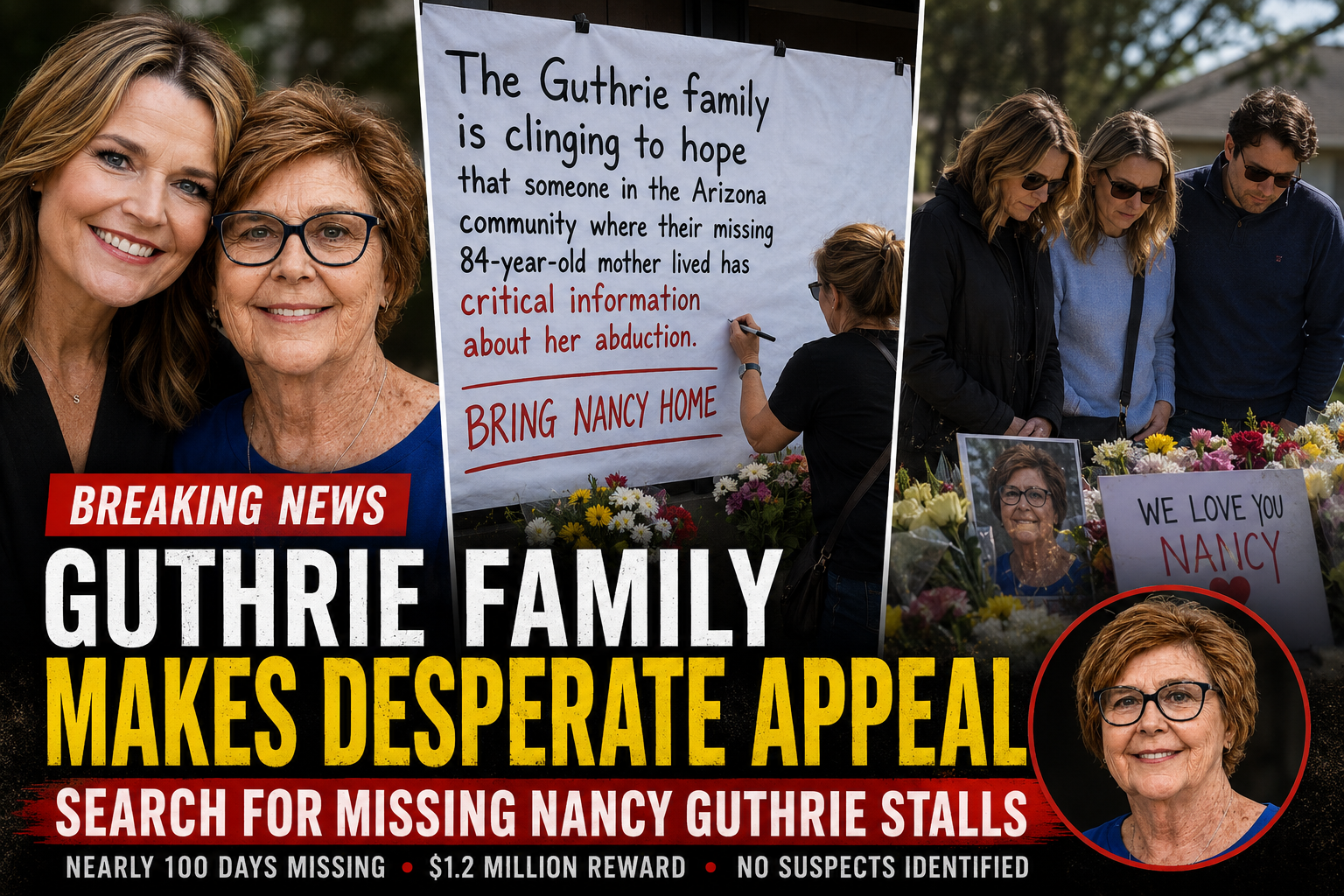
An image collage containing 3 images, Image 1 shows Savannah Guthrie and Nancy Guthrie posing together for a photo, Image 2 shows A woman writing on a large white banner that reads
The Guthrie family is clinging to hope that someone in the Arizona community where their missing 84-year-old mother lived has critical information about her abduction, they said in a heartbreaking statement.
Nancy Guthrie’s three children expressed their gratitude to residents of Tucson for their support in a statement to KVOA on Saturday, but urged renewed focus on the case as the search for the missing mother enters its seventh week.
“We continue to believe it is Tucsonans, and the greater southern Arizona community, that hold the key to finding resolution in this case,” the statement said.
“Someone knows something. It’s possible a member of this community has information that they do not even realize is significant. We hope people search their memories, especially around the key timelines of January 31 and the early morning hours of February 1, as well as the late evening of January 11.
“We desperately ask this community for renewed attention to our mom’s case – please consult camera footage, journal notes, text messages, observations or conversations that in retrospect may hold significance,” they added.
“No detail is too small. It may be the key.”
The heartbroken family said they miss their mother deeply and won’t find peace until she is home.
“We cannot grieve; we can only ache and wonder,” they said.
“Our focus is solely on finding her and bringing her home. We want to celebrate her beautiful and courageous life. But we cannot do that until she is brought to a final place of rest.
Nancy, mother of “Today” show star Savannah Guthrie, is believed to have been taken from her Tucson, Arizona, home during the early hours of Feb. 1.
She was reported missing after she failed to show up at church, and security footage recovered from her doorbell camera captured a masked man loitering around doorstep the night police believe she was kidnapped.
Police have still not identified any suspects.
Nancy Guthrie Update: Officials Push to Remove Pima County Sheriff Chris Nanos From Office
Nancy Guthrie Update: Officials Push to Remove Pima County Sheriff Chris Nanos From Office
Today co-anchor Savannah Guthrie‘s mom, Nancy Guthrie, 84, is still missing nearly 100 days after her abduction in Tucson, Ariz.—and officials are pushing to remove Pima County Sheriff Chris Nanos from office.
On May 8, CBS News spoke with two members of the Pima County Supervisors Board, who said they plan to file a motion to force Nanos to step down by Tuesday, May 12, or to have the sheriff’s office vacated.
🎬SIGN UP for Parade’s Daily newsletter to get the latest pop culture news & celebrity interviews delivered right to your inbox🎬
One of the board’s issues with Nanos stems from his allegedly lying during a deposition for an unrelated lawsuit. During the deposition, he denied under oath having been suspended during his time as an officer in El Paso, Texas, before joining the PCSD in the ’80s. In reality, Nanos was suspended several times, according to records obtained by CBS News.
“A unanimous vote of the disciplinary board at that time for a whole host of problems said, ‘Hey, he can’t be a cop anymore. He’s just bad at this and he’s not upholding our standards … he’s got to go,’” Dr. Matt Heinz, a Pima County Board of Supervisors member, told CBS.
Heinz continued, of Nanos, “He has definitely lost the confidence of the community. He’s embarrassed himself, and it’s time for him to go.”
Related: Nancy Guthrie: Sheriff Chris Nanos Shares Hopeful Update as Case Nears 100 Days
In a letter to the board, Nanos’ attorney, James Cool, said, per Fox News, “It is 100% correct that Sheriff Nanos was never suspended during his four decades of decorated and faithful service with the Pima County Sheriff’s Department. However, Sheriff Nanos was suspended more than forty years ago while employed by El Paso Police Department.”
Cool added, in the 12-page response to the board’s demand for answers, “Sheriff Nanos did not understand the question related to discipline with a different agency not governed by the Arizona Peace Officers Bill of Rights. In reviewing the transcript shortly after his deposition, Sheriff Nanos spotted the misunderstanding and promptly notified his attorney.”
The push to remove Nanos as sheriff is not related to Nancy’s ongoing case, which is nearing 100 days. “In no way has the Guthrie investigation ever factored into this. It really hasn’t,” Heinz insisted. However, it comes on the heels of FBI Director Kash Patel criticizing the PCSD’s handling of the investigation, claiming that the FBI was blocked for four days.
Despite a $1 million reward from Savannah and the FBI releasing video clips and images of a masked individual on Nancy’s front porch, no suspect has been named in the investigation.
Next: Savannah Guthrie’s Husband Shares Emotional Mother’s Day Tribute as Nancy Remains Missing
This story was originally published by Parade on May 10, 2026, where it first appeared in the News section. Add Parade as a Preferred Source by clicking here.
Nancy Guthrie case: Former cop shows how missing mom could vanish just yards from homes
(Fox News)
TUCSON, Ariz. — Walking down a desert path carved through the neighborhood just a mile and a half from Nancy Guthrie’s home in the Catalina Foothills, retired Pima County Sheriff’s Lt. Bob Krygier points into the dense brush.
“You can throw something under the tree right there, in this brush right back here,” he says. “We could walk past… I guarantee you we’ve walked by things that are probably suspicious in nature, dead animals, things like that, and you’re just not going to see them the terrain itself acts as a natural hide for things.“
He’s in what locals call a “wash.” They are the pathways that water escapes during heavy rainfall, also known as ephemeral rivers, and they appear all over Tucson and the surrounding Pima County.
“Hundreds upon hundreds [of] these throughout the county and the city, if not thousands,” he told Fox News Digital earlier this week. “They’re just literally everywhere. It’s just the nature of the terrain, the way the geography was made.”
Former Fbi Agent ‘Stunned’ By Unforgiving Conditions Complicating Nancy Guthrie Search
(Fox News)
They can also be natural escape routes, he said.
Read On The Fox News App
He spent almost three decades with the Pima County Sheriff’s Department, the lead agency in the search for the 84-year-old mother of “Today” co-host Savannah Guthrie.
In that time, he said he chased countless suspects into the washes. Authorities have also recovered the remains of other missing persons many times over the years.
Search For Nancy Guthrie Enters 5Th Week, Cadaver Dogs On Hold
Some are narrow. Some are wide, like one just east of Guthrie’s neighborhood, which at some points stretches more than an estimated 150 yards across. In a situation like that, a vehicle could fit inside.
“We’re here within five minutes. And you could, you saw, we could drive down this road for 10 seconds and be completely out of sight from any roadway,” he said. “So then you now have what you need, which is time, and some cover from prying eyes.”
Follow The Fox True Crime Team On X
In the same area, deputies responded to an abandoned vehicle discovered on Feb. 2, parked just up the street from the entrance to the wash.
Nancy Guthrie Disappearance: Sheriff Says Authorities Looking Into Car Caught On Ring Cam, Haven’t Made Id Yet
A Pima County Sheriff’s Department spokesperson previously said the vehicle was not connected to the Guthrie investigation. Fox News Digital has requested but not yet received records about how and why it was there.
Sign Up To Get True Crime Newsletter
The route itself had been flagged to Fox News Digital by another neighbor — who said she saw a suspicious man walking in the area that same day. She asked not to be named due to concerns for her children’s safety amid the unsolved kidnapping investigation.
In the same neighborhood, Fox News Digital obtained Ring camera video from another resident that shows a vehicle headed in the direction away from Guthrie’s home a few minutes after her suspected abduction. The video was provided to the FBI in February, and there have been no updates since.
Timeline: Nbc Host Savannah Guthrie’s Mother Disappears As Sheriff Says She May Have Been ‘Abducted’
Once inside, power lines lead toward nearby roads, Krygier said, providing guideposts along the way back out.
“I think they’d have to be very familiar with it because you’re not gonna stumble upon this area from Nancy’s house,” Krygier said. “But it’s close enough to where if you did some scouting days and weeks ahead of time, which there’s some evidence that says they might have been out here prior to that night, this would be an area that I would look at and say, ‘All right, let’s figure this out. I can get here to there without being seen.’”
LISTEN TO THE NEW ‘CRIME & JUSTICE WITH DONNA ROTUNNO’ PODCAST
Guthrie is believed to have been taken from her home around 2:30 a.m. on Feb. 1. Her family discovered she was missing around noon. Searches on foot, plane and helicopter did not find her.
Savannah Guthrie’s Mother Nancy Missing Over A Month, $1M Reward Remains Unclaimed
“Even with airplanes, even with the FLIR that we have, the infrared, you’re looking down, you can’t see through a lot of different things, so it’s not going to see something that might have been stashed underneath some of this brush,” Krygier said.
Like What You’re Reading? Find More On The True Crime Hub
The federal government even provided a high-tech piece of equipment that attempted to pick up the Bluetooth signal from her pacemaker device, with no results.
“At this point, I can’t imagine saying no to anyone offering help, whether it be cadaver dogs, the Cajun Navy has popped up again,” Krygier told Fox News Digital. “Those are just extra feet on the ground that I don’t have to pay, quite honestly. Maybe if they find something, awesome. We probably wouldn’t have found it. If they don’t, great. I personally would be accepting some of that help. There’s no reason not to at this point.”
There is a combined reward of more than $1.2 million for information that cracks the case.
Click Here To Download The Fox News App
To remain anonymous, contact Tucson’s 88-Crime tip line at (520) 882-7463.
The family is also urging anyone with information to dial 1-800-CALL-FBI.
Original article source:Nancy Guthrie case: Former cop shows how missing mom could vanish just yards from homes
Updated
Retired FBI profiler Jim Clemente believes the suspect accused of kidnapping Nancy Guthrie “bumbled” his way through the alleged abduction and may have left behind enough evidence to eventually be identified, RadarOnline.com can reveal.
Nearly 100 days after the 84-year-old vanished from her Tucson-area home, Clemente claimed the masked intruder’s alleged mistakes suggest he was “not a sophisticated offender.”
‘Bumbling His Way Through This’
Clemente, who spent 22 years with the FBI, pointed to blood evidence found outside Guthrie’s home as a sign she was still alive when she was allegedly forced from the property.
“There was a concentration of round droplets near the front door, then a thinning trail toward her driveway,” he told Fox News Digital, explaining he believes Guthrie coughed up blood while close to the ground.
The former profiler claimed the suspect appeared unprepared despite allegedly scouting the home in advance. According to Clemente, the intruder used nearby foliage to try to block the Nest doorbell camera instead of disabling it properly.
“In the process of doing that, I believe he revealed what looked like a tattoo on his wrist,” Clemente said. “So it tells me that he is not a sophisticated offender. He was sort of bumbling his way through this.”
Video Footage Raises Questions
Clemente believes the suspect likely showed signs of stress after investigators publicly released surveillance images.NBC
Authorities previously released recovered Nest footage showing a masked man arriving at Guthrie’s home around the time she disappeared on Feb. 1.
The suspect was described as above average height and build and allegedly wore gloves, a ski mask, long sleeves, and a black Ozark Trail backpack. A holstered pistol was also visible in the footage.
Although the doorbell camera itself reportedly disappeared from the scene, investigators were still able to recover imagery from the device with help from Google and the FBI.
Clemente claimed the release of those images may have rattled the alleged kidnapper.
“Because of all the mistakes this guy made, because of his ineptness and non-professional behavior in this, I believe that he exhibited a great degree of stress when the images were first released,” he said.
Hair Sample Could Crack Case
Investigators also reportedly recovered an unidentified hair sample from Guthrie’s home that was eventually sent to the FBI for advanced analysis after initially being processed by a private lab in Florida.
“If it is a hair from the offender, then it will lead to his identification,” Clemente claimed. “They will have his name.”
Authorities have not publicly identified any suspects in the case.
Profiler Suggests Savannah Guthrie May Have Been Target
The mystery surrounding Guthrie’s disappearance was also recently examined during the special NewsNation Presents: The Nancy Guthrie Mystery, which aired May 6 on The CW.
During the program, veteran profiler Dr. Ann Burgess weighed in on a possible motive behind the alleged abduction.
When asked who may have been intended to suffer most from the crime, Burgess suggested the answer may not have been Nancy herself.
“It could be somebody in the family. Somebody — Savannah,” Burgess said, referring to Today co-host Savannah Guthrie.
When asked directly whether the motive could have been to make Savannah suffer, Burgess replied, “Yes.”
Our thoughts and prayers go out to Hillary Clinton

Concern Surrounding Hillary Clinton Prompts Calls for Compassion and Restraint
Uncertainty Quickly Drew Public Attention
Concern surrounding Hillary Clinton began spreading after reports suggested that something may be wrong with one of the most recognizable figures in American political life.
There were no campaign speeches, debates, or major policy announcements driving the discussion.
Instead, attention centered on uncertainty and the possibility that Clinton could be facing a personal health concern.
Details remained limited, leaving the public with more questions than answers.
That lack of confirmed information quickly became part of the story itself.
Questions Spread Before Clear Answers Emerged
As discussion grew, social media users began trying to determine what had happened.
Some posted questions.
Others offered theories about Clinton’s condition or circumstances.
Without reliable details, however, there was little foundation for firm conclusions.
The situation demonstrated how easily uncertainty involving a famous person can become a source of widespread speculation.
A small amount of information can quickly produce a much larger conversation, particularly when the person involved has spent decades in public life.
Many People Chose Support Instead of Speculation
Alongside the rumors, another response became noticeable.
Many people simply wished Clinton well.
Some came from people who had supported her during her political career.
Others came from individuals who had strongly disagreed with her positions or political identity.
For a brief period, those differences appeared less important than concern for another person’s well-being.
Messages of encouragement reflected the idea that political disagreement does not prevent someone from showing basic compassion.
Support Came From Different Political Perspectives
The public reaction included prayers, wishes for strength, and expressions of hope that Clinton would recover from whatever may have prompted the concern.
Many people also urged others to avoid making assumptions until more reliable information became available.
That restraint was significant because public uncertainty often creates an environment where speculation spreads quickly.
Instead of immediately turning every unanswered question into a conclusion, some observers emphasized patience.
Their message was simple: concern could exist without pretending to know more than had actually been confirmed.
A Life Spent Under Constant Public Scrutiny
Clinton has spent much of her adult life under intense public attention.
Her years as first lady placed her at the center of American political life.
She later served as a senator from New York and then as secretary of state.
She also became a two-time presidential candidate.
Each stage of that career exposed her to extraordinary levels of scrutiny.
Her political victories became major news.
Her mistakes were examined publicly.
Her marriage became the subject of national discussion.
Her health also became something people analyzed and debated.
Fame Can Create the Illusion of Complete Access
Decades of visibility can create a misleading sense that the public knows nearly everything about a famous person’s life.
People see speeches, interviews, public appearances, photographs, and political events.
Over time, that familiarity can begin to feel like personal knowledge.
But public visibility does not eliminate private life.
Famous people still receive personal phone calls that nobody else hears.
They still sit with family members away from cameras.
They still experience fear, uncertainty, and difficult moments that may never become public.
Their relatives also experience those moments privately.
Health Concerns Deserve Particular Caution
The distinction between public interest and private life becomes especially important when health is involved.
Without confirmed information, even a small detail can quickly be transformed into something much larger.
A photograph may be treated as evidence of a diagnosis.
A canceled appearance can generate assumptions.
An unclear statement may be repeated as though it were proof.
Within a short period of time, speculation can travel farther than the facts that eventually emerge.
That is why caution matters.
Concern Does Not Require a Diagnosis
People do not need detailed medical information in order to express support.
They can hope that Clinton is well without claiming to know exactly what happened.
They can wish strength to her family without inventing a medical explanation.
They can acknowledge uncertainty without turning it into certainty.
This approach allows concern to remain compassionate rather than intrusive.
It also prevents rumor from becoming more influential than reliable information.
Clinton Has Long Inspired Strong Opinions
Few political figures have generated reactions as intense as Hillary Clinton.
Supporters have often viewed her as an example of persistence, experience, and the expansion of opportunities for women in American politics.
Critics have strongly opposed many of her policies, decisions, and associations.
Those disagreements have lasted for decades.
They are unlikely to disappear because of a personal health concern.
Nor does compassion require anyone to erase serious political differences.
Political Disagreement and Humanity Can Coexist
A person can strongly disagree with Clinton’s political career while still hoping that she is healthy.
Those two ideas are not contradictory.
Political criticism concerns public decisions, policies, and conduct.
Concern for another person’s health belongs to a different category.
There are moments when disagreement can temporarily make room for humanity without disappearing.
A possible medical concern is one of those moments.
Illness Is Not a Partisan Experience
Health uncertainty reaches beyond political identity.
Families across every background understand what it feels like to wait for news about someone they love.
People understand the anxiety that appears when ordinary routines suddenly stop and attention narrows to one question.
Will the person be okay?
That fear does not disappear because someone is famous.
Status cannot remove it.
Financial resources cannot eliminate it.
Political influence cannot guarantee that a family avoids uncertainty.
Some Experiences Reduce Everyone to Waiting
When health becomes uncertain, many of the things that normally define public status can suddenly feel less important.
Political influence offers no complete protection from fear.
International connections do not remove the emotional experience of waiting for answers.
Security arrangements do not eliminate uncertainty.
Even people who have spent years managing national and international crises can encounter moments in which they have little choice but to wait.
That basic human experience is shared across families everywhere.
Privacy Can Be a Form of Compassion
When reliable details are limited, allowing a family time and space can be more respectful than demanding immediate information.
Clinton has spent decades answering questions in public.
People have asked where she is going, what she believes, what she plans to do next, and how she intends to respond to major events.
A private health concern is different.
Not every question requires an immediate public answer.
Sometimes concern can exist without constant demands for additional details.
Simple Messages Can Carry Meaning
Some of the public responses were brief.
“Praying for her.”
“Wishing her strength.”
“Politics can wait.”
None of those statements requires ideological agreement.
They do not ask anyone to rewrite political history or abandon strongly held beliefs.
They simply acknowledge that another person may be experiencing a difficult moment.
Political Arguments Can Suddenly Feel Smaller
A serious personal concern has a way of changing perspective.
Arguments that felt urgent only hours earlier can temporarily lose some of their importance.
Campaign statistics become less relevant.
Old speeches feel distant.
Political victories and defeats fade into the background.
The person at the center of the conversation stops looking like only a political symbol.
She becomes a member of a family
Public Identity Is Only One Part of a Person
Clinton’s public identity is enormous.
She has occupied some of the most visible roles in American political life.
But those positions do not describe every part of her life.
She is also a wife, mother, grandmother, friend, and relative.
Those relationships exist outside campaign events and political institutions.
They are part of the private world that remains even when public attention becomes intense.
Rumors Should Not Become Diagnoses
Until reliable information is available, caution remains important.
Concern should not automatically become confirmation that something serious has happened.
Rumors should not be treated as medical facts.
Unanswered questions should not be used as opportunities to invent explanations.
The desire to understand what is happening is natural.
But curiosity does not make speculation accurate.
The Speed of Social Media Increases the Risk
Modern communication allows rumors to travel almost instantly.
A single post can be repeated by thousands of people before anyone verifies what it means.
Once a claim gains attention, corrections often move more slowly than the original speculation.
That creates a particular problem when health is involved.
Private medical issues can become public narratives built from fragments of information.
By the time accurate details emerge, the rumors may already have reached millions of people.
Waiting for Reliable Information Is Not Indifference
Refusing to speculate does not mean refusing to care.
In fact, restraint can be one of the clearest forms of respect.
People can remain concerned while acknowledging that they do not know the full circumstances.
They can wait for Clinton, her family, or representatives to decide what information should be shared.
Until then, uncertainty can simply remain uncertainty.
Compassion Does Not Require Political Agreement
The reaction surrounding Clinton offered a reminder that compassion is not the same thing as political support.
A person does not have to agree with a politician’s record to wish that person good health.
Someone can remain critical of Clinton’s policies while still recognizing her humanity.
Likewise, supporters do not need to turn concern into political defense.
A personal health issue does not need to become another contest between ideological sides.
Families Understand the Fear of Waiting
At the center of any health scare is usually a much smaller circle than the public discussion surrounding it.
There are relatives waiting for information.
There are loved ones trying to remain calm.
There may be private conversations that nobody outside the family ever hears.
That experience is familiar to countless people regardless of politics or social status.
It is one reason the public response can remain humane even when details are scarce.
There Will Be Time for Facts
If Clinton or those close to her choose to provide additional information, there will be time to consider those facts when they emerge.
Until then, speculation does not improve understanding.
It only fills the absence of information with assumptions.
The more responsible response is to distinguish clearly between what is known and what remains uncertain.
That distinction protects both accuracy and privacy.
Hope Can Exist Without Certainty
For now, the most meaningful response may be one of simple hope.
Hope that whatever prompted the concern proves manageable.
Hope that Clinton is receiving whatever care she may require.
Hope that the people closest to her have enough privacy and support to navigate the situation.
None of those wishes requires additional medical details.
None requires political agreement.
A Rare Pause in a Divided Culture
American political life has become increasingly hostile and divided.
Clinton’s name has been at the center of that division for many years.
Yet moments involving personal vulnerability can briefly change the nature of the conversation.
Instead of another argument, people can choose restraint.
Instead of immediately demanding answers, they can allow time.
Instead of treating uncertainty as entertainment, they can recognize that a real family may be dealing with it privately.
The Person Behind the Political Figure
It can be easy to forget that a famous political figure exists beyond speeches, elections, controversies, and headlines.
Public life encourages people to think in symbols.
A politician can come to represent an entire ideology or period of history.
But the individual behind that symbol still experiences ordinary human emotions.
Fear remains fear.
Uncertainty remains uncertainty.
Family remains family.
A Moment for Restraint Rather Than Assumptions
Whatever the reality behind the concern surrounding Hillary Clinton, the absence of confirmed information should encourage caution rather than certainty.
There is no need to transform questions into conclusions.
There is no need to diagnose someone from a distance.
There is no need to turn a potentially private health situation into another political confrontation.
People can simply acknowledge that something may be happening and hope that the outcome is positive.
Humanity Can Exist Beyond Politics
The broader lesson is simple.
Compassion does not require agreement.
People do not have to vote for someone to wish that person good health.
They do not have to admire an entire career to recognize another person’s vulnerability.
Decades of disagreement can remain intact while people still respond with basic decency.
That does not erase political differences.
It simply recognizes that health, fear, family, and uncertainty belong to everyone.
For Now, the Most Responsible Response Is Hope
Until reliable information becomes available, the wisest approach is to avoid treating rumors as facts.
Clinton and those closest to her can decide what they wish to share and when they wish to share it.
The public does not need every answer immediately in order to express concern.
Sometimes the most respectful response is also the simplest.
Whatever prompted the uncertainty, people from very different political backgrounds can still share one basic wish.
They can hope that Hillary Clinton is okay
For several days, the public conversation refused to disappear.
People continued searching for information, hoping that a clearer explanation would emerge. Some television programs discussed the uncertainty. Comment sections filled with questions. Social media users reposted old photographs and statements, trying to determine whether any hidden meaning could be found in them.
But none of those efforts could replace confirmed information.
The more people searched, the more obvious one uncomfortable truth became:
Nobody outside the immediate circle truly knew what was happening.
That realization forced some observers to reconsider the way they were approaching the situation.
At first, curiosity had driven the conversation.
Then concern had taken over.
Now, for many people, patience was becoming the most responsible response.
They could remain concerned without pretending they knew the answer.
They could hope for good news without inventing explanations.
They could wait.
And waiting, although difficult, sometimes showed more respect than speculation.
 The Human Side of a Famous Name
For decades, Hillary Clinton had been discussed as a political figure.
People remembered elections.
They remembered speeches.
They remembered controversies.
They remembered moments that had divided the country.
But behind all those headlines was a person with a private life.
She had family members who knew her differently than the public did.
Friends who had conversations that never appeared on television.
People who worried about her without posting anything online.
People who might have preferred silence over attention.
That distinction became increasingly important.
A public figure can spend decades answering questions about politics without becoming obligated to answer every question about personal matters.
There is a difference between public responsibility and private vulnerability.
The public may debate a politician’s decisions.
It does not automatically gain ownership of the politician’s personal life.
Part 3 — The Messages That Mattered
Among the thousands of comments being shared, some were surprisingly simple.
“Wishing her strength.”
“Hope she is okay.”
“Praying for her family.”
“Politics can wait.”
Those messages did not solve the uncertainty.
They did something else.
They changed the tone.
Instead of demanding details, they expressed concern.
Instead of turning the situation into another partisan battle, they recognized the possibility that someone might be going through a difficult moment.
For some people, that was enough.
One older woman wrote that she had spent years disagreeing with Clinton but still understood what it meant to worry about someone’s health.
A younger man wrote that political arguments could continue later.
Another commenter simply wrote:
“Whatever your politics, nobody deserves unnecessary cruelty when they may be facing a difficult time.”
The comments spread.
Not because they contained new information.
Because they contained something increasingly rare online:
Restraint.
When the Rumors Became Too Much
But not everyone chose restraint.
Some accounts continued posting dramatic claims.
One rumor suggested a serious diagnosis.
Another claimed an emergency had occurred.
A third suggested that Clinton’s absence from a public event proved something was terribly wrong.
None of those claims came with reliable confirmation.
Yet each was repeated hundreds of times.
This was the danger.
A rumor did not need evidence to become popular.
It only needed to sound convincing.
People could take a photograph from one year, combine it with an unrelated statement from another, and create an entirely new story.
Within hours, the invented narrative could look more familiar than the truth.
That was why responsible observers began emphasizing the same message again and again:
Do not confuse attention with evidence.
Part 4 — A Family Waiting in Private
While strangers debated online, the people closest to Clinton had something the public did not.
They knew what was actually happening.
They could make phone calls.
They could sit together.
They could ask questions directly.
They could offer support without posting it publicly.
That private circle mattered.
In moments of uncertainty, family often becomes the place where the outside world disappears.
There are no hashtags there.
No arguments.
No viral headlines.
Only people asking the simplest questions.
Are you okay?
Do you need anything?
What can I do?
Those are very different questions from the ones being asked online.
They don’t demand a story.
They offer support.
The Silence Was Difficult
For people watching from the outside, the lack of information was frustrating.
Some believed the family should say more.
Others believed they had already shared enough.
There was no universal agreement.
But one thing remained true:
Silence does not automatically mean the worst.
A quiet period can mean many things.
It can mean someone is protecting privacy.
It can mean a family is waiting.
It can mean there simply isn’t information ready to share.
Without confirmation, outsiders cannot know which explanation is correct.
And that uncertainty should discourage certainty—not encourage it.
Part 5 — Politics Was Still There
Eventually, political arguments returned.
They always do.
Supporters remembered Clinton’s accomplishments.
Critics revisited old controversies.
Commentators debated her legacy.
Different sides interpreted her career through completely different lenses.
But something had changed.
For a short time, many people had remembered that political identity was only one part of a person.
A political career can be examined.
Policies can be criticized.
Decisions can be challenged.
But personal vulnerability is not a campaign issue.
Health is not an ideological position.
And concern does not require surrendering one’s beliefs.
That became perhaps the most important lesson of the entire episode.
The Perspective of Age
For older Americans especially, the story carried another meaning.
Many had reached an age where health concerns were no longer abstract.
They had watched parents become ill.
They had cared for spouses.
They had taken relatives to appointments.
They had spent nights waiting for phone calls.
They knew how quickly a normal day could become a day defined by uncertainty.
When someone you love may be facing a serious situation, the outside world can suddenly become very small.
The only thing that seems important is the next update.
The next phone call.
The next answer.
That experience does not belong to one political party.
It belongs to families.
Part 6 — What the Public Could Actually Do
As the conversation continued, a more reasonable approach began to emerge.
People could wait for reliable information.
They could avoid repeating unverified claims.
They could separate genuine reporting from speculation.
They could remember that photographs do not automatically reveal someone’s medical condition.
They could allow family members to speak for themselves.
And they could express concern without demanding private details.
None of those choices required anyone to become a Clinton supporter.
None required anyone to change a political opinion.
They required only a small amount of patience.
A Different Kind of Strength
Some people assumed that strength meant speaking loudly.
Others discovered that strength could mean saying less.
It took very little courage to repeat a dramatic rumor.
It took more discipline to say:
“We don’t know yet.”
That sentence became important.
Because acknowledging uncertainty protects everyone.
It protects the person being discussed.
It protects the family.
And it protects the public from believing something that may later prove completely false.
Final Part — The Story Behind the Story
Eventually, the intense online discussion began to slow.
New headlines appeared.
Other stories replaced the old ones.
People moved on to the next political argument, the next breaking-news event, the next viral post.
But the lesson remained.
The concern surrounding Hillary Clinton had shown how quickly uncertainty surrounding a famous person could become a nationwide conversation.
It had also shown how differently people can respond to that uncertainty.
Some choose speculation.
Some choose outrage.
Some choose political attacks.
And some choose compassion.
The most responsible response does not require knowing every detail.
It simply requires recognizing the limits of what is known.
At the center of the entire conversation was one unanswered question:
Is Hillary Clinton okay?
Until reliable information answers that question, nobody else can honestly answer it for her.
And perhaps that is where the story should end—not with an invented diagnosis, not with a dramatic revelation, and not with another rumor.
But with hope.
Hope that she is surrounded by people who care about her.
Hope that her family has the privacy and support it needs.
Hope that whatever prompted the concern is manageable.
And hope that the next information people receive comes from a reliable source rather than from speculation.
Because politics will always provide another argument.
There will always be another election.
Another controversy.
Another disagreement.
But when uncertainty touches someone’s health, there is something more important than winning an argument.
There is humanity.
And for a brief moment, thousands of people from completely different political backgrounds remembered exactly that.
Politics can wait.
Compassion doesn’t have to.