hard as the shed would. Not because I hadn’t prepared for age, I had, but because I had not prepared for the delay in his gaze, the searching uncertainty, the face trying to place me and failing.
“Hello, sir,” I said. My voice came out rougher than I intended.
He gave a polite nod. “Good afternoon.”
“I’m an old friend. From the service.”
He squinted. “Korea?”
“Yes, sir.”
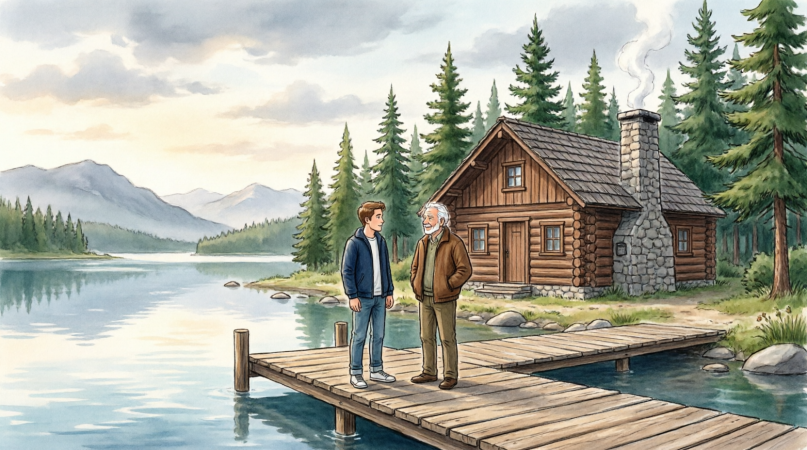
“Ah.” He nodded and turned back toward the leaves. “Haven’t had many visitors lately. Busy with the guests.”
He gestured toward the house with the rake.
“The guests?”
“Mr. David’s guests. Renting the house. Good income.”
He said it like a line he had memorized from someone else’s explanation.
“Mr. David handles all that. I just help with the grounds.”
Mr. David.
My brother.
“And where are you staying, Frank?” I asked.
He pointed behind the house. “Got a nice little place out back. Shed’s been fixed up. Very comfortable. Mr. David says the guests need the full run of the main house.”
I followed his gesture and saw it near the tree line. A shed with weathered siding and two small windows, the kind of structure meant for lawn tools and a riding mower, now fitted with a flue pipe sticking out the side like a concession to survival. Not a guest house. Not a cottage. A shed.
The laughter from the main house drifted across the grounds.
“When did you last see David?” I asked.
Dad’s face pinched with concentration. “Oh, he comes by. Busy man. Important business.” He offered me an apologetic smile, as if he were making excuses for someone who deserved better. “Stephanie too. Very busy people.”
He kept raking a moment, then stopped and looked at me with that dim, searching courtesy.
“Do you have children?”
“No,” I said.
He nodded slowly. “I had two boys. David. Good boy, lives here in Kelowna.” A pause. “Had another son too. Robert. Bobby.”
His voice softened around the name.
“But he’s gone. Died eight years ago. Line of duty. He was RCMP, you know.” He cleared his throat. “Very proud of that boy.”
I have been shot and stabbed. I have had gun barrels pressed to the back of my neck by men who meant to use them. Nothing in eight years of undercover work hurt like hearing my father tell a stranger I was dead, telling him with that particular soft grief of a man who had learned to carry loss without letting it stop him.
“I’m sorry for your loss,” I said.
He nodded politely and went back to raking.
I walked to the car before I did something I couldn’t take back.
I sat behind the wheel with my hands locked on it while the sun moved and the music kept playing twenty yards away. Then I called David.
He answered on the third ring. “Yeah?”
“It’s Robert.”
A silence that told me everything.
“Jesus Christ. Bobby?”
“I’m home. I’m in Kelowna.”
More silence, and under it I could already hear the calculation starting, the mental inventory of what I might know, what I had seen, how much time he had.
“You should’ve called ahead,” he said finally.
“I did. Left a message on Dad’s line.”
“Right. He doesn’t really check messages anymore. His memory isn’t…”
“I noticed.”
“Look, we should meet. There’s a lot to explain.”
“The house is a vacation rental.”
“It’s complicated.”
“Try me.”
“Not over the phone. Tomorrow, Bean Scene on Bernard. Ten o’clock.”
“Fine.”
“Bobby.” He lowered his voice into something that was trying for sincerity. “It’s good you’re back. Really good. We have a lot to catch up on.”
I hung up.
That night I sat in a hotel room with the lights off and my laptop open and began to do what eight years of operational work had trained me to do: find the truth inside systems people assume are too boring to examine closely.
I started with land records. The property was still in Dad’s name, but there was a lien against it and a home equity line of credit for four hundred thousand dollars, signed two years earlier under Frank McKenzie’s name. I stared at the signature on the scan for a long time. His handwriting had once been slow and square and careful. This looked shaky, uncertain, as if someone had steered his hand while he was barely following what was happening.
The Airbnb listing was next. Eight hundred dollars a night, minimum three nights, reviews going back eighteen months. One review called the groundskeeper quiet and sweet. I closed the laptop and stared at the wall for thirty seconds.
I logged into Dad’s bank account using credentials I had set up before disappearing. My monthly deposits were there, all of them, fifteen hundred every month without exception. But within a day or two of each deposit, the same amount had been transferred out to an account I didn’t recognize. Dad’s pension was going to the same place. Grocery transactions of forty, sixty, seventy dollars. Not enough for a healthy man living on lakefront property in his mid-eighties. Not close.
Property taxes: eighteen thousand overdue.
David was taking my money and Dad’s pension and the rental revenue, had leveraged the house itself for four hundred thousand, and still wasn’t paying the taxes.
I sat in that hotel room and felt something old and cold settle in. Not rage. Rage burns hot and stupid. This was colder than that. Operational.
I did not sleep.
At ten the following morning, David came into Bean Scene wearing an expensive jacket and a watch too heavy for a man supposedly carrying the burden of caring for his father. He looked rested and groomed and prosperous. He opened his arms when he spotted me.
I let him touch me because I needed to feel what kind of man he had become. He smelled like cologne and espresso. We sat down. He ordered some elaborate latte with oat milk. I got black coffee.
He made a few passes at small talk. I shut them down until he sighed and leaned back.
“About Dad.”
“Tell me.”
“It’s dementia. Started maybe three years ago. Misplacing things, forgetting bills, repeating himself. I had to step in.”
“And you didn’t contact me.”
“How? RCMP said you were unreachable.”
That was technically true. But there are emergency channels. There are ways to relay catastrophic family information without blowing an operation. If David had wanted me found, people far better equipped than he was could have started the process. He hadn’t wanted me found.
“Keep going,” I said.
He spread his hands. The gesture of a man presenting a burden rather than a crime. “He couldn’t manage the house alone. Taxes, insurance, repairs, it was too much. The Airbnb gave us a way to make it self-sustaining.”
“You put him in a shed.”
“It’s a renovated cottage.”
“I saw it.”
He looked away briefly. “He’s comfortable. Heat, plumbing, a bed, a kitchenette. The main house had to stay guest-ready. You can’t have a confused old man wandering around when people are paying eight hundred a night.”
I let that sit in the air between us long enough to spoil.
“He thinks I’m dead.”
David’s jaw flexed. “That was a kindness. He kept asking where you were, why you didn’t call. I thought closure would help.”
“You gave an old man a dead son so he’d stop asking inconvenient questions.”
“You weren’t here.”
“No. I was sending money, though. Fifteen hundred every month. So where is it?”
“Excuse me?”
“Show me the care account. Right now. On your phone.”
His hand tightened around the cup.
“This is insulting,” he said.
“Show me.”
He stood so quickly the chair scraped. “I’m not being interrogated by you after everything I’ve carried while you were off playing hero.” He leaned in slightly, something hardening behind the rehearsed performance. “If you don’t like how I handled it, congratulations. You’re back now. You deal with it.”
He walked out without looking back.
I watched him climb into the BMW and drive away.
Then I got to work.
The first call I made was to Sarah Chen, a former RCMP officer who had left the force and built a private investigations firm in Vancouver that specialized in financial crimes and forensic document review. She answered on the second ring.
“Robert McKenzie,” she said. “Back among the living.”
“Barely. I need you on something.”
I laid it out in clean steps. The property. The shed. The false death story. The line of credit. The redirected transfers. She listened without interrupting. When I finished she said, “How far are you willing to take this?”
“All the way.”
“It’s your brother.”
“He stopped being my brother somewhere before the shed.”
The second call went to Veterans Affairs Canada. Three transfers and a hold queue and a careful voice who finally took my details, logged the situation, and promised a home visit within forty-eight hours. The third call went to the Kelowna RCMP detachment, fraud unit, a corporal named Jennifer Walsh who listened to my summary and said come in for a formal statement.
Walsh took notes by hand first, then on a computer. Mid-thirties, sharp, no wasted sympathy. When I finished she folded her hands and said, “If your brother holds a valid power of attorney, he has legal authority to make certain financial decisions. We need to prove he acted against your father’s interests. We need the money trail, questions around capacity, documentation on the living conditions. We need to show enrichment, not poor judgment.”
“I can get you that.”
“No confronting witnesses before we’re ready,” she said. “No off-book pressure. You spent eight years undercover. You know how a case gets built.”
“No cowboy stuff,” I said.
“Exactly.”
I spent the next three days watching the property from different positions, different distances, rotating rentals so no one vehicle logged too much time. I watched Dad rake, sweep, haul linens from the back door to the shed. Watched David come by twice for mail and once to meet a cleaning crew without staying more than a few minutes. Not once did he sit with his father. Not once did he bring groceries. Stephanie arrived in a cream Mercedes one afternoon carrying shopping bags, stayed nineteen minutes, and left.
On the fourth day, Sarah called.
“Got it,” she said.
She laid it out methodically. The Airbnb income went directly into David’s personal account, reported as his own rental income, no trust, no dedicated care fund. The line of credit had paid off David’s personal debts: credit cards, a boat loan, a private line on his own home, retail spending, cash withdrawals. My monthly deposits and Dad’s pension were being redirected, forty-five thousand per year just from those two streams. Add the rental revenue and the annual diversion was north of two hundred thousand. Meanwhile the actual traceable cost of Dad’s care, food, basic medications, shed utilities, came to maybe eight thousand a year.
Over three years. Three-quarters of a million dollars.
“There’s more,” Sarah said. “He started the process of listing the house. Preliminary agreement, not live yet. Projected for next month.”
“He was going to sell it.”
“Asking three point eight million.”
I stayed quiet for a moment.
“The power of attorney signature,” I said. “What does the document examiner say?”
“Guided signature,” she said. “Someone controlled his hand. Strong evidence of capacity abuse or outright fraud.”
That night I went back to the property on foot.
Cut through the trees after dark. Wet earth under my boots. Cold lake air. The main house was lit and occupied, another round of guests. The shed had one small window with a light behind it.
I looked through.
Dad was sitting on a cot still wearing his work jacket, staring at the wall. Ten by twelve feet, maybe. Narrow bed, small dresser, mini fridge, camping stove, one chair. No insulation I could see. On the dresser sat a photograph. My RCMP graduation. Me in Red Serge. Dad beside me, grinning like he had won something no one else could name. Mom had taken the picture. She cried through the whole ceremony and laughed at herself afterward for crying.
Dad reached out slowly and touched the frame with two fingers.
His lips moved. I couldn’t hear him through the glass, but I could read the shape of it.
Bobby.
I went back to the hotel and did not sleep. I wrote everything out. Dates, transfers, observations, photographs, Sarah’s findings, my own logs. Clean and chronological, the way I had written operational briefs before raids.
At eight the following morning I sent the full package to Walsh.
At nine she called. “This is strong. Very strong. I’m taking it to the staff sergeant for warrants.”
The Veterans Affairs inspector called at ten. Her voice carried the particular controlled anger of someone bound by procedure but incensed by what they had found. “Mr. McKenzie, the conditions are wholly inappropriate for a veteran of his age and medical state. I’m filing an immediate report and recommending urgent intervention.”
“I can tell you who put him there,” I said.
“I’d very much like that.”
Forty-eight hours later, Walsh called from outside David’s house.
“Warrants approved. We’re moving now.”
The second call came just before two in the afternoon.
“We have them,” she said. “Both of them. They were sloppy. Found forged documents, altered statements, email correspondence about maximizing the property assets, a review of guest ratings, conversations about whether the old man was visible from the patio.”
She let that last detail sit a moment.
“Charges are exploitation of a vulnerable person, fraud over five thousand, theft, forgery, and related offenses. Very serious.”
“What about Dad?”
She explained the situation: with David in custody, the practical care authority was gone. Emergency placement pending guardianship review.
“No institutions,” I said, before I had consciously formed the thought.
A pause. “He needs somewhere safe.”
“I know. But not some emergency bed with strangers and fluorescent lights. Let me take him.”
Another pause. Then: “Let me make calls.”
By evening, after more forms than should be legal and a social worker assessment that covered everything from my medical history to the square footage of the suite, the arrangement was approved. Temporary emergency custody pending formal guardianship. A veteran-focused memory care residence in town for immediate stabilization.
I drove to the property as the last light was leaving.
The main house had yellow tape across the entry. The vacationers were gone. For the first time since I arrived, the place looked like what it actually was: a crime scene layered over a home.
Dad was on the cot when I stepped into the shed.
He looked frightened. A day of police questions had shaken loose what little orientation he had managed to maintain.
“I don’t understand,” he said. “They say David stole from me.”
I crouched in front of him.
“That’s right.”
“But he’s my son.”
“I know.”
His voice thinned. “David wouldn’t…”
There are few things more heartbreaking than watching an old man try to protect the person who hurt him because the shape of fatherhood is stronger in him than the facts. I looked into his cloudy blue eyes.
“Dad,” I said. “It’s me. It’s Bobby.”
He frowned. “Bobby’s dead.”
“No.” My voice broke and I let it. “I was away working. Deep undercover. I couldn’t contact you. But I’m back now. I’m here.”
His hand lifted slowly and touched my cheek. He stared at me the way you stare at something in heavy fog, deciding whether what you see is possible. Then something changed in his face. Not mental clarity, dementia doesn’t yield that cleanly, but a deeper kind of recognition. Something older than recent memory. The body knowing what the mind has been told to doubt.
He pulled me into him with surprising strength.
He smelled like cheap soap and old wool and underneath that the aftershave he had worn my whole life. I had not realized until that moment how much of my idea of home was scent.
“I thought you were gone,” he whispered. “Like your mother.”
“I’m here.”
“You’re not leaving again?”
“No,” I said. “I’m not going anywhere.”
Both plea deals landed within two months. David took nine years. Stephanie took seven. Asset seizure orders followed: their house, the cars, a boat I hadn’t known existed until Sarah traced the payments, investment accounts, retail purchases clawed back through the civil proceedings. Most people imagine justice as a gavel and a sentence. In financial crimes it often looks like paperwork. Freezes and orders and numbers moving back toward the person they should never have left.
The guardianship hearing put the legal stamp on what I had already decided standing in the yard the first afternoon. Dad’s physician testified about the dementia, the Veterans Affairs inspector about the living conditions, Sarah about the money trail. I testified about my plan to return to British Columbia permanently and take over his care.
The judge adjusted her glasses, looked at me, and said, “Mr. McKenzie, your father is fortunate to have a son willing to step forward after everything he has endured. Guardianship is granted.”
The following weeks blurred into contractors, lawyers, tax authorities, insurance, and the slow undignified work of undoing years of neglect. New roof. Updated plumbing. Dock repaired and re-stained. Medical access modifications for Dad. I tore the shed down. I could have left it standing as evidence or reminder. I didn’t want a reminder. Some structures don’t deserve memorial status.
On a warm June morning with sunlight on the lake and the valley smelling of thawed earth and lilac, I drove Dad home from the residence. He sat beside me in the passenger seat, thinner than he should have been but steadier than the man I had found in the yard. The residence had done what it was designed to do.
When we pulled into the drive, he looked through the windshield and went very still.
The house was clean again. Stone washed, timber sealed, flower beds replanted, dock rebuilt, the sign at the gate gone. No rental lockbox. No strangers’ cars. Just the property as it had always been meant to be.
“Bobby,” he said softly. “Is this really mine?”
“It’s really yours. Always was.”
We walked through together, room by room, at his pace. He touched things: the back of the sofa, the kitchen countertop, the window frame above the lake. In the main floor bedroom I had converted into his suite, I had placed the graduation photograph on the dresser.
He stopped when he saw it.
“That was a good day,” he said.
“Yeah,” I said. “It was.”
“Your mother was proud.”
“She was.”
He looked at me with the particular clarity that came and went unpredictably now.
“You came back for me.”
“Of course I did.”
His eyes filled. “I knew you weren’t dead. I knew it. My boy wouldn’t leave me.”
I held him carefully. His bones felt more fragile now but his grip on me was fierce for those seconds, as if some part of him was still checking that I was solid.
That evening we sat on the dock.
The lake held the sky in copper and rose. A loon called somewhere out across the water. Woodsmoke drifted in thin threads from a bonfire somewhere along the far shore. I had bought him a comfortable outdoor chair with thick cushions and arms sturdy enough to push against when he needed to stand. He had a blanket over his knees despite the warmth, because old men and veterans both distrust evenings near water. We had sat like this when I was young, my father and I, at a dozen different lakes, and the silence between us had always been the good kind, the kind that doesn’t ask anything of you.
After a while he said, “Can you tell me where you were?”
So I told him. Some of it. The cities by their weather rather than their cases: Halifax rain, Montreal winters, Vancouver damp. I told him I had lived under different names and worked near men who built their lives on the suffering of the vulnerable, because they counted on vulnerability meaning no challenge would ever come. I told him I had helped take them down, one case at a time, across eight years and six provinces.
I didn’t tell him about the bullet or the knife or the night in Surrey when I had thought the grave was already chosen. Parents don’t need every image.
He listened quietly.
When I finished, he said, “You did good work, Bobby.”
“I tried to.”
He was quiet a while. The water touched the dock in its patient way.
“And David.” His voice went thin. “What he did. That was real.”
“Yes.”
“He’s my son.”
“I know.”
“But he hurt me.”
“Yes, Dad. He did.”
We sat in silence after that, the kind that doesn’t demand anything. Birds settling down for the night. Light thinning over the mountains. Then he reached over and took my hand. His grip was weak but it was still my father’s hand, and I knew those hands, had known them since I was small enough to hold one crossing a street.
“I’m glad you’re home,” he said.
I squeezed back.
“Me too, Dad.”
The stars came out one by one, their reflections shaking on the blackening water. Somewhere across the lake the bonfire was still going, ordinary life in its ordinary ways. I thought about the eight years I had spent becoming invisible for the job, about the violent men I had watched from inside their confidence, about how harm always arrived wearing something reasonable and efficient. David had turned theft into management. Exile into practicality. Erasure into kindness. He had counted on the lie lasting because he assumed it wouldn’t be examined, because he assumed family loyalty would fog the accounting.
What he hadn’t counted on was me coming home before he sold the last proof that Dad had ever mattered.
Tomorrow there would be work. An estate lawyer to make the property legally unassailable. A meeting about whether there was any role for a sixty-two-year-old man with too much undercover mileage in him to do anything normal. Mom’s letters to sort through, the ones David had boxed carelessly in the shed like clutter instead of history. In the patch of ground where the shed had stood, I was going to put a garden, because Dad had always loved gardens, and because my mother would have taken one look at that open soil and already known where the tomatoes should go.
But that night we stayed where we were. Two old men by the lake, one who had gone to war in Korea, one who had spent eight years at war in quieter places. Both of us, in our own ways, home late.
Dad’s breathing slowed, and I thought he had drifted off. Then he stirred.
“Bobby?”
“Yeah?”
“Thank you for finding me.”
I had to swallow before I could answer.
“Always, Dad,” I said. “I’ll always find you.”
He squeezed my hand once, weak but deliberate, and we sat there in the gathering dark with the water touching the dock below us and the mountains holding their long shapes against the sky.
Finally home.