Chapter 4: The Standoff and the Digital Trail
“My daughter has been brutally assaulted,” I spoke into the phone, my voice dropping an octave, possessing the steady, rhythmic cadence that only comes from years of commanding chaotic disaster scenes. People listen to that voice; it cuts through panic like a scalpel.
“Adult female, conscious, severe facial trauma, bleeding, possible rib or internal injury. The address is 18 Hawthorne Lane. Send police and advanced life support EMS immediately. Step it up.”
Ryan’s remaining veneer of smug control instantly vaporized. His hands twitched at his sides. “You’re… you’re seriously calling the cops? Tom, are you out of your mind?”
I didn’t look at him. I couldn’t afford to focus on the garbage; I had a victim to stabilize. I dropped back down to one knee beside Emily, moving with deliberate, telegraphed slowness so as not to trigger a flinch response.
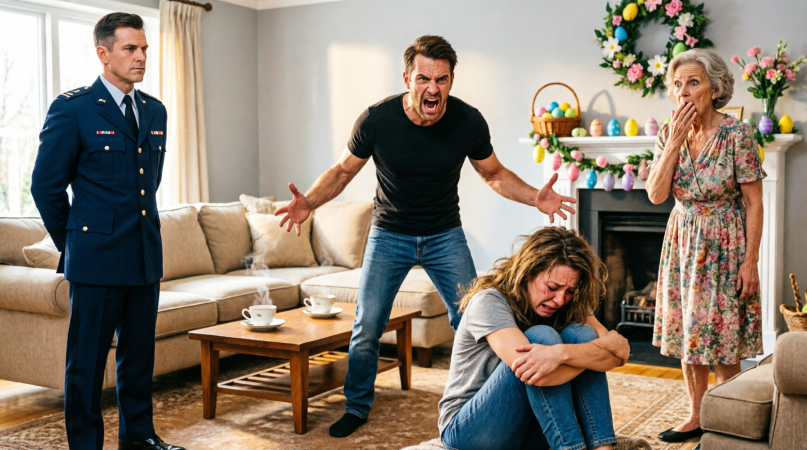
“Em,” I whispered, keeping my tone gentle but probing. “Look at me. Did you lose consciousness? Even for a second?”
She squeezed her eyes shut, shaking her head once, a minute movement that caused her to whimper in agony.
“Okay. Good. Any trouble taking a deep breath?”
“My… my side hurts,” she gasped, her hands hovering protectively over her ribs.
I cast a quick, clinical glance at the shape of her torso beneath the torn, bloody fabric of the yellow dress. The anger inside me threatened to boil over again, rising like noxious heat radiating off black asphalt in July. But anger was a useless, dangerous indulgence right now if it clouded my judgment. I swiftly slipped out of my heavy cotton blazer, folded it into a makeshift pillow, and slid it gently beneath her trembling head. “Stay perfectly still, sweetheart. Help is already rolling.”
Linda, recovering from her shock, suddenly launched into a manic, rapid-fire monologue. It was the frantic, over-enunciated cadence of a liar who feels the crushing weight of impending silence.
“This is absolutely ridiculous and out of proportion!” she shrieked, her voice echoing off the vaulted ceilings. “She tripped over the child’s toys! She’s always been incredibly dramatic, Tom, you know this. Ryan was merely trying to help her up, and she started thrashing and screaming like an absolute lunatic in front of my grandchild!”
Emily violently flinched at the word lunatic. I saw it. The dispatcher, still silently monitoring the open line via speakerphone, undoubtedly heard it.
“Sir,” the dispatcher’s sharp voice cut through Linda’s hysterical rambling. “Are the assailants currently still on the scene?”
I stood up, slowly unfurling my full height, and deliberately positioned my body as a solid, impenetrable wall of muscle and bone between my broken daughter and the Mercer family.
“Yes,” I stated clearly into the microphone. “Both of them are right here.”
Ryan took a sudden, aggressive half-step forward, his fists balling tightly. “Turn that damn phone off, Tom. Now.”
I lowered my chin, locking my eyes onto his. My voice dropped to a terrifyingly quiet whisper. “Try me, Ryan. Please. Take one more step.”
He froze. The coward inside him recognized the absolute certainty of violence in my eyes, and it anchored his feet to the floor.
A tiny, almost imperceptible movement near the edge of the dark hallway caught my peripheral vision. I shifted my gaze slightly. Standing there, swallowed by the shadows of the expansive house, was my six-year-old granddaughter, Sophie.
She was clutching a cracked, pink plastic egg basket so tightly her tiny knuckles were white. She was completely frozen, her eyes wide with a profound, unnatural terror. Smeared across her right cheek and her small fingers was melted milk chocolate, mixing with tears she was too terrified to shed audibly. No child, in any universe, should ever learn the survival tactic of going completely invisible and silent at that age.
The tactical armor around my heart cracked. I softened instantly, dropping to a low crouch and extending one hand toward her. “Sweetheart. Sophie. Come here to Grandpa.”
Linda reacted with lightning speed, stepping forward to intercept. “Sophie, absolutely not. Go upstairs to your room this instant.”
But the spell was broken. Sophie dropped the basket. It clattered loudly against the floorboards as she sprinted across the room, bypassing her grandmother entirely, and crashed into my legs. She buried her face into my trousers, her small body trembling with the force of a minor earthquake.
I wrapped one large hand around the back of her head, shielding her eyes from the room.
“Daddy pushed Mommy,” Sophie whispered.
It was barely a breath, but in the tense acoustics of the living room, it sounded like a thunderclap.
Nobody in the room dared to breathe. The dispatcher heard it. Emily heard it from the floor. And Ryan, for the first and only time since I had breached his sanctuary, looked genuinely, profoundly terrified. The wail of approaching sirens began to bleed through the heavy, insulated walls of the house, growing louder by the second.
Suddenly, Ryan pivoted, desperately changing his strategy. He threw his hands up in a gesture of surrender, attempting to summon his characteristic charm. “Tom, listen to me. Let’s be adults here. Okay? Whatever you think you just saw, whatever she said… we can handle this privately. Emily’s upset, Sophie’s confused, and you’re escalating this and making it much, much worse for everyone.”
I stared at him with an expression of pure, unadulterated disgust. “No, Ryan. What made this worse was putting your hands on my daughter.”
I lifted my phone, switching from the call screen to the camera application. With rapid, documented precision, I photographed Emily’s battered face, the blood-stained yellow dress, the shattered crystal wineglass resting near the fireplace hearth, and the ominous smear of fresh blood on the sharp edge of the marble coffee table.
As I snapped the last photo, a flash of movement caught my eye. Linda was slowly, stealthily sliding her own smartphone backward, attempting to conceal it behind a massive, extravagant arrangement of white lilies resting on the console table.
My tactical instincts flared. I abandoned my position, stepped over the wreckage, and snatched the device from the table before her manicured fingers could release it.
She gasped in outrage, reaching for it, but I held it out of her reach. The screen was unlocked. It was open to a ‘Mercer Family’ group chat. The cursor was blinking at the end of an unsent draft message.
It read: Emergency. Emily got completely hysterical, attacked Ryan, and fell hard. Police might be involved. Please back us up and say she’s been acting erratic if anyone asks.
I turned the screen around, shoving the digital evidence directly into Linda’s horrified face.
“You weren’t checking on her,” I growled, my voice dripping with venom. “You were preparing a script.”
Before Linda could form a defense, three thunderous, authoritative pounds struck the heavy oak of the front door, shaking the frame. The cavalry had arrived.
I turned, marched to the entryway, and threw the deadbolt, yanking the door open. Two uniformed officers stood on the porch, hands resting cautiously on their duty belts.
“Tom Whitaker,” I said, stepping back to grant them entry. “I’m the caller.”
And as the first heavy-booted officer stepped across the threshold, stepping on a crushed plastic rabbit, little Sophie peeked out from behind my leg. She raised her tiny, chocolate-covered finger, pointed directly at Ryan’s chest, and said, with the clear, unwavering bell-like tone of absolute truth:
“He hurt Mommy because she wanted to leave.”
The officers’ eyes instantly locked onto Ryan, and the air in the room grew instantly, dangerously cold.
But as the lead officer reached for his handcuffs, Ryan’s eyes darted toward the staircase, and he made a sudden, desperate sprint for the second floor.
Chapter 5: The Reckoning and the Architecture of Truth
“Hold it right there!” the second officer bellowed, lunging forward and tackling Ryan at the base of the grand mahogany staircase. The ensuing scuffle was brief and pathetic; Ryan’s tailored shirt tore at the shoulder as he was slammed face-first against the polished hardwood, the cold steel of the handcuffs ratcheting tightly around his wrists.
The next two hours unfolded with the heavy, cold, and irreversible force of truth finally being dragged into the harsh light of documentation. The immaculate illusion of 18 Hawthorne Lane was systematically dismantled piece by piece.
Paramedics arrived, their heavy boots echoing through the foyer. They stabilized Emily’s neck with a rigid collar, gently shifted her onto a backboard, and carried her out into the blinding spring sunlight. I adamantly refused to let Sophie out of my sight; she rode beside her mother in the back of the ambulance, her small hand gripping the edge of the gurney, away from the poison of that house.
I remained on the scene to ensure the narrative wasn’t twisted in my absence. A seasoned female officer took my official statement in the driveway, the flashing red and blue lights of the cruisers painting the pastel Easter eggs in sinister, alternating colors. Inside, a crime scene technician systematically photographed the entry hall, the overturned pink basket, the blood staining the priceless rug, and the dark, angry bruising already forming like storm clouds on Emily’s arms.
Inside the house, Ryan, now sweating profusely and stripped of his arrogance, desperately tried to deny everything. He blamed the floor, he blamed the toys, he blamed Emily’s “instability.” But the officers wisely separated him from his mother. Cut off from her coaching, Ryan’s story mutated and changed twice within a ten-minute span, a fatal error in the eyes of law enforcement.
Then, the true reckoning began when the pristine neighborhood finally found its voice.
The flashing lights had drawn the neighbors from their glazed hams and family dinners. The polite veneer of the cul-de-sac cracked. One woman from across the street, wrapped in a cashmere cardigan, hesitantly approached an officer. She pointed to a high-definition doorbell camera mounted by her front door, angled perfectly toward the Mercer front walk.
She hadn’t captured the brutal assault inside the living room, but the digital eye had recorded more than enough prologue. I stood behind the officer and watched the footage on a tablet: It showed Emily, terrified, trying to quickly step out the front door, clutching Sophie’s hand. Seconds later, Ryan burst through the door, his face contorted in rage, and violently dragged Emily backward by her wrist, her heels skidding across the porch. It showed Linda physically blocking the doorway to prevent their escape. And minutes later, it showed my truck arriving, and my forced entry into the chaos.
The dam broke. Another neighbor, a man who had been smoking on his patio, admitted to police that he had heard violent, terrifying shouting echoing from the Mercer house long before the neighborhood Easter egg hunt had even commenced. A third neighbor, an older woman with tears in her eyes, quietly pulled a detective aside. She confessed that she had seen dark, finger-shaped bruises on Emily’s upper arms at a neighborhood Christmas party months ago, and had lived with the sickening regret of saying nothing.
By early evening, as the sun began to cast long, dark shadows over the manicured lawns, Ryan Mercer was formally arrested and booked on felony charges of domestic violence and child endangerment. Linda, stripped of her wineglass and her dignity, was taken into custody for obstruction of justice and making false statements to law enforcement. The officers had recovered her phone, and a forensic extraction had instantly unearthed not only the drafted text message but a deleted, frantic voice memo sent to Ryan months prior, coaching him on how to explain away a previous “incident.”
Their perfect, untouchable holiday collapsed entirely before the sun fully set.
I arrived at the hospital an hour later. The sterile, biting smell of antiseptic was a jarring contrast to the heavy perfume of the Mercer house. I found Emily in a private room. She was propped up on thin pillows, an IV line trailing from the back of her bruised hand. She was holding Sophie’s hand, who was asleep in a chair beside her, and Emily was staring blankly at the acoustic ceiling tiles.
I pulled up a chair and sat heavily beside the bed, the adrenaline finally leaving my system, replaced by a deep, bone-weary exhaustion.
When she finally spoke, the silence stretching between us for several minutes, her voice was hoarse, fractured, and heavy with a profound, unearned shame.
“I kept thinking…” she whispered, a tear escaping her good eye and tracking through the dried blood on her cheek. “I kept thinking that if I just stayed quiet… if I just kept everything calm and perfect… he’d eventually change back into the man I married.”
I reached out, wrapping my large, calloused hand over hers, careful of the IV line. I shook my head gently, my voice thick with emotion.
“Emily, listen to me,” I said. “Bad men don’t change because you stay quiet. Bad men build the foundations of their entire lives on the hope that you will stay quiet.”
She turned her head toward me, the physical pain evident in the movement. More tears slipped sideways, disappearing into her matted hair. “I should have left sooner. I was so stupid.”
“No,” I said firmly, squeezing her hand. “You left today. You survived today. You left when you finally could. And that is the only thing that counts.”
She closed her eyes, exhausted. I sat back, keeping watch over my family.
But as I watched her chest rise and fall in the dim hospital light, my phone buzzed violently in my pocket. I pulled it out. It was a text message from an unregistered, masked number. It contained a single, chilling sentence: “You think this is over, Tom? We own the judges in this county.”
Chapter 6: Peace is Not Silence (Epilogue)
The threat was hollow, the desperate flailing of a drowning family used to buying their way out of consequences. The following weeks were incredibly brutal, an exhausting marathon of depositions, courtroom waiting rooms, and legal maneuvering, but they were also profoundly clean.
I didn’t fight the Mercers alone. I mobilized my old network. My former tactical team wasn’t some shadowy, secret squad of vigilantes waiting in the wings to destroy people; they were something far more effective. They were highly trained former colleagues from crisis response units, seasoned forensic investigators, veteran medics, and ruthless victim advocates who knew exactly, down to the syllable, how abusers and their enablers manipulated the justice system and their victims.
We formed an impenetrable wall around Emily. We connected her to the most aggressive, specialized family law attorney in the state. We found the right trauma counselor for both her and Sophie, and we engaged a covert shelter network to implement a flawless safety plan during the transitional period.
What Ryan and his mother had fully expected was the same silence they had cultivated for years. They expected Emily to retreat out of shame.
What they got instead was an avalanche of aggressively filed paperwork, sworn testimonies from former silent neighbors, meticulously documented medical records, cascading felony charges, and absolute, undeniable consequences. The court granted Emily an immediate emergency protective order, sole temporary custody of Sophie, and exclusive use of their assets while the divorce proceeded. The Mercer empire of illusion was entirely dismantled by the boring, relentless mechanics of the truth.
It was the first Sunday after Easter. The weather had finally turned, bringing a genuine, warm spring breeze through the open windows of my small, quiet house.
Emily and Sophie had come over for a quiet dinner. The heavy bruises on Emily’s face had faded to a pale, yellowish-green, a fading map of a war she had finally won. In the kitchen, standing on a step stool at the counter, Sophie was meticulously dyeing the very last of a carton of hard-boiled eggs. We were doing it weeks late, simply because she had asked to, and in this house, we didn’t need a calendar to dictate joy.
The air was light. No one yelled about spilling dye on the counter. No one pretended to be perfect for the sake of appearances. Most importantly, no one in the room was afraid to breathe.
As the sun began to drop behind the line of oak trees in my backyard, casting long, golden shadows across the linoleum floor, Sophie carefully placed a vibrant blue egg into a cardboard carton. She wiped her hands on a paper towel, looked up at me with bright, unburdened eyes, and offered a piece of profound wisdom.
“Grandpa,” she said, her voice clear and happy. “This feels way better than Easter.”
I smiled, a genuine, deep smile, even though the sudden rush of emotion made my eyes burn fiercely. I reached out and tapped her gently on the nose. “Yeah, sweetheart. It really does.”
I stood leaning against the doorframe, watching my daughter laugh softly as Sophie accidentally dyed her own thumb blue. I realized then that I had spent the years since my wife died confusing silence with peace. But they were not the same thing. True peace, I understood now, was never the simple absence of noise, nor was it the act of keeping ugly things quietly hidden in the dark to maintain a perfect facade.
Peace was the loud, messy, and sometimes violent act of dragging the truth into the light.
And if the echoes of this story ring familiar in the quiet corners of your own life, or behind the closed doors of a house you walk past every day, remember this ultimate truth: real love does not demand silence. Real love fiercely protects, it actively listens, and when the moment demands it, it kicks down the door and acts. The world does not need more quiet endurance. It needs more people willing to shatter the illusion.
THE END