I was Tom Whitaker, a man who had spent twenty-five years navigating the chaotic, blood-soaked trenches of emergency crisis response. I had retired to a life of profound quiet, a quiet I both craved and despised. I was halfway through reaching for the handle of the microwave door when my phone, resting on the chilled granite countertop, violently vibrated to life.
The screen flared brightly, illuminating a single word: Emily.
A reflex, born of a father’s enduring affection, brought a warm, instinctive smile to my face. I anticipated the chaotic, joyful background noise of my granddaughter, Sophie, tearing through wrapping paper, or perhaps a panicked question about how long to glaze a ham. I swiped the screen and brought the receiver to my ear.
“Happy Easter, sweetheart,” I began, my voice rich with anticipated warmth.
The sound that met me stripped the air from my lungs.
“Dad… please come get me.”
It was not a request; it was a desperate, hollow transmission from a nightmare. Emily never sounded like that. Never. Not even during the suffocating, protracted divorce scare three years earlier, a turbulent period where she had almost called off her wedding to Ryan Mercer. Back then, she had cried with frustration and confusion before eventually convincing herself, and all of us, that everything would be fine. But this current sound was an entirely different frequency of despair. Her voice was ragged, terrifyingly thin, and vibrating with an animalistic terror that I had only ever heard from victims trapped in the wreckage of twisted metal on the highway.
The father in me felt a sudden, agonizing compression in the chest. The veteran first responder in me immediately detached, compartmentalizing the panic, and slipped into a state of icy hyper-vigilance.
“I’m on my way,” I said, my tone flat, commanding, and utterly devoid of hesitation. I didn’t ask questions. I didn’t demand explanations. The tactical assessment had already begun.
I abandoned the coffee. I grabbed my keys from the brass hook by the door, the metal jingling sharply against the oppressive silence of the house. I threw myself into my truck, the engine roaring to life with a ferocious, guttural growl that matched the sudden, violent thrumming of my pulse. I threw the gear into reverse, my mind racing through a rolodex of worst-case scenarios. I knew the Mercer house. I knew the immaculate facade they presented to the world. But as the tires squealed against the asphalt, leaving my quiet driveway behind, a singular, terrifying thought lodged itself in the forefront of my mind.
What exactly am I driving into?
And as I crested the hill leading into their exclusive, gated neighborhood, the flashing lights of an unseen security vehicle in the distance suggested that the immaculate illusion of the Mercer family was already bleeding out into the street.
Chapter 2: The Porcelain Suburb
The Mercer residence sat like a crown jewel at the dead end of a polished, curving cul-de-sac in one of the state’s most fiercely guarded, wealthy suburbs. 18 Hawthorne Lane. It was a sprawling, modern colonial structure of pristine white brick and slate roofing. As I threw my truck into park, the tires grinding harshly against the meticulously edged curb, the sheer dissonance of the scene struck me like a physical blow.
The front yard was a sickeningly sweet diorama of suburban perfection. Oversized, pastel-colored plastic eggs were scattered artfully across the dew-kissed, emerald grass. Cheerful little wooden rabbits stood at attention near the azalea bushes, and a massive, professionally printed banner draped across the expansive front porch read, Happy Easter. From somewhere a few houses down, the innocent, bell-like laughter of neighborhood children drifted on the crisp breeze, mingling with the rich, savory aroma of a honey-glazed ham venting from the Mercers’ open kitchen window.
It looked exactly like the kind of insulated, moneyed sanctuary where nothing ugly, violent, or untoward could ever conceivably happen.
I didn’t bother using the flagstone path; I marched straight across the damp lawn, my heavy boots crushing a purple plastic egg into sharp, jagged splinters. Before my knuckles could even strike the heavy oak of the front door for a second knock, the brass handle turned.
Ryan Mercer stood in the threshold. He was dressed in a crisp, expensive oxford shirt, the sleeves casually rolled up to the elbows to reveal a heavy, platinum chronograph watch. His hair was perfectly styled, but it was his face that made the metallic taste of pure adrenaline flood the back of my throat. He wore a smile—a smug, lazy, incredibly irritated smirk of a man who felt entirely inconvenienced by my existence.
Looming like a shadow over his right shoulder stood his mother, Linda Mercer. She was a woman constructed entirely of sharp angles, inherited wealth, and cold calculation. She held a heavy crystal wineglass loosely in her manicured hand, surveying me with the bored contempt of a monarch observing a peasant trespassing on her estate.
“Emily called me,” I stated, my voice a low, rumbling baritone that carried no inflection of a greeting. “She’s coming with me.”
Ryan actually chuckled. It was a wet, dismissive sound that scraped against my nerve endings. He leaned casually against the doorframe, blocking the entrance. “Tom, relax. She’s just emotional. It’s Easter. Don’t make a scene in front of the neighbors.”
He attempted to close the door, but I planted my steel-toed boot firmly against the base of the frame. The heavy oak stopped dead with a dull thud.
Linda’s eyes narrowed into venomous slits. She stepped forward, her expensive perfume—something cloying and floral—washing over me. With a sudden, shocking burst of aggression, she thrust her free hand forward and shoved me hard in the center of my chest, attempting to force me back onto the porch.
“She is not leaving our holiday dinner,” Linda snapped, her voice vibrating with aristocratic rage. “Go back to your lonely, pathetic little house, Tom.”
The grief of losing Sarah had been a brutal teacher. It had meticulously trained me on how to absorb immense emotional and psychological pain without physically reacting. I barely registered the impact of her hand. But decades of extracting domestic violence victims from seemingly perfect homes had also gifted me with a dark, secondary instinct. I knew exactly when arrogant, dismissive words were deployed as a tactical cover for active danger.
As Linda’s shrill voice echoed off the porch ceiling, a sound slipped through the crack in the doorway. It was faint. Muffled. It wasn’t the sound of crying. It was a wet, ragged, desperate sound.
It was the sound of someone violently struggling to pull air into their lungs.
Every muscle in my body coiled tight. The polite, grieving father vanished, instantly replaced by the tactical responder. I didn’t ask for permission. I dropped my shoulder, braced my weight, and drove myself forward, violently pushing past Linda’s frail resistance.
Ryan shouted in alarm and lunged, his fingers digging like iron claws into my forearm. But he was soft, a man accustomed to fighting with lawyers and bank accounts, not physical leverage. I tore my arm free with a violent twist of my torso, sending him stumbling backward into the entryway console table.
I crossed the expansive, marble-tiled foyer in three massive strides, my eyes frantically sweeping the space, completely unprepared for the shattered reality waiting just beyond the threshold of the living room archway.
Chapter 3: The Ruined Holiday
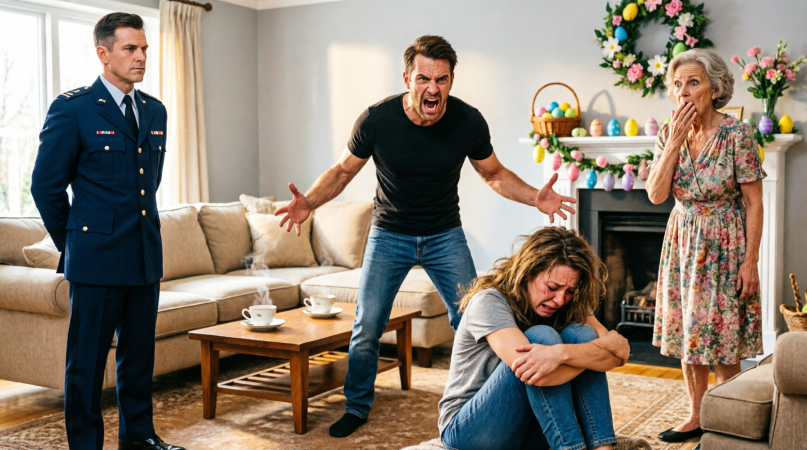
The living room of 18 Hawthorne Lane was a masterpiece of interior design, a spread worthy of an architectural magazine, now violently desecrated. Smaller, brightly colored plastic eggs were crushed and scattered violently across a priceless Persian rug. A toddler’s woven Easter basket lay overturned near the edge of an immaculate white leather couch, its green plastic grass spilling out like spilled entrails alongside a crushed chocolate bunny.
And there, half-curled into a tight, defensive fetal position on the hardwood floor beside the sharp glass edge of the coffee table, was my daughter.
“Emily,” I breathed, the word snagging painfully in my throat.
Her beautiful face was a canvas of fresh brutality. Her lower lip was split deep, a steady trickle of bright, arterial blood escaping the corner of her mouth. Her left cheekbone was already swelling violently, the delicate skin turning a mottled, angry shade of plum that signaled severe blunt force trauma. The collar of her pale yellow spring dress—a dress she had bought specifically because it reminded her of her mother—was soaked in a dark, spreading crimson stain.
For one agonizing, suspended second, the entire house plunged into a vacuum of absolute silence. The ticking clock, the distant children, the hum of the refrigerator—everything ceased to exist.
Then, Emily slowly, agonizingly lifted her head. Her right eye, the one not swelling shut, found mine. It was wide, dilated with shock, and brimming with a profound, soul-crushing shame.
Her lips parted, trembling violently, and she whispered a sentence that would forever be burned into the darkest corners of my memory.
“He said… he said I ruined Easter.”
The rage that detonated inside my chest was absolute and blinding. It wasn’t the fiery, chaotic anger of a bar fight; it was a cold, absolute, glacial fury. It was the kind of anger that slows time, sharpening every detail into high-definition clarity.
Without breaking eye contact with my battered daughter, I reached into the breast pocket of my jacket. I withdrew my phone, swiped the screen to unlock it, hit the speakerphone icon, and punched three digits with absolute, unwavering precision: 9-1-1.
I held the phone in my left hand, the dialing tone echoing loudly in the cavernous, silent room.
With my right hand, I reached up behind me, grabbed the heavy brass deadbolt of the front door, and violently snapped it into the locked position. The mechanical clack echoed like a gunshot.
I slowly stood up, turning my back on Emily to face the foyer. Ryan had recovered his balance and was stepping into the living room, smoothing his shirt. But as he saw the phone in my hand, heard the second ring of the emergency dispatcher, and processed the sound of the deadbolt locking us all inside… his arrogant stride faltered.
The blood drained rapidly from Ryan Mercer’s face, leaving him a sickly, pale white. His eyes darted from me, to the locked door, to the phone, and finally, to the terrifying realization dawning in his cowardly soul.
He suddenly understood that this was no longer a private family drama he could control with money and manipulation. He was locked in a room with a desperate father, and the police were already on the line.
“9-1-1, what is the address of your emergency?” the dispatcher’s calm, metallic voice boomed from the speaker, shattering the remaining illusion of their perfect life.
And from the shadows of the hallway behind Ryan, I heard the faint, terrifying sound of a heavy kitchen drawer slowly sliding open……………….
Click Here to continuous Read Full Ending Story👉: (ENDING)”I arrived for Easter dinner. Overheard their cruelty. Found my daughter injured. I called backup. What they did next shocked us.”