You place the canvas bag on the glass coffee table like you are setting down a final receipt.
The apartment is small but decorated with expensive intentions. There are gold-framed prints on the wall, a white couch no one with a real life would ever buy, and a candle burning on the kitchen counter that smells like vanilla trying too hard to be classy. Behind Miguel, his mistress stands frozen in a silk nightgown, one hand still holding a spoon over a yogurt cup as if her body forgot how to complete its own movements.
Miguel stares at the wheelchair, then at you, then back at his mother.
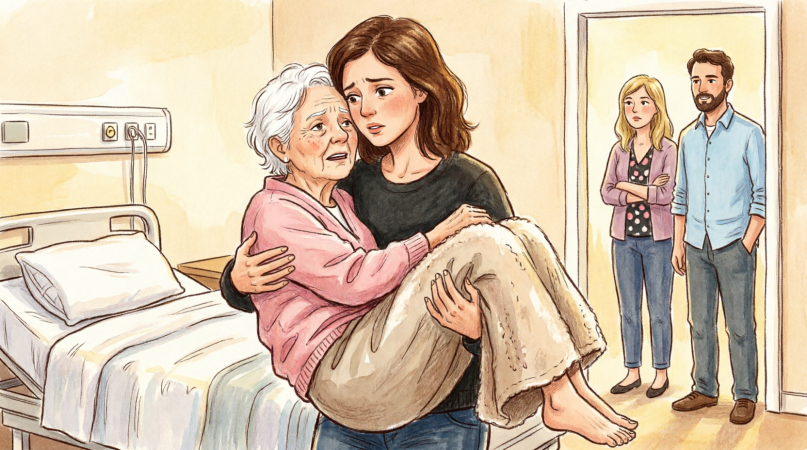
Carmen sits wrapped in the blue blanket you always tuck around her knees, her hair brushed, her cardigan buttoned, her face lit up with the fragile delight of a woman who believes she is visiting her son. She looks from Miguel to the young woman in the doorway and smiles weakly, unaware of the temperature in the room. “Mijo,” she says, her voice slurred but warm, “you look tired.”
Miguel swallows hard.
“Are you out of your mind?” he hisses, lowering his voice like that will make the situation smaller. “You can’t just bring her here.”
You keep your hands resting lightly on the wheelchair handles. Calmly. Deliberately. Not because you feel calm, but because fury dressed in silence lands harder than fury dressed in screams. “Actually,” you say, “I can. She’s your mother.”
The mistress finally finds her voice.
“What is this?” she asks, looking at Miguel instead of you, which tells you everything you need to know about the dynamic in this apartment. “You said your ex was dramatic. You didn’t say there was… this.” Her hand flicks vaguely toward Carmen, as though illness is an indecent object someone forgot to remove before company arrived.
Miguel shoots her a look, embarrassed now in a way he never was when humiliating you.
“Lena, just give me a second.”
You unzip the canvas bag and begin taking things out one by one.
Prescription bottles with color-coded stickers. Adult briefs. Rash cream. Physical therapy notes. Feeding instructions. Blood pressure logs. A laminated card listing emergency contacts and hospital preferences. You place each item on the table with the same composure you used for seven years when arranging medicine beside a bed at 2:00 a.m.
“Here are the monthly prescriptions,” you say. “She takes the heart medication with breakfast, the muscle relaxer after lunch, and the anti-seizure tablet at eight every evening. She has to be turned every four hours if she’s in bed too long, or her shoulder locks and the pressure sores start. She can’t swallow dry food well anymore, so don’t rush her. If she coughs while drinking, stop immediately and wait.”
Lena is pale now.
Not compassionate pale. Not shocked by the betrayal pale. This is the pale of a woman realizing the fantasy she bought came with unpaid invoices stacked to the ceiling. She sets the yogurt down slowly on the kitchen counter and says, “Miguel… what is she talking about?”
Miguel steps toward you, voice cracking with anger.
“Stop this. Stop humiliating me and take her back home.”
You tilt your head just slightly. “Home?” you repeat. “You mean the house where you left me to bathe her, lift her, feed her, clean her, and pretend you were just working late while you played boyfriend in this apartment?”
His jaw tightens.
Carmen looks from one face to another, her smile fading a little now, confusion drifting over it like a cloud. “Miguel?” she says again, softer this time. “What’s happening?”
That is the moment his mistress looks at him and really sees him.
Not the charming man with the tired-marriage story. Not the victim of an “overbearing ex.” Not the overworked son supposedly trapped in a loveless home. She sees the son who outsourced his disabled mother to his wife for seven years and then abandoned both women with a fresh lease and silk sheets.
“Miguel,” Lena says slowly, “you told me your mother was in assisted care.”
You almost smile.
He looks at her, then at you, and for the first time since you found that message on his phone, he does not seem angry so much as outnumbered by truth. “I was handling it,” he says weakly. “It’s complicated.”
“No,” you say. “It was convenient.”
Then you look him straight in the eye and deliver the sentence you had rehearsed all afternoon, the one that made your hands tremble while packing Carmen’s medications, the one you knew would strike deeper than rage.
“One more thing,” you say. “I filed for divorce this morning, and Adult Protective Services already has copies of every message proving you abandoned your disabled mother while stealing her pension to fund this apartment.”
The color vanishes from both their faces so fast it feels theatrical.
Lena’s mouth opens but no sound comes out. Miguel actually stumbles back a step, his heel catching against the edge of the rug. For one second, nobody moves except Carmen, whose fingers twitch against the blanket because she can feel panic in the room even if she doesn’t yet understand its shape.
Then Miguel snaps.
“You did what?” he barks.
“I reported what happened,” you say. “That’s different.”
His breathing turns ragged. “You can’t prove anything.”
“I can prove the account linked to your mother’s disability checks started paying this rent five months ago. I can prove you forged three of her signatures on transfer forms because you didn’t know she still writes the capital C in her first name like a printmaker from 1962. I can prove you never visited the neurology follow-ups you claimed to attend. And I can prove you told me, in writing, that if I was ‘already playing nursemaid,’ I should stop bothering you with medical expenses.”
Lena looks at him like she just discovered something dead inside the walls.
“You used your mother’s money?” she whispers.
Miguel rounds on her. “Don’t do this now.”
“When exactly did you want me to do it?” she shoots back. “Before or after I helped change her bed?”
Carmen makes a small sound in her throat.
It is not quite a word. More like the body’s version of a cracked bell. You move instantly to her side, kneeling so your face is level with hers, because whatever else is happening, your habits of care do not break on command. “You’re okay,” you say gently. “You’re okay, Mama.”
Miguel hears the tenderness in your voice and seems almost offended by it.
“Don’t call her that here,” he says.
You look up at him, and something in you finally goes hard as steel. “Seven years,” you say. “For seven years I have earned the right to call her anything love allows.”
Silence falls heavy again.
Carmen’s eyes move slowly to your face, then to her son. You see understanding beginning to gather in the corners of her expression, not all at once, but in painful little pieces. A week ago, you might have tried to shield her. Tonight, you are too tired to lie for men anymore.
“Miguel,” she says, each syllable thick with effort, “you… left?”
He freezes.
There are many kinds of cowardice, but perhaps the ugliest is the kind that only appears when the witness is your own mother. Miguel, who lied so effortlessly to you, to Lena, to his colleagues, to himself, now cannot seem to form a full sentence. “Mom, it’s not… she’s making it sound…”
Carmen turns her head away from him and looks at you instead.
That hurts more than if she had slapped him.
You stand slowly and take your purse from the chair. “The social worker has my statement already,” you say. “The home aide service I paid out of my own paycheck for the last three months also submitted records. Tomorrow morning, my attorney files the financial fraud claim along with the divorce petition.”
Miguel’s face contorts.
“You vindictive little—”
Lena cuts him off.
“No,” she says, and this time there is no confusion left in her voice. “No, you don’t get to call her names. Not after this.” She steps away from him as if the air around him has become unsafe. “You told me she was cold. You told me she used your mother to control you. You told me all you wanted was peace.”
He glares at her. “And I still do.”
She laughs once, sharply. “This is your peace? Fraud, lies, and a disabled woman in my living room?”
Carmen closes her eyes.
You know that look. It is not fatigue exactly. It is grief hitting an old body that has already paid too much for love. You reach for the water bottle in her bag, help her sip, then tuck the blanket closer around her shoulders. Even now, with your marriage in ashes and legal papers moving like knives behind the scenes, your hands know exactly how to make another person more comfortable.
That is when Carmen opens her eyes again and says something you never expected to hear.
“Take me… home with you.”
The room stops.
Miguel stares at her. Lena stares at her. You stare at her too, because in seven years this woman has criticized your cooking, your housekeeping, your weight, your job history, your parenting, your family, and the way you folded towels. She has never once chosen you over her son.
Until now.
“Mama,” Miguel says, stepping forward quickly, “you’re upset. You don’t understand what’s happening.”
Carmen’s good hand trembles on the blanket, but her gaze stays on him. “No,” she says, fighting for the words, “I understand… enough.”
Then she looks at you again.
“Please.”
You swallow hard.
The apartment around you seems to sharpen at the edges. The fake elegance. The candle. The silk nightgown. The spoon abandoned on the counter. Every piece of the fantasy Miguel built with stolen money and borrowed lies is suddenly ridiculous beside the simple force of that one word from the woman who once measured your worth in teaspoons and sighs.
You nod once.
“Okay,” you say.
Miguel lunges toward the wheelchair as if he can physically stop the turning of the tide. “She can’t just leave,” he says. “She’s my mother.”
You meet his panic with a calm that terrifies him more than shouting ever could. “Then you should have remembered that before today.”
Lena moves to the door and opens it for you.
The gesture is small, almost absurd, but it lands in the room like a verdict. She doesn’t look at Miguel when she does it. She looks at you. “I’m sorry,” she says quietly. “I didn’t know.”
You believe her.
Not because innocence excuses everything, but because you recognize the specific humiliation in her face. She thought she was stealing a man from a bitter marriage. Instead, she discovered she had been sleeping beside a son who pawned his mother’s dignity for convenience. There are some lies too rotten to survive first contact with daylight.
You wheel Carmen toward the door.
Before leaving, you pause and turn back one last time. Miguel stands in the middle of the room looking like a man whose reflection just stepped out of the mirror and refused to return. “You wanted a life without burdens,” you tell him. “Now you get one. Just not the house, the pension, or the child you were planning to visit on holidays like a fun uncle.”
His lips part. “What?”
You hold his gaze. “I’m filing for full custody.”
That lands too.
You leave before he can answer.
The elevator ride down is silent except for Carmen’s uneven breathing and the rattle of the wheelchair over the seam in the floor. Outside, the evening air is cool and damp, and the city smells like rain on concrete. You load her carefully into the wheelchair-accessible van you borrowed from your neighbor’s brother, strap her in, and stand there a moment with both hands on the open door.
Carmen does not speak until you start the engine.
“You knew,” she says at last, the words blurred by fatigue, “for how long?”
You keep your eyes on the windshield.
“About the affair? A week. About the money? Three days.”
She nods once, absorbing the arithmetic of betrayal. Then she asks the question you knew would come sooner or later. “Why didn’t… you leave before?”
It is such a clean question.
No accusation. No defense. Just truth asking for another truth. You let the silence breathe before answering because some answers deserve a little space around them.
“For Mateo,” you say. “For stability. For the mortgage. For your physical therapy. For all the reasons women keep calling sacrifice when really it’s survival with lipstick on.”
Carmen exhales through her nose, a sound almost like a broken laugh.
“You should have left,” she murmurs.
You glance at her in the mirror. “Maybe. But then who would have made sure you got your meds on time?”
She looks down at her lap.
The streetlights slide across her face in stripes as you drive, making her seem older and smaller than ever. For the first time since you met her, she does not try to defend Miguel, excuse him, or redirect blame toward your tone, your attitude, your choices. She just sits with what he has done, which may be the harshest punishment of all.
You take her back to the house.
Not because it still feels like yours, and not because you plan to stay forever, but because that is where her hospital bed is, where the grab bars are installed, where the bathroom has the lift seat and the kitchen has the medications arranged in the order her body understands. A social worker can help with long-term placement later if that becomes necessary. Tonight, she needs familiarity more than symbolism.
Mateo is asleep when you get home.
He is six years old and curled sideways in bed with one sock off and a dinosaur tucked under his chin. Looking at him sends a clean blade of love through your exhaustion. Whatever happens next, you think, this is the center. Not the marriage. Not the fraud. Not even justice.
The center is the child breathing safely in the next room.
You settle Carmen for the night, change her, turn her gently, massage lotion into the arm that stiffens when she’s upset, and make sure the monitor is clipped where she can reach it. She watches you the whole time with an expression you can’t read. Not her old superiority. Not warmth exactly either. Something more unsettling.
Respect, maybe.
At midnight, after you finally sit down with a cup of reheated coffee you are too tired to taste, your phone erupts.
Miguel.
Again.
Again.
Again.
You let it ring itself empty.
Then the texts start.
You’re making a huge mistake.
You’re blowing up our family over a misunderstanding.
Delete the complaint and we can talk.
If APS gets involved, they’ll tear everything apart.
You think you’re going to win? On what income?
And then, because cowardice always circles back to its favorite tool:
No judge is going to hand a kid to a bitter woman who kidnaps disabled people.
That one almost makes you laugh.
Instead, you screenshot everything and forward it to your attorney.
Her name is Andrea Klein, and she once described family court as “a place where bad men discover paperwork is a predator too.” You hired her with the last of your savings three days ago after quietly gathering bank statements and photographing the pension deposit history. You did not expect to move this fast, but betrayal has a way of clearing procrastination from the bloodstream.
Andrea calls you at eight the next morning.
Her voice is bright, caffeinated, and almost offensively pleased. “Morning,” she says. “Your husband is either stupid, arrogant, or both.”
“Both,” you answer.
“Excellent. Those are my favorite clients’ spouses.”
You would laugh if you weren’t so tired.
Andrea tells you APS has opened an emergency review due to financial exploitation concerns, especially because the disability income appears to have been rerouted without proper authority. The custody petition can be filed immediately with temporary orders requesting the house for primary residence, full interim control of Carmen’s medical funds, and exclusive use of the family vehicle. Apparently Miguel’s late-night texts are not helping his case.
“Can he take Mateo?” you ask.
“Not today,” she says. “And not if he keeps texting like a drunk freshman with access to a calculator.” You hear papers shuffling. “Also, I looked into the house deed. Interesting little surprise there.”
Your spine straightens.
“What surprise?”
“The house isn’t in Miguel’s name.”
For a second, you think you misheard.
“What?”
“It’s in Carmen’s name,” Andrea says. “Transferred eight years ago after the stroke as part of a Medicaid planning strategy. Miguel has been paying the mortgage from a joint account, but legally he doesn’t own it. Which means if Carmen revokes his management authority, he has no right to force a sale or remove you while she’s residing there.”
You close your eyes.
The room seems to tilt slightly, not from fear this time but from the sudden realization that the foundation beneath your feet is not as cracked as Miguel assumed. “Does she know?” you ask.
“Maybe. Maybe not. Depends how much she understood when the paperwork was done. But if she has lucid capacity today, I want a notary there this afternoon.”
You turn slowly toward Carmen’s room.
Her door is open.
She is awake, staring at the ceiling.
The social worker arrives at noon. The notary at one. Andrea at two, carrying a leather portfolio and the energy of a woman who eats weak husbands for protein. By then, the house is full of professionals asking careful questions in slow voices, documenting the bed sores you’ve managed to prevent, the med schedule you maintained, the account irregularities, the caregiving hours, the lack of paid support, the absence of Miguel.
You expect Carmen to be confused.
Instead, she is devastatingly clear.
Not perfectly strong, not verbally elegant, but lucid. Clear enough to answer yes or no. Clear enough to identify the forged signatures. Clear enough to say, in front of witnesses, “My son used my money.” Clear enough to look at Andrea and add, “And she,” nodding toward you, “kept me alive.”
You stand very still when she says it.
Because praise from Carmen feels unnatural, like hearing a church bell ring underwater. For seven years you received criticism as your daily weather. This acknowledgment, late and imperfect and earned through far too much suffering, slips under your ribs in a way anger never could.
Andrea wastes no time.
By evening, temporary emergency motions are filed. Carmen signs a revocation of Miguel’s authority over her finances and designates you as her healthcare and residential representative pending the court’s review. APS freezes the questioned transfers. The apartment rent linked to Carmen’s pension stops the next morning.
Lena calls you two days later.
You almost don’t answer, but curiosity gets there first.
Her voice is smaller now, stripped of gloss. “I moved out,” she says.
You lean against the kitchen counter, looking at the sink full of dishes and the drying rack of Carmen’s adaptive cups. “That was probably wise.”
“I didn’t know about any of it,” she says quickly. “I know people say that, but I really didn’t. He told me you were cruel. He said you controlled him through guilt and used his mom to keep him trapped.”
You let the silence stand there a moment.
Then you say, “That’s what men say when a woman’s labor has become so invisible they mistake it for furniture.”
She breathes out shakily.
“I’m sorry,” she says again. “For what it’s worth, he’s furious. He says you’re destroying his life.”
You look toward the hallway where Mateo is building a block tower on the rug while cartoon dinosaurs roar softly from the TV. In the bedroom, Carmen is napping after physical therapy, one hand resting open on the blanket like she has finally unclenched from something years old. “No,” you say. “I’m just returning it to the right address.”
The hearing for temporary custody and household control is scheduled two weeks later.
Miguel arrives in a navy suit with a fresh haircut and the exhausted martyr expression he thinks judges enjoy. He has shaved carefully. He’s wearing the watch you once bought him for your fifth anniversary, which feels almost funny now. Andrea, beside you, takes one look at him and mutters, “He dressed like a youth pastor and still looks guilty.”
The judge is a woman in her fifties with sharp eyes and zero appetite for performance.
Miguel’s attorney tries first. He paints you as unstable, impulsive, vindictive, emotionally manipulative. He claims you “weaponized” Carmen’s condition after marital tensions and are trying to alienate Mateo from his father. He says Miguel has always been the family’s financial backbone and was “temporarily residing elsewhere” to gain clarity.
Then Andrea stands.
The room changes.
She submits the pension records. The forged signature comparison. The text messages. The missed neurology appointments. The home health receipts you paid. The apartment lease linked through recurring transfers. Lena’s sworn statement. The APS emergency findings. Then, with almost gentle cruelty, she plays one voicemail from Miguel in which he snarls that if you are “already wiping asses all day,” you should stop whining and “just use Mom’s check.”
The courtroom goes quiet.
Miguel’s face drains.
His attorney closes his eyes briefly, like a man realizing he has brought a decorative umbrella into artillery fire. The judge listens to the full clip, sets down her pen, and looks directly at Miguel with the expression of someone considering whether contempt is an emotional state or a legal option.
The temporary orders are granted in under twenty minutes.
Primary physical custody of Mateo to you. Supervised visitation only for Miguel pending evaluation. Exclusive residential possession of the house due to Carmen’s residence and care needs. Temporary control of Carmen’s medical funds and care decisions to you under emergency protective review. Immediate forensic accounting of the pension transfers.
Miguel says your name under his breath when the ruling lands.
Not lovingly.
Not hatefully either, not exactly. More like a man testing whether the universe still recognizes his voice after ignoring his demands all morning. You do not turn around.
Outside the courthouse, rain starts falling in fine silver lines.
Andrea opens her umbrella and says, “You know what the beautiful part is?”
“What?”
“We’re still at the beginning.”
And she’s right.
Because court orders are not endings. They are doors. What comes after is paperwork, home adjustments, difficult mornings, pediatric therapy for Mateo because children hear more through walls than adults like to admit, and a thousand practical little battles that revenge stories never include. Justice, when it arrives, often comes wearing orthopedic shoes and carrying a three-ring binder.
But things begin to shift.
Without Miguel in the house, the air changes first. Not magically. Not all at once. But the tension he carried around like static starts to leave the walls. Mateo sleeps better. You stop bracing when your phone buzzes. Even Carmen seems calmer, as if her body had been absorbing her son’s cowardice long before her mind named it.
One evening, about a month after the hearing, you are spoon-feeding Carmen pureed chicken and vegetables when she says, “I was cruel.”
You pause.
The kitchen clock ticks. Mateo hums softly in the living room while coloring. Outside, a lawn mower drones somewhere two houses down. Ordinary sounds. The kind that make confessions feel even larger.
Carmen swallows carefully and says it again.
“I was cruel… to you.”
You set the spoon down.
There are apologies you dreamed about for years, during nights of changing bedding and mornings of biting your tongue while she found fault with your eggs, your shirt, your parenting, your breathing. Back then, you imagined one perfect scene where she would break and admit everything and you would feel healed in a bright dramatic rush.
Instead, the moment arrives quietly in a kitchen with bad lighting and overcooked carrots.
“Yes,” you say.
Tears gather in her eyes.
“My mother… taught me… daughters-in-law are temporary,” she says with great effort. “Sons stay. So I held… him tighter. And punished you… for being there.”
The honesty is so raw it strips away the need for theatrical forgiveness.
You look at her long enough for the truth to fully arrive between you. This woman hurt you. Diminished you. Used tradition like a blade wrapped in politeness. And still, when the real test came, you were the one who stayed. That does not erase what happened. But it changes the map.
“I know,” you say.
She closes her eyes, and a tear slips down toward her ear. “I’m sorry.”
You do not rush to comfort her.
Some apologies deserve to sit in the room unpadded for a few seconds. Then you lift the spoon again, because tenderness and accountability do not have to cancel each other out, and say, “Eat before it gets cold.”
That becomes the beginning of something strange and slow and almost holy.
Not friendship exactly. Not redemption tied up with a bow. But an honest peace. Carmen starts telling you stories from before the stroke, before bitterness hardened her into a woman who measured everyone by usefulness. She talks about sewing dresses for neighbors when she was nineteen. About crossing into Texas from Nuevo Laredo with three dollars in her shoe. About raising Miguel after his father walked out and swearing no one would ever take from her again.
Fear, you realize, wears ugly disguises when it ages.
Meanwhile, Miguel keeps unraveling.
The forensic review finds more than expected. Not only had he redirected pension funds, he also borrowed against Carmen’s small life insurance policy and neglected the supplemental insurance premium for her rehab equipment. He claimed overtime at work during hours that corresponded with hotel charges and restaurant bills with Lena. His employer, which had been tolerating him as a reliable mid-level operations manager, places him on leave after the fraud complaint gains traction.
He blames you for all of it.
The messages keep coming, though less often now. Some rage-filled. Some pleading. Some weirdly nostalgic, as if memory itself can launder behavior. One says, We had good years too. Another says, Mateo deserves both parents. Another, past midnight, says, You always made me feel small in my own house.
That last one you read twice.
Not because it hurts, but because it reveals more than he meant. Men like Miguel often call accountability humiliation. They call being needed oppression, being witnessed judgment, being compared to their own promises emasculation. It is easier than admitting they simply wanted the benefits of love without the labor attached.
Spring arrives in cautious green.
The jacaranda down the street begins to bloom, and the house, which once felt like a stage set for your exhaustion, starts becoming livable in a softer way. Mateo’s laughter comes back first. Then your appetite. Then sleep. You hire a part-time licensed aide using restored care funds, enough to give you afternoons for work. The community college down the road offers a remote certification in medical office administration, and for the first time in years you sign up for something that belongs only to your future.
One night, after Mateo is in bed and Carmen is watching a game show at low volume, you sit at the kitchen table with your laptop open and realize you are no longer picturing escape as a blurry miracle.
You are building it line by line.
The final divorce trial is set for early June.
By then, Miguel has lost the apartment, the mistress, and most of his composure. He asks repeatedly for reconciliation through intermediaries because the idea of publicly becoming the man who abandoned both his wife and disabled mother is somehow more frightening to him than actually being that man. Andrea declines every olive branch on your behalf with professional cheer.
In court, the judge finalizes the divorce, grants you primary custody, maintains supervised visitation, and orders Miguel to repay the misappropriated pension funds under a structured judgment. The house, because it belongs to Carmen and because she is mentally clear enough to state her preference, remains your residence with her and Mateo as long as she chooses.
Then comes the moment no one expects except perhaps Carmen.
She asks to address the court.
The judge allows it.
Carmen is rolled forward in her chair, one hand trembling against the armrest, voice still thick from the stroke but steady enough to cut. She looks first at the judge, then at Miguel. “My son,” she says slowly, “thought blood meant ownership.” She turns her head toward you. “He was wrong.”
Miguel goes still.
Carmen continues. “This woman fed me, cleaned me, fought doctors, paid bills, raised my grandson, and carried our whole house on her back while my son played visitor in his own life.” She swallows with effort. “If I leave anything behind… it goes to the one who stayed.”
There are people in the courtroom crying openly by the time she finishes.
You are one of them.
Not because the words erase everything, but because some forms of recognition arrive so late they carry the weight of resurrection. For years, you existed in that house as labor people stepped around. In one public minute, Carmen names you as family with all the authority blood failed to provide.
Miguel stares at his hands.
He does not look at you on the way out.
That summer, the house feels different in a way that is hard to explain to people who have never lived inside resentment. The furniture is the same. The hallway still creaks near the bathroom. The old refrigerator still makes that coughing sound before the compressor catches. But the emotional gravity has shifted.
Mateo plants tomato seedlings in the backyard with the kind of seriousness only six-year-olds can bring to dirt.
Carmen sits on the patio in a wide-brimmed hat, issuing opinions no one asked for about watering schedules, which somehow sounds less cruel now and more like proof of life. You finish classes online at the kitchen table and start interviewing for medical billing jobs that can grow into something stable. The future, once a locked room, now has windows.
Then, in August, Miguel shows up at the gate unannounced.
He is thinner. Less polished. The self-importance has not vanished, but life has taken a few hard bites out of it. Mateo is at school and the aide is inside with Carmen, so you step onto the porch alone and keep the screen door between you.
“What do you want?” you ask.
He looks around the yard.
At the tomatoes. The trimmed hedge. The wheelchair ramp. The little plastic soccer ball abandoned by the steps. The life continuing without his permission. “I wanted to see Mom.”
“You had supervised time yesterday.”
“I mean really see her.”
You wait.
He rubs a hand over his mouth. “She won’t talk to me much.”
The answer that rises in you is meaner than the one you choose.
Instead, you say, “That happens when trust gets pneumonia.”
He gives a short, rough laugh that dies almost immediately.
Then, to your surprise, he says, “I didn’t think it would go this far.”
There it is.
Not I’m sorry.
Not I was wrong.
Just the small, sad confession at the center of so many disasters. I didn’t think consequences would arrive with a full tank of gas.
You study him through the screen. “That was your whole problem, Miguel. You thought everything was temporary except your comfort.”
He absorbs that without argument.
For a second, you almost pity him. Not enough to reopen any door. But enough to see the outline of the lonely man underneath the selfish one, and how often those two people feed each other until they become indistinguishable. Then he looks up and asks, “Do you hate me?”
It is such a childish question.
Like asking whether the fire hates the hand that started it. You think about the years. The betrayal. The smell of Carmen’s medicine on your clothes while he texted another woman. Mateo asking why Daddy worked at night so much. The apartment. The silk gown. The candle. The spoon of yogurt suspended in shock. The bank statements. The courtroom. Carmen’s apology.
“No,” you say at last. “I outgrew you.”
That lands deeper than hatred could have.
He nods once, almost as if accepting a diagnosis. Then he turns and walks back down the path without asking to come in.
By fall, you are working full-time from a medical office downtown, half remote, half in person. Mateo starts first grade. Carmen’s health remains fragile, but steady. She has bad days, stubborn days, funny days. On good afternoons she helps Mateo with Spanish words and tells him stories about border buses and dust storms and church raffles. On bad days she sleeps with her hand curled around yours and wakes embarrassed by needing so much.
You stop telling her not to be embarrassed.
Instead, you say, “This is what family is supposed to do.”
And every time you say it, you realize you finally believe it.
In December, Carmen calls Andrea and asks her to come by with a will.
You try to protest. She ignores you. “I am not dead yet,” she says, irritated, “but I also did not survive this long to leave paperwork to fools.” Andrea arrives with two witnesses and a legal pad, and Carmen revises everything. The house goes into trust for Mateo, with you as trustee and residency rights for as long as you want them. A small savings account is set aside for your education. Miguel receives exactly what she says he earned.
Nothing.
When Andrea leaves, she grins at you by the front door and whispers, “Your mother-in-law is terrifying. I love her.”
The title catches in your chest for a second.
Your mother-in-law.
Not because the marriage still matters. But because the phrase, once heavy with hierarchy and daily abrasion, has transformed into something less sharp and more human. Not mother. Not enemy. Something complicated and real in between.
Winter settles in.
One evening, while snow drifts past the kitchen window and Mateo builds a blanket fort in the living room, Carmen asks you to brush her hair. You stand behind her chair doing it slowly, the way you have done a thousand times, but tonight she reaches up with her good hand and rests it over yours midway through a stroke.
“I thought strength looked like control,” she says.
You meet her eyes in the mirror.
“What does it look like now?”
She squeezes your fingers as much as she can. “Staying… without becoming cruel.”
You have no clever answer to that.
So you finish brushing her hair and kiss the top of her head, because sometimes the most accurate response to truth is touch.
She dies in early March.
Quietly. At home. In her own bed with the window cracked because she wanted “real air” and the rosary from her mother looped around her wrist. You and Mateo are with her. Miguel arrives too late. There is sorrow in that, even after everything. The priest says the usual beautiful things. The casserole dishes arrive from neighbors who know only enough of the story to be kind.
At the burial, Miguel cries like a boy.
Not performatively. Not strategically. Just wrecked. Watching him, you understand something important and useless at once: a man can love and still fail spectacularly at being decent. One does not cancel the other. Love without responsibility is just appetite wearing perfume.
After the service, Miguel approaches you by the cemetery gate.
The wind is cold, and everyone smells faintly of wool and damp earth. He looks at you for a long moment, then says, “She changed her will, didn’t she?”
You do not lie.
“Yes.”
He nods slowly, as if some part of him expected it all along. “I deserve that.”
That is the closest thing to adulthood you have ever heard from him.
Maybe grief finally broke a window open. Maybe consequences did the patient work you could not. Maybe nothing permanent will come of it. But there it is. A single clean sentence standing alone in the weather.
You say, “Yes. You did.”
Then you walk back toward Mateo, who is holding a paper cup of hot chocolate with both hands and waiting for you by the car.
Months later, people still tell the story wrong.
They say you rolled your cheating husband’s mother into his love nest as revenge. They tell it like a punchline, a savage move, a delicious humiliation. They imagine the dramatic doorway, the mistress in silk, the son going pale, and they clap for the scene the way people clap for justice only when it entertains them.
But that was never the whole story.
The real story is that you spent seven years doing invisible labor so constant it became the wallpaper of your own life. The real story is that betrayal did not make you cruel, just clear. The real story is that when you pushed that wheelchair into his apartment, you were not returning a burden. You were returning responsibility to the address that had dodged it longest.
And the sentence that drained the color from their faces was not magic.
It was paperwork.
It was proof.
It was the end of pretending that selfishness was just stress, that infidelity was the biggest crime in the room, that a man’s convenience should outweigh an old woman’s care, a wife’s labor, and a child’s stability. It was consequence finally showing up in daylight with files, timestamps, and witnesses.
That is what made them pale.
Not your anger.
Your evidence.
And in the end, that is what saved you.
Not revenge.
Not luck.
Not a perfect speech.
Just the moment you stopped protecting the person who was breaking the house from the inside and started protecting everyone else instead.