“You thought you were starving a helpless, penniless old woman,” I continued, walking slowly toward them. “You were actually starving the majority shareholder of the real estate firm you work for, Steven. You locked the rightful holder of the deed to this house in a closet. And,” I looked at Brenda, whose eyes were wide with a sudden, dawning terror, “you assaulted the woman who just legally wrote you out of a forty-million-dollar estate.”
Steven’s tablet slipped from his fingers, shattering against the hardwood floor. “Forty… million?” he whispered, the blood completely leaving his face.
Mr. Sterling placed a small, sleek tablet on the dining table. He tapped the screen. The crystal-clear audio from the burner phone I had left recording in my apron pocket filled the room.
“YOU ARE NO GOOD TO THIS FAMILY IF YOU DON’T BRING IN THE COLD HARD CASH!” Brenda’s recorded voice shrieked, followed by the sickening thud of my body hitting the floor and my desperate, unanswered plea to Steven.
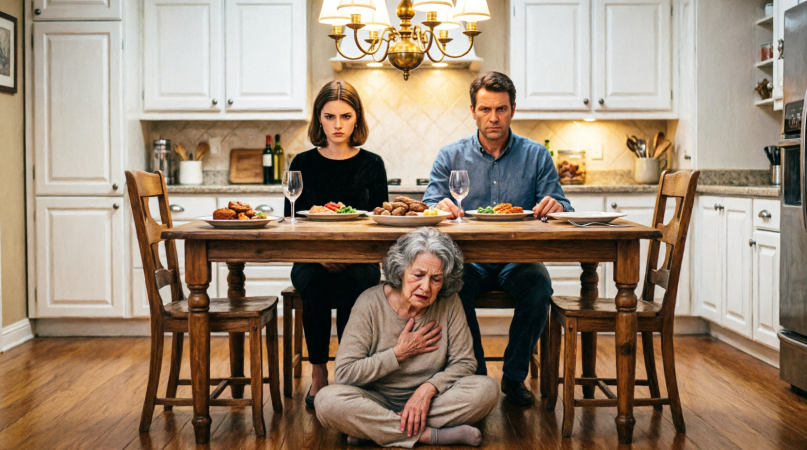
The detective didn’t need to hear anymore. He stepped forward, pulling a pair of heavy steel handcuffs from his belt. “Brenda Miller, you are under arrest for felony elder abuse and unlawful imprisonment.”
Brenda shrieked, scrambling backward, knocking over a designer chair. “No! No, she’s lying! Steven, do something! Tell them she’s crazy!”
But Steven couldn’t move. He wasn’t looking at his wife being wrestled into handcuffs. He was staring blindly at the document Mr. Sterling had just slid across the glass table—a formal notice of immediate eviction, terminating their residency in the home they thought they owned, effective the moment they vacated the premises.
Six months later, the bitter Chicago winter had faded into a gentle, coastal spring. I stood on the private balcony of my penthouse suite at Oceanview Terrace, a luxury assisted living community in California. I didn’t just live here; my trust had purchased the entire facility two months ago. I wasn’t stocking shelves anymore. I was surrounded by a staff who treated me with genuine warmth, and neighbors who valued me for my conversation, not the digits in my checking account.
I took a sip of Earl Grey tea, enjoying the warmth of the ceramic mug against my healing joints. On the patio table beside me sat a crumpled, tear-stained letter.
It was from Steven.
The fallout from that morning in the living room had been absolute. Brenda was currently serving a five-year sentence in a county correctional facility, stripped of her silk robes and designer knockoffs, learning the true meaning of a locked door.
Steven’s reality was arguably worse. Once Mr. Sterling froze the bridge accounts, Steven’s partners at the firm discovered he was entirely reliant on anonymous capital. They ousted him within a week. The house was sold, the cars were repossessed. According to the private investigator I kept on retainer, Steven was currently renting a cramped, moldy one-bedroom apartment over a laundromat, working three grueling, minimum-wage jobs just to keep the lights on. He was finally experiencing the brutal “worth” of money he had once so casually demanded from me.
His letter was pathetic. Six pages of frantic apologies, blaming Brenda for everything, claiming he was “paralyzed by fear,” and begging for a “second chance” alongside a request for a “small loan to get back on my feet.”
I didn’t feel anger as I looked at his handwriting. I only felt a profound, hollow pity. I had given him my heart, my youth, and my sweat for thirty-two years, and he had traded it all for a woman’s approval and the blind hope of an inheritance.
I picked up a pen and wrote a single sentence across the bottom of his letter: “I paid for your life once; I will not pay for your mistakes again.” I folded it into an envelope and handed it to my assistant to mail.
Later that afternoon, I walked down to the manicured courtyard to meet Mr. Sterling. He looked relaxed, the coastal sun softening the sharp edges of his usual courtroom demeanor.
“Margaret,” he smiled, holding a leather portfolio. “You look well. The sea air suits you.”
“It does, Richard,” I replied. “Are the papers ready?”
“They are. The donation for the new cardiac wing at Mercy General is finalized. We’re just waiting on your signature to confirm the dedication plaque.”
I took the pen from him. “Name it the Eleanor Gable Pavilion. She taught me that some people are worth more than any paycheck.” Mrs. Gable had survived her bypass, and my trust had quietly ensured she would never see another medical bill for the rest of her life.
I signed the document with a flourish, feeling the final lingering shadows of my past lift from my shoulders. It was done. I had won my peace.
Just as I handed the portfolio back to Mr. Sterling, my personal cell phone rang. It was the private investigator.
“Mrs. Miller,” his gruff voice came through the speaker. “I know you told me to close the file on your son, but while I was auditing Arthur’s old shell corporations… I found something you need to see. Unsealed birth records from a private clinic in Ohio.”
I frowned, a cold prickle of unease washing over me. “Records of what?”
“Steven isn’t your only heir, Margaret,” the investigator said, the gravity of his words hanging heavy in the air. “Your husband had another daughter.”
The city park was awash in the golden, bruised hues of late autumn. I sat quietly on a wooden bench, the collar of my cashmere coat turned up against the chill, watching the playground.
A young woman in her early thirties—Sarah—was pushing a toddler on the swings, her laughter bright and unguarded. She had Arthur’s eyes, that deep, unmistakable shade of hazel.
When the investigator first brought me the file, it felt like a betrayal from beyond the grave. Arthur had an affair early in our marriage, a secret he took to his tomb. But as I read through Sarah’s life, the anger dissolved into a strange, poignant curiosity. She was a public school teacher. She drove a beat-up sedan. She had spent the last five years paying off her mother’s medical debts without a word of complaint.
She was everything Steven was not.
Sarah jogged over to the bench, holding two steaming cups of coffee, her cheeks flushed from the cold. She didn’t know I was a multimillionaire. She certainly didn’t know I was her father’s widow. She only knew me as “Maggie,” the eccentric older woman she had met at the library, who happened to represent the anonymous scholarship fund that had recently paid off the remainder of her student loans.
“Thank you for the coffee, Maggie,” Sarah said, sitting down and exhaling a cloud of white breath. She looked at me, a genuine, warm expression crinkling the corners of her eyes. “You know, you didn’t have to meet me all the way out here. But I’m glad you did. You remind me so much of the mother I wish I had.”
I smiled, a true smile that reached my eyes, untouched by grief or malice. I had spent my entire adult life trying to buy my son’s love, enduring abuse and humiliation, only to find that the most valuable connections in this world are the ones that simply cannot be bought. They are forged in mutual respect.
As the sun dipped below the skyline, casting long, peaceful shadows across the grass, I realized that my will had finally been executed perfectly. I hadn’t just torn a toxic family apart; I had pruned a dead, rotting branch so that a new one could finally grow. I had a second chance at family, on my own terms.
I stood up, giving Sarah a gentle squeeze on the shoulder. “I’ll see you next week, Sarah. Bring the kids.”
“Count on it, Maggie!” she called out as she ran back to the swings.
I pulled my coat tighter and began the walk back to my waiting car. As I reached the edge of the park, I stopped.
Standing across the street, huddled near a broken streetlamp, was a man. His clothes were ill-fitting and worn. His shoulders were permanently hunched, carrying the invisible, crushing weight of survival. It was Steven. He looked decades older, his eyes tired and utterly desperate. He had clearly tracked me down, perhaps hoping to force an in-person confrontation, to beg one last time.
He saw me. He took a hesitant step off the curb, his hand raising slightly in a pathetic echo of the boy he used to be.
But then, he stopped.
He looked at the calm certainty in my posture. He looked at the vast, unbridgeable distance between us. In that moment, the final realization seemed to break over him: between us lay a canyon made of cold linoleum floors, locked doors, and a violence that even forty million dollars could never bridge.
I didn’t wave. I didn’t scowl. I simply turned my head forward and kept walking, my shadow long and steady in the evening light, leaving him behind in the dark.
If you want more stories like this, or if you’d like to share your thoughts about what you would have done in my situation, I’d love to hear from you. Your perspective helps these stories reach more people, so don’t be shy about commenting or sharing.