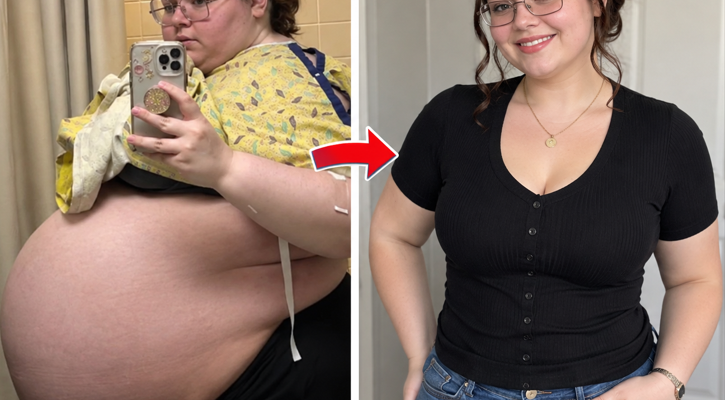
At just 20 years old, Allison Fisher was struggling with an enormous abdomen, difficulty breathing, and years of unanswered medical concerns. What doctors eventually discovered inside her body was extraordinary: a massive ovarian cyst weighing approximately 104 pounds (47 kilograms). Her story became a powerful reminder of why persistent symptoms should never be dismissed simply because of a person’s weight.
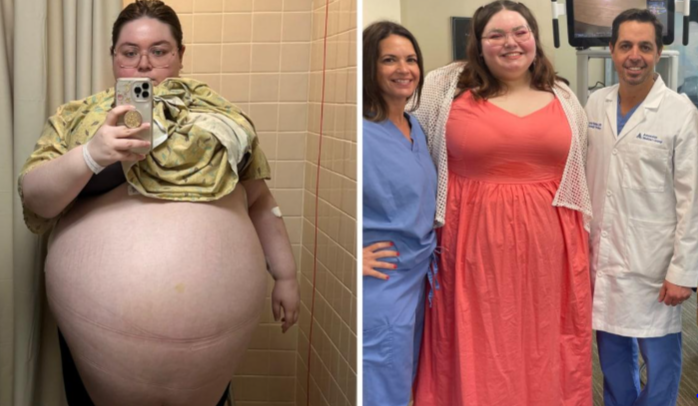
A Young Woman Living With a Burden No One Could See
For most young women, turning 20 means looking forward to independence, new experiences, friendships, and the possibilities of adulthood. But for Allison Fisher, a young woman from Jacksonville, Florida, everyday life had become increasingly difficult.
Her abdomen had grown to an extraordinary size. Simple activities that most people take for granted were becoming uncomfortable and exhausting.
The swelling was so severe that Allison described feeling as though she were pregnant with ten children.
But she wasn’t pregnant.
Unknown to her, an enormous cyst was growing inside her abdomen, taking up space and putting pressure on surrounding organs.
For years, Allison had struggled to get answers about her changing body. According to her account, medical professionals repeatedly attributed her symptoms to her weight.
Rather than receiving an explanation that addressed the unusual swelling, she felt that her concerns were being overlooked.
Over time, those experiences affected her willingness to seek medical care.
She eventually stopped going to doctors.
What appeared from the outside to be a problem related to body size was actually a serious medical condition that required specialized treatment.
And the longer it went undiagnosed, the greater the burden became.
Years of Feeling Unheard

Allison’s experience highlights a difficult issue in healthcare: patients with obesity sometimes report that their medical complaints are attributed to their weight before other possible explanations are fully investigated.
Weight can certainly affect health, but it does not rule out the possibility of an unrelated or additional medical condition.
In Allison’s case, the extraordinary enlargement of her abdomen was not simply the result of weight gain.
A large ovarian cyst had been developing inside her body.
Ovarian cysts are fluid-filled sacs that form in or on an ovary. Many are small, cause few symptoms, and disappear without treatment. Others can grow much larger and require medical evaluation.
Allison’s cyst was exceptionally large.
As the mass expanded, it occupied more and more room inside her abdomen.
The consequences extended beyond her appearance. The cyst was eventually found to be interfering with her breathing, showing how seriously it was affecting her body.
For Allison, the emotional effects were also significant.
She had spent years feeling that something was wrong while struggling to obtain an answer.
Repeatedly feeling dismissed can make patients hesitant to return for help, even when symptoms worsen.
The Pandemic Made Everything More Difficult
When the COVID-19 pandemic disrupted everyday life, Allison faced additional barriers to receiving medical care.
Like millions of people, she was concerned about leaving home during a period when hospitals, public spaces, and ordinary activities carried new uncertainties.
She also did not have health insurance.
The combination of previous negative medical experiences, financial concerns, and the pandemic made seeking treatment even more difficult.
Meanwhile, her abdomen remained enormously enlarged.
What had begun as a troubling health concern had become a condition affecting her quality of life.
But a deeply personal family situation would eventually influence her decision to seek help.
Her mother was fighting cancer.
Watching someone close to her confront a serious illness brought the importance of medical care into sharper focus.
As Christmas 2022 approached, Allison decided she could no longer continue living without answers.
She went to Ascension St. Vincent’s Riverside Hospital in Jacksonville.
That decision would change her life.
A Hospital Visit That Revealed Something Extraordinary
When Allison arrived at the hospital, her medical team began evaluating the unusual size of her abdomen.
What they discovered was astonishing.
Inside her body was a gigantic ovarian cyst weighing approximately 47 kilograms, or about 104 pounds.
The cyst contained roughly 46 liters of fluid.
To understand the scale, 46 liters is more than twelve U.S. gallons of fluid.
This was not an ordinary ovarian cyst.
It was an enormous abdominal mass that had grown large enough to interfere with Allison’s normal bodily functions.
Dr. Martin Martino, a gynecologic oncologist involved in her treatment, explained that the mass was affecting her ability to breathe.
The pressure inside her abdomen was not merely uncomfortable. It was creating a potentially serious medical problem.
For Allison, the discovery finally provided an explanation for the physical changes she had experienced for so long.
The swelling had a medical cause.
And now, for the first time in years, there was a plan to address it.
A Delicate Operation That Removed 104 Pounds
Removing such an enormous mass required careful planning and coordination.
Dr. Martino and his colleagues faced a challenge that few surgical teams encounter.
The tumor measured approximately 50 centimeters by 50 centimeters, roughly 20 inches in each dimension.
Rather than relying on a large traditional incision, the surgeons used robotic-assisted minimally invasive surgery.
This technique allowed the medical team to operate through smaller incisions while using specialized instruments and magnified visualization.
For Allison, the approach offered the possibility of less surgical trauma and a smoother recovery.
The operation took place on December 21, 2022.
The team removed the enormous mass and drained approximately 46 liters of fluid. The procedure involved specialists from several areas of the hospital, reflecting the complexity of Allison’s condition.
The tumor was subsequently reported to be benign, meaning it was not cancerous.
But the operation revealed another serious problem that had previously been hidden by the enormous mass.
A Second Discovery: Her Other Ovary Was Twisted Three Times
Once the massive tumor was removed, surgeons could finally examine structures that had been difficult to see.
That was when they discovered another problem.
Allison’s left ovary had twisted around itself three times.
This condition, known as ovarian torsion, occurs when an ovary rotates around the tissues supporting it. The twisting can interfere with blood flow and potentially damage ovarian tissue.
It is a condition that may require emergency surgery.
In Allison’s case, the medical team was able to untwist the ovary.
Dr. Martino explained that this discovery was particularly important because the surgeons were able to preserve the possibility of future fertility.
For a young woman only 20 years old, that was a significant outcome.
The operation had done more than remove an enormous tumor. It had also addressed a condition that could have threatened the function of her remaining ovary.
Although preserving an ovary does not guarantee future pregnancy, it can protect reproductive potential.
For Allison, who had already endured years of uncertainty, this was another reason to feel hopeful.
Waking Up to a Completely Different Life
After surgery, Allison woke up to a reality that must once have seemed almost impossible.
The enormous weight she had carried inside her body was gone.
Her body was approximately 104 pounds lighter because of the removal of the tumor.
But the transformation was about much more than a number on a scale.
For years, Allison had struggled with ordinary activities. Standing for extended periods, moving comfortably, wearing clothes, and even seeing her own feet had become difficult.
After the operation, many of those things became possible again.
She could look down and see her feet.
She could stand longer.
She could move with less discomfort.
And she could begin imagining a future that was no longer dominated by the enormous mass inside her abdomen.
The hospital reported that when her breathing tube was removed, Allison thanked the medical team for saving her life.
For the doctors, it was an extraordinary surgical achievement.
For Allison, it was the beginning of a new chapter.
The Emotional Transformation Was Just as Important
Allison’s physical recovery attracted widespread attention, but her emotional journey was equally meaningful.
For years, she had lived with embarrassment, fear, and the belief that her body might never change.
She had also experienced the painful consequences of being judged by her appearance.
People had mistaken her enlarged abdomen for pregnancy.
As a child and teenager, she had struggled with comments about her size.
Those experiences affected her confidence and contributed to her withdrawal from ordinary social activities.
Following the surgery, however, Allison began describing herself in a very different way.
Instead of focusing only on the limitations she had experienced, she began talking about the things she wanted to accomplish.
She wanted to learn to drive.
She wanted to become more independent.
She wanted to improve her health.
And she wanted other people who had experienced similar difficulties to understand the importance of seeking medical attention.
Her transformation was not simply about becoming smaller.
It was about regaining control over her future.
Her Journey Didn’t End With the Tumor Removal
One of the most remarkable developments in Allison’s story came after her initial recovery.
In May 2023, she underwent gastric bypass surgery as part of a broader plan to improve her health.
By December 2023, the Florida Times-Union reported that she had lost a total of approximately 264 pounds from her highest recorded weight, including the weight of the ovarian tumor.
The report described a young woman who had become more confident and more willing to participate in everyday life.
She had also developed a close connection with Amy Wells, a bariatric care coordinator at Ascension St. Vincent’s who had undergone weight-loss surgery herself.
That relationship provided encouragement as Allison continued making changes to her health and lifestyle.
She also expressed interest in helping other people navigate their own medical challenges, potentially through a career in health coaching.
Her experience had given her a new perspective on the importance of listening to patients and treating them with dignity.
These are documented developments from 2023; they should not be mistaken for a verified update on Allison’s health in 2026.
What Allison’s Story Teaches Us About Ovarian Cysts
Although Allison’s condition was extraordinarily rare, ovarian cysts themselves are relatively common.
Many develop as part of the normal menstrual cycle and disappear without causing serious problems.
However, larger or persistent cysts may produce symptoms that require medical attention.
Some warning signs include:
-
Persistent abdominal swelling or bloating.
-
Pelvic or lower abdominal pain.
-
Unusual menstrual bleeding.
-
A sensation of fullness or pressure in the abdomen.
-
Difficulty eating normal-sized meals.
-
Increasing abdominal size without a clear explanation.
-
Changes in urination or bowel habits.
These symptoms can have many causes and do not necessarily indicate an ovarian cyst.
However, symptoms that persist, worsen, or interfere with everyday life deserve proper evaluation.
Sudden, severe pelvic pain, particularly when accompanied by nausea or vomiting, may indicate ovarian torsion or another emergency and requires urgent medical care.
Allison’s case also demonstrates why unusual symptoms should not automatically be attributed to weight.
A thorough medical assessment can identify conditions that might otherwise remain untreated.
A Powerful Reminder to Listen to Patients
One of the most important lessons from Allison’s experience concerns the relationship between patients and healthcare professionals.
When people feel that their concerns are repeatedly dismissed, they may lose confidence in the healthcare system.
That loss of trust can lead to delayed diagnosis and treatment.
Allison had experienced this firsthand.
She believed something was wrong, but earlier encounters left her reluctant to seek help.
It was only after she found a physician who recognized the unusual firmness and size of her abdomen that imaging revealed the true cause.
Her story emphasizes the importance of investigating persistent symptoms, regardless of a patient’s body size.
It also reminds patients that seeking a second opinion can be appropriate when symptoms remain unexplained.
Every person deserves to have their concerns taken seriously.
From Fear to Hope: Allison’s Second Chance
Allison Fisher’s story began with years of uncertainty and discomfort.
As a child, she noticed that her stomach looked different.
As a teenager, she faced judgment and struggled with her confidence.
As a young adult, she lived through the pandemic while dealing with serious physical symptoms and barriers to medical care.
By the time she reached the hospital in December 2022, the enormous tumor had become a threat to her health.
Yet what followed was an extraordinary transformation.
A team of surgeons removed a 104-pound ovarian tumor.
They discovered and untwisted her other ovary, helping preserve her reproductive potential.
Allison recovered and began pursuing goals that had once seemed beyond her reach.
Then, in the months that followed, she continued working toward improved health and greater independence.
Her story is not simply about a rare medical condition or an astonishing amount of weight removed during surgery.
It is about a young woman who spent years feeling unheard, finally received an explanation, and found renewed hope for her future.
For anyone experiencing persistent symptoms while feeling afraid or discouraged about seeking care, Allison’s experience carries an important message:
Your symptoms deserve attention. Your concerns deserve to be heard. And getting the right medical care can change your life.