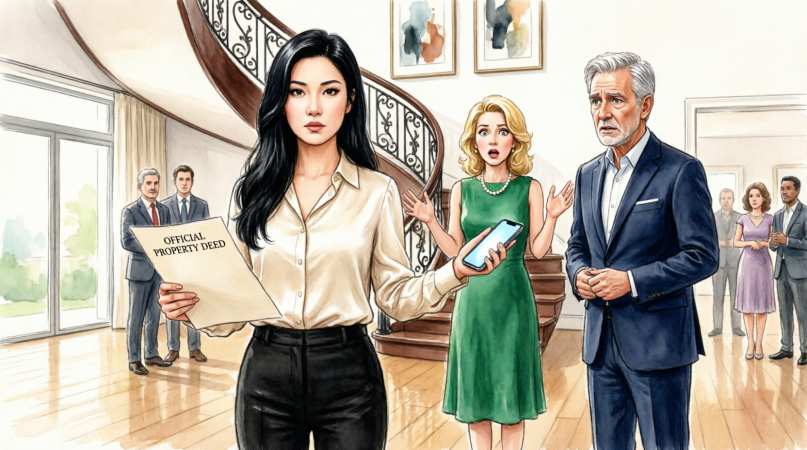
My sister stood inside my $850K house just before the family reunion, a smirk on her face. “Dad promised me this as a wedding gift,” she said. My father laughed—even though I had paid $760,000 for it. “You don’t belong here,” he added. I didn’t respond. I simply took out the deed and sent one text.
The property was valued at about eight hundred and fifty thousand dollars by the time my father decided it wasn’t mine anymore.
I had purchased it two years earlier, right after selling my stake in a medical logistics company I had helped build from nothing. The market was tight, the neighborhood was peaceful, and after years of cramped apartments and constantly putting others first, I wanted something that was unmistakably mine. I invested seven hundred and sixty thousand dollars of my own money, financed the rest, and never missed a payment. The deed, mortgage, insurance, tax filings—every legal document carried my name: Nathan Cole.
But in my family, official paperwork had never carried as much weight as my father’s interpretation of reality.
He had always treated my younger sister, Ava, as though she had an inherent claim to anything someone else earned. When she got engaged to a man who switched jobs every six months and called himself an entrepreneur because he once sold vintage sneakers online, my father became fixated on giving her a “wedding start in life.” He began talking about property, legacy, and how “real family wealth stays in the bloodline,” which was ironic since I seemed to fall outside that bloodline whenever something belonged to me.
I ignored it. That was my mistake.
That summer’s family reunion was planned at my house because it had the largest backyard and the best setup for hosting. I only agreed because my mother pleaded, saying it would be good to have one peaceful gathering where everyone acted like adults. By noon, the catering had arrived, tables were arranged on the patio, and I was upstairs changing before guests arrived. When I came back down, Ava was standing in my foyer, slowly spinning in a circle like she was already deciding where her furniture would go.
She looked at me, smirked, and said, “Dad promised this as my wedding gift.”
At first, I honestly thought she was joking.
Then she added, “You really think this is your place?”
I stared at her. “Excuse me?”
Before she could respond, my father walked in from the kitchen with a glass of iced tea, completely comfortable in the house I had paid for. He let out a short laugh. “Nathan, don’t act surprised. This home makes more sense for Ava now. You don’t belong here long-term anyway.”
I could hear my pulse pounding in my ears.
After everything I had paid, every closing document I had signed, every dollar that came out of my account—he was standing in my entryway telling me I didn’t belong.
I didn’t argue.
I walked into the study, opened the fireproof drawer, took out the deed folder, snapped a photo, and sent a group text to the entire family gathering for the reunion:
Before lunch starts, everyone should know this house belongs solely to me. Since certain people think otherwise, the reunion is canceled. Anyone not invited by name needs to leave my property in the next ten minutes.
The silence after I pressed send was immediate—and strange.
Even before the phones started buzzing, the atmosphere shifted. It was the kind of silence that happens when a lie is dragged into the open before everyone has agreed on the same version of events. Ava’s smile vanished first. My father looked at my phone, then at me, as if he still believed a harder stare could override legal ownership.
Then the notifications began lighting up one after another.
My cousin Daniel, already parked outside, wrote: Wait, what happened?
My aunt Marjorie sent: Nathan, call me now.
My mother, who had been in the powder room, texted: Please do not do this today.
Of course, that was her instinct. Not what are they talking about, not why would your father say that—but please don’t make this visible.
Ava recovered first. “You are being unbelievably dramatic,” she snapped. “Dad and I were just discussing family plans.”
I raised the deed folder slightly. “Family plans for a property neither of you owns?”
My father placed his glass on the console table with a sharp click. “Lower your voice.”
I almost laughed. “In my own house?”
He stepped closer, his tone flattening into the one he used whenever he wanted obedience disguised as authority. “You’re embarrassing yourself.”
“No,” I said. “You tried to erase me in my own foyer.”
By then my mother had rushed in, pale-faced, still holding her phone. She looked between me, my father, and Ava, and I could tell she understood enough to know this wasn’t a misunderstanding—it was simply something she had hoped would never be exposed in front of others.
“Nathan,” she said softly, “let’s not ruin the day.”
That phrase had followed me my entire life.
Not let’s address what was said.
Not your father was wrong.
Not Ava has no right to claim this.
Just the familiar family request: swallow it, smooth it over, and let everyone else enjoy the meal.
I placed the deed folder on the entry table and opened it. Purchase agreement. County record copy. Mortgage statement. Homeowner’s policy. I laid them out one by one with a calm that felt more dangerous than anger.
“Ava,” I said, “tell me exactly what Dad promised you.”
She crossed her arms, though her confidence was already cracking. “He said after the wedding there would be a transition. That you’d understand because you always land on your feet.”
I turned to my father. “You told her this house would become hers?”
He didn’t answer directly, which was answer enough. “I told her family assets should serve family milestones.”
I looked at him, honestly wondering if he could hear himself. “This isn’t a family asset. It’s my house.”
“You’re one person,” he said. “She’s starting a family.”
There it was—the entire flawed logic, simple and unapologetic. My work mattered less because it didn’t fit the sentimental version of legacy he preferred. My ownership was temporary because, in his mind, my role was always to build and then surrender.
My mother tried again. “Arthur, stop.”
But he was too committed. “You’ve always been selfish with success, Nathan. Even when you help, it’s on your terms.”
Something inside me went completely still. “Yes,” I said. “That’s usually how ownership works.”
Guests had already begun arriving, some of them reading the message while still sitting in their cars. My cousin Daniel stepped awkwardly into the hallway with his wife close behind him. Aunt Marjorie hovered just outside the front door, scanning the room in a single glance and realizing this wasn’t ordinary family tension.
“Nobody comes any further inside,” I said, without raising my voice.
Ava looked stunned. “You’re seriously kicking everyone out over this?”
“No,” I said. “I’m ending an event in a house where the host was just told he doesn’t belong.”
My father scoffed. “This is exactly why people find you difficult.”
“And this,” I said, “is exactly why I stopped trusting you with anything important.”
I picked up my phone and sent a second message to the group:
For clarity: no one except me has legal ownership, residency rights, or authority over this property. Anyone told otherwise was misled. Catering will be donated. Gathering is over. Please leave respectfully.
That did it.
Because people can overlook tension. They can even ignore cruelty when it’s dressed up in family hierarchy. But once legal language enters the picture—clear, documented, undeniable—the illusion weakens fast.
Aunt Marjorie spoke first. “Arthur, you told Ava this house was hers?”
My father shot back, “That is not the point.”…………………………………..
Click Here to continuous Read Full Ending Story👉: “Sister claimed my $850K home was her wedding gift. Dad said I didn’t belong. I pulled out the deed and sent one text.” (PART2ENDIND)