The first memory I trust is the airport floor, cold speckled tile, and the smell of pretzels and jet fuel.
I was five years old, wearing a puffy red coat that made me look like a walking marshmallow. My feet could not reach the chair when I sat down, so I swung my legs back and forth while watching the luggage carousel spit out suitcases like an endless magic trick. Brown cases appeared, then black ones, then a bright blue one, and even a pink suitcase tied with a ribbon.
My parents told me to wait beside the carousel.
“Do not move,” my mother said with the same impatient tone she used when speaking to a dog she barely liked. “We are going to get the car.”
My father had already started walking away while scanning the crowd instead of looking at me. He squeezed my shoulder once, firm and brief, and then both of them disappeared into the moving crowd of travelers.
At first I believed them because children always do. I counted the bags that slid down the conveyor belt, and I hummed quietly to myself. Whenever a suitcase dropped heavily onto the metal ramp, I held my breath because the sound seemed strangely angry.
Time stretched in a way that felt wrong. Families came and went, hugging each other while collecting their luggage. The carousel slowed, stopped, and then started again for another arriving flight. My throat began to tighten.
I slipped down from the chair and stood on my toes while searching the crowd. Every adult face looked tall and distracted. I focused on a woman wearing a beige coat and stared at her with desperate hope, silently wishing she would turn into my mother, but she only glanced at me briefly and then looked away faster.
“Mom?” I called softly. “Dad?”
Nobody answered.
I sat back on the chair and pressed my palms against my knees the way I always did when I was trying not to cry. I told myself they would come back soon. I told myself they had forgotten something. I repeated every comforting lie a child invents to keep the world from breaking apart.
A loudspeaker announcement crackled overhead while someone laughed somewhere behind me. A rolling suitcase bumped into my shin and continued moving without stopping.
Eventually I slid down from the chair again and walked toward the large glass doors where people greeted arriving passengers. The crowd was thick, and I was quickly surrounded by legs, coats, and moving luggage. The noise from voices, wheels, and announcements felt like water closing over my head.
I stopped walking because I suddenly felt lost.
A man nearly collided with me before stopping himself. He looked down with surprise, as if he had discovered something that should not be standing alone.
“Hey there,” he said gently. “Where is your grown up?”
I did not answer because if I spoke I knew I would cry, and crying felt dangerous because it would mean the truth had finally arrived.
The man crouched down so that our eyes were level. He looked older, perhaps in his late fifties, with silver hair and thoughtful eyes that did not rush away. His coat looked plain and his shoes were scuffed, as if appearances did not matter much to him.
“What is your name?” he asked calmly.
I blinked several times. “Madison,” I whispered.
“Madison,” he repeated slowly, as if the name mattered deeply. “Alright Madison, are you lost or did someone leave you here?”
The word leave struck my chest like a stone. I swallowed and nodded.
His expression changed immediately. I saw quiet anger there, carefully controlled.
“Okay,” he said softly. “We are going to handle this safely. We will find airport police, and we will stay together until we do.”
I stared at him, frightened of trusting another adult.
He lifted both hands in the air to show they were empty. “You do not have to hold my hand,” he said kindly. “You can simply walk beside me. My name is Walter.”
“Walter,” I repeated.
He guided me through the crowd without pulling me, simply matching my small steps until we reached a uniformed airport officer. Walter spoke calmly and clearly while explaining what he had seen. The officer’s tone changed the moment he noticed my trembling lip.
They asked me questions I could not answer such as which terminal my parents used or what car they drove. Walter removed his coat and wrapped it around my shoulders while we waited.
When security footage appeared on a monitor, I watched my parents walking away from me without looking back. I did not understand the reason yet, but I understood the fact that they were not returning.
Walter stayed beside me the entire time.
When the officer asked if there was any responsible adult who could remain with me while authorities searched for family members, Walter answered calmly. “If the state needs someone to stay with her temporarily, I will wait right here for as long as necessary.”
That night divided my life into two parts. One part ended beside a luggage carousel at an airport, and the other began with a stranger who refused to walk away.
The state did not immediately place me in Walter’s care because reality is more complicated than stories. Social workers arrived and conducted interviews while paperwork filled several folders. A gentle woman named Ms. Ortega brought me apple juice and repeated questions in many different ways.
Authorities tried contacting my parents for two days before finally reaching my mother by phone. Her voice sounded annoyed.
“She probably wandered off,” she said impatiently. “She does that.”
Ms. Ortega replied firmly. “Security footage clearly shows you and your husband leaving the airport without your daughter.”
There was a pause before my father spoke sharply. “We told her to stay. If she did not listen, that is her responsibility.”
Within a week the investigation officially became a suspected abandonment case. The court process began soon afterward.
Walter never behaved like a dramatic hero. Instead he simply appeared at every meeting and every hearing. He did not promise amusement parks or candy. He promised stability.
He lived in a modest house outside Milwaukee with a small fenced yard and a quiet kitchen that smelled like coffee and toast each morning. He bought me pajamas decorated with stars and learned which stuffed animal I needed in order to fall asleep. Whenever nightmares woke me during the night, he sat beside my bed until my breathing slowed again.
One evening I asked him why he had chosen to help me.
He looked thoughtful before answering. “Because every child deserves at least one adult who refuses to treat them like an inconvenience.”
In court my parents never fought to regain custody. They only argued about responsibility. They missed hearings and blamed misunderstandings while offering no plan for caring for me.
When the judge asked my mother if she wanted reunification services, she rolled her eyes and said, “She has always been difficult.”
Walter’s attorney, a precise woman named Allison Grant, presented evidence patiently and clearly. Over time the court granted Walter legal guardianship, and by the time I turned eight my parents’ rights were officially terminated.
Walter never celebrated the ruling. Instead he took me to a diner for pancakes and quietly said, “Now you do not have to worry about someone leaving you again.”
As I grew older I noticed Walter lived like a man who kept parts of his life private. He drove a simple sedan and wore the same wristwatch every day. He read financial newspapers yet rarely discussed money. Occasionally he took serious phone calls in his office and spoke with firm authority, then returned to the kitchen sounding relaxed again.
I assumed he worked as some kind of consultant.
He taught me practical skills like balancing a checkbook, changing a tire, and reading contracts carefully before signing anything. When I was accepted into the University of Wisconsin, he hugged me awkwardly and paid my tuition without hesitation.
I once asked if spending that much money felt difficult.
Walter smiled slightly. “Money becomes difficult only when people use it to control others.”
When I was twenty four years old, Walter suffered a sudden stroke. Within two days he was gone, leaving silence throughout the house.
I felt abandoned again, although this time it was the universe that had walked away.
At the reading of the will I arrived wearing black clothes and trembling hands. Allison Grant sat beside me. Across the table sat my parents, Russell Blake and Diane Blake, looking older but not kinder. My mother wore the same harsh red lipstick I remembered from the airport.
They smiled when they saw me, but the smile looked hungry.
The executor began reading the document. “Walter Price established a trust naming Madison Blake as the sole beneficiary.”
My mother leaned forward eagerly.
“Total value,” the executor continued, “approximately five point five million dollars.”
My parents did not pretend to grieve. My father leaned back with smug satisfaction.
Then Allison slid a page toward me. Walter had written a clause in simple language addressed directly to my parents. It stated that they abandoned their daughter and therefore forfeited any claim to her life or property. It warned that if they challenged the trust they would receive nothing.
Two weeks later I received legal papers.
My parents had filed a lawsuit claiming fraud and undue influence while arguing they deserved rights to family assets.
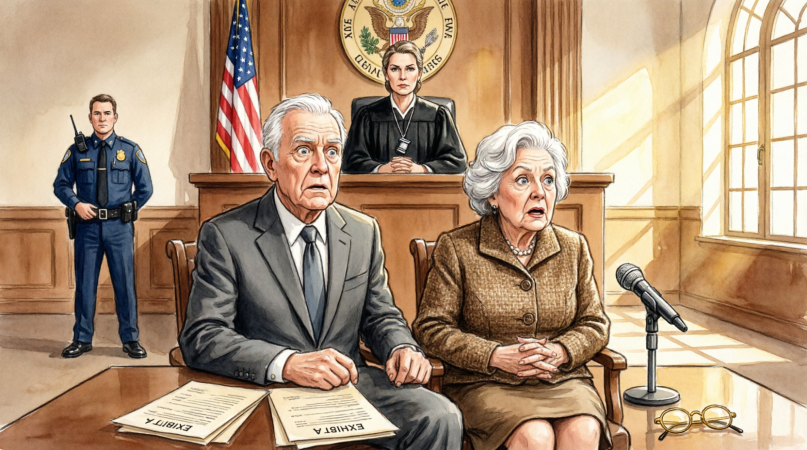
Probate court felt smaller than I imagined. Wooden benches lined the room while fluorescent lights hummed overhead. My parents sat beside their attorney while staring at me with quiet hostility.
The bailiff called the courtroom to order.
“Everyone rise for Judge Teresa Halbrook.”
My parents stiffened slightly as the judge entered. She wore a black robe and carried an expression of firm intelligence.
She studied the file briefly before looking directly at my parents. “Mr. and Mrs. Blake,” she said.
My mother smiled politely. “Yes, Your Honor.”
“I recognize your names,” the judge replied.
My father frowned slightly. “I do not recall meeting you.”
“I remember your family case,” Judge Halbrook said calmly. “It involved the abandonment of your daughter at O’Hare International Airport and the guardianship petition filed by Walter Price.”
The courtroom became silent.
My parents attempted to argue, but the judge continued reviewing documents while Allison Grant presented clear evidence showing Walter’s intentions and mental competence.
Finally Judge Halbrook asked my parents a single question. “Where were you during the twenty years Mr. Price raised Madison Blake?”
My mother hesitated before answering weakly, “We did not know where she lived.”
The judge lifted a page from the file. “Court records show you were notified multiple times.”
My father tried to protest, but Judge Halbrook spoke firmly. “The trust is valid and the lawsuit is dismissed.”
My parents looked stunned.
Outside the courtroom my mother whispered angrily, “You think you won.”
I looked at her calmly. “I did not win,” I said. “I survived because someone chose to stay.”
In the months afterward I paid my student loans and created a small scholarship in Walter Price’s name for children leaving foster care.
The greatest inheritance he left me was not the money.
It was proof that being chosen with patience and intention can completely change a life.