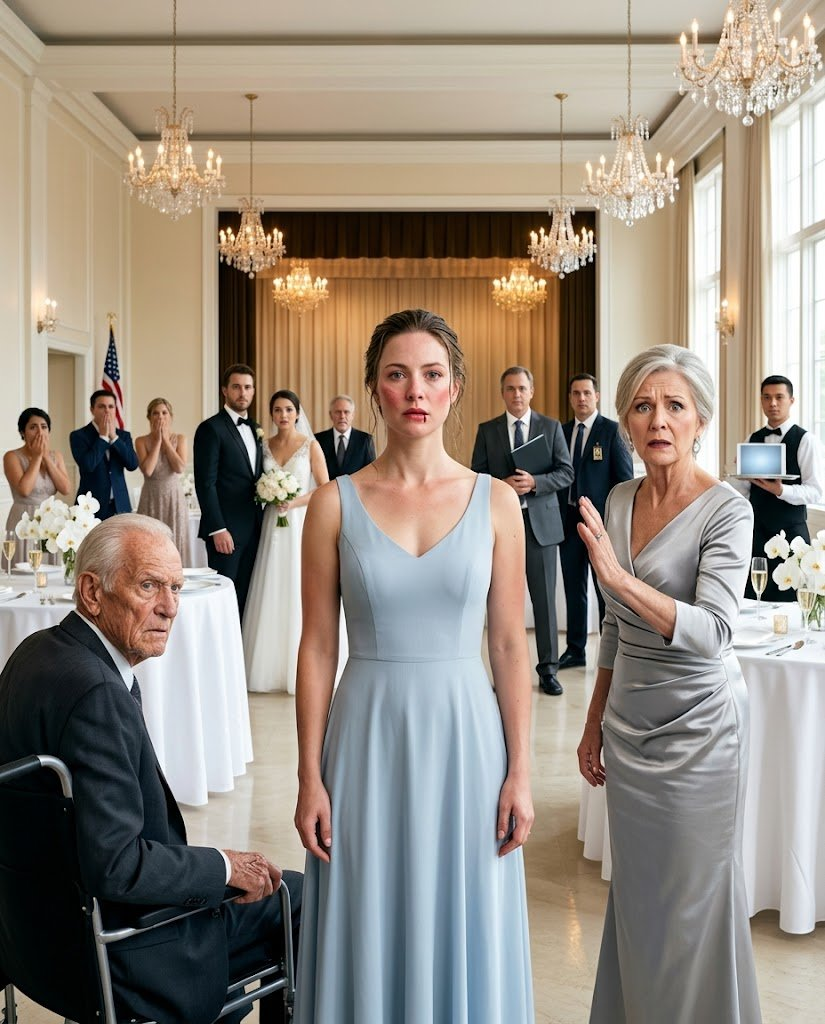
Have you ever stood on a stage while your own mother tried to extort you in front of 300 people? Imagine the grand ballroom of the Fairmont Olympic Hotel in downtown Seattle. The room is a sea of tailored tuxedos and designer gowns.
State senators, tech founders, and the city elite are all sipping imported champagne. It is my younger brother Julian’s wedding day. My mother stands under the crystal chandelier.
She holds a microphone in one hand and a silver digital tablet in the other. She has just called me up to the stage. With a sweet practice smile, she announces to the silent room that I have a special surprise for the bride and groom.
She demands I enter the master biometric passcode to my $3.5 million smart home penthouse. She wants me to sign over my sanctuary as a wedding gift. I lean into the microphone and say no.
Her hand connects with my left cheek. The sharp crack echoes through the ballroom, stopping the jazz orchestra midnote. The silence that follows is heavy.
My cheek burns. My father cowers in his seat at the head table, refusing to make eye contact. The bride, Vanessa, lets out a performative gasp.
My mother expects me to break. She expects me to fold under the crushing weight of public shame and punch my code into that tablet just to make the nightmare end. Instead, I roll my jaw.
I stand tall, look her dead in the eye, and turn my back on her. I walk down the stage steps, past the staring crowd, and push through the heavy doors onto the rainy terrace. The cold Seattle air hits my stinging face.
I pull out my phone, dial a secure number, and say two simple words. It is time. An hour later, the ballroom doors swing open.
A man navigates his mobility chair straight down the center aisle, flanked by a corporate lawyer and a federal investigator. My mother drops her glass. She starts screaming.
The man she told everyone was incapacitated has just arrived to dismantle her empire. To understand the pressure campaign we have to go back two years. I am the director of logistics for a major Pacific Northwest shipping firm.
I paid my own tuition, worked exhausting shifts, and built my life one calculated step at a time. My brother Julian is the family golden boy. He failed out of two boutique tech startups, both bankrolled by our parents, Charles and Beverly.
While I optimized supply chains, Julian spent his 20s taking sabbaticals to discover his passion. The contrast in our treatment was a standard feature of my life. When I earned my director title, my mother sent a brief text with a thumbs up emoji.
When Julian decided to take a year off to clear his head, my parents booked a private room at a Michelin star restaurant to celebrate his journey. I was the reliable scapegoat. Julian was the fragile investment.
The real friction ignited when Julian proposed to Vanessa. Vanessa possessed a taste for high society that far exceeded Julian’s non-existent salary. Less than a week after the engagement, my mother requested a lunch meeting.
She slid a leatherbound binder across the table. It was the wedding budget. Since you are the successful older sister Samantha, she said her tone, leaving no room for debate.
We have allocated the rehearsal dinner to you. It is a small contribution, just $50,000. I did not laugh.
I looked at the binder, then looked at my mother. I told her my income was not a safety net for Julian’s social climbing. I slid the binder back across the table and said, “No.” Her smile stayed fixed, but her eyes hardened into glass.
She told me I would regret being so ungrateful. That single refusal planted the seed for a war that would ultimately burn their entire lives to the ground. Walking out of that lunch was the first time I felt the air leave my lungs.
I got into my car and gripped the steering wheel. Within 10 minutes, my phone started buzzing. It was Julian.
He did not ask how I was doing. He sent a wall of text accusing me of ruining his fiancé’s vision. He said Vanessa was in tears because they had already booked a private yacht club for the rehearsal and the deposit was due.
I replied with a single sentence. I told him he should probably cancel the yacht. The response from my father came an hour later.
Charles Adams was a man who preferred to let my mother handle the dirty work. He sent a passive aggressive email. He wrote that family requires sacrifice and that my selfishness was deeply concerning.
Let me explain how my brain works. In the logistics industry, efficiency is survival. You track every metric.
You measure fuel consumption, transit times, and warehouse capacity. You learn very quickly how to identify a drain on the system. You fix the weak link.
You do not pour more resources into a failing route. My family was a failing route. They operated on the delusion that image was more important than solvency.
For my entire adult life, I watched my parents pour their wealth into Julian’s bottomless pit. Julian’s first startup was an app for artisanal dog food delivery. He blew $200,000 of my parents’ money on branding and office beanbag chairs before securing a single vendor.
His second venture was a digital currency consulting firm that folded when he lost the login credentials to his own digital wallet. Yet in my parents’ eyes, he was an unfortunate genius victimized by bad market timing. I remembered the day I paid off my final student loan.
I had worked 60-hour weeks for four years to clear $80,000 of debt. I bought myself a cheap bottle of wine and called my mother to share the news. She listened for about 10 seconds before interrupting to tell me they were helping Julian secure a loft in South Lake Union.
He needed a creative space to brainstorm his next project. She said the project would change everything. It never launched.
The loft rent was paid by my parents for 3 years. Now Julian was marrying Vanessa. Vanessa was the kind of woman who wore designer clothes to walk her dog.
She viewed wealth not as something you earned, but as a basic atmospheric condition she was entitled to breathe. 2 weeks after the rehearsal dinner, refusal attendance was demanded at my parents house in Bellevue for Sunday dinner. I knew it was a trap, but I went anyway. I needed to observe their strategy.
The dining room table was a masterclass in financial delusion. silver candlesticks, crystal goblets, and a centerpiece of imported orchids. Vanessa sat next to Julian, twirling a two karat diamond ring that I knew my brother could not afford. My mother served the roast with a tight, brittle smile.
The conversation was a calculated performance. Vanessa sighed loudly, talking about how stressed she was. She mentioned that the floral arrangements for the ceremony were going to cost $30,000 because she simply had to have out-of-season white peonies flown in from Europe.
I took a bite of my dinner and asked how they planned to pay for that. The table went silent. Julian shot me a dark look.
He said that mom and dad were liquidating some older stock portfolios to help them out, but it was still tight because certain people were not stepping up. He stared directly at me. I put my fork down.
I told him that adults pay for their own parties. My mother slammed her wine glass onto the table. The dark red liquid splashed onto the white tablecloth.
She pointed a finger at me and raised her voice. She said I had a cold corporate heart. She accused me of hoarding my wealth while my own flesh and blood suffered.
Suffered. They were eating prime rib in a $2 million house complaining about imported flowers. I did not raise my voice.
I looked at the wine stains spreading across the linen. I told my mother that her definition of suffering was insulting. I stood up, thanked them for the meal, and walked toward the door.
My father followed me to the driveway. The Seattle drizzle had started to fall. He grabbed my arm.
It was the first time he had touched me in months. “Samantha,” he said, his voice dropping to a harsh whisper. “You are making a terrible mistake. You have the money. Just write the check and keep the peace.
I pulled my arm away. I told him that buying their affection was a bad investment. As I drove back to my apartment, I realized the rules of engagement had changed.
They were no longer just asking. They felt entitled to my bank account. They viewed my career not as my achievement, but as their backup fund.
I needed someone to talk to who understood the difference between an asset and a liability. There was only one person in the Adams family who spoke that language. Grandfather Theodore.
Theodore Adams was a retired maritime shipping magnate. He built his fortune on the docks of Seattle, turning a single cargo vessel into a fleet. He was sharp, ruthless in negotiations and suffered zero fools.
My father was his only son, a fact Theodore often lamented. Charles had inherited none of the grit and all of the entitlement. Two years ago, Theodore had suffered a mild stroke.
It slowed his physical mobility, confining him to a wheelchair, but his mind remained a steel trap. My parents treated his stroke like a convenient waiting room for their inheritance. They visited him at his assisted living suite, maybe once a month, usually just to complain about their expenses and hint at early distributions from his trust.
I visited him every Sunday morning. We drank black coffee and played chess. We never talked about feelings.
We talked about global supply chains, port tariffs, and market trends. He was the only person who actually respected my mind. The morning after the disastrous Sunday dinner, I drove to his facility.
I found him sitting by the window watching the rain hit the glass. He did not look up when I entered. He just moved his night on the chessboard, resting on his lap.
He asked me why my mother had called him at 6:00 in the morning crying about a yacht club deposit. I sat down across from him. I laid out the entire situation.
The lunch, the binder, the $50,000 demand, the Sunday dinner ambush. I presented the facts logically without tears. Theodore listened.
His eyes narrowed. He looked at the chessboard for a long time. Then he knocked his own king over with his index finger.
He said Charles and Beverly were bleeding him dry. He said, “My father had been asking for trust amendments for months to cover Julian’s lifestyle.” Theodore knew the wedding was going to be a financial slaughterhouse. Then he looked directly into my eyes.
The expression on his face was one I had never seen before. It was a mixture of deep sorrow and cold, calculating wrath. “Samantha,” he said, his voice a low gravel. “They think I am a dying old fool, and they think you are a cash register. It is time to secure the perimeter.
He rolled his chair over to a small mahogany desk in the corner of his room. He pulled out a heavy metal lock box keyed in a code and extracted a thick manila envelope. He dropped it onto the table between us.
He told me that inside that envelope was the deed to the most valuable physical asset he owned outside of his company, a property Charles had been drooling over for a decade. He said he was going to sign it over to me today irrevocably. But there was a catch, a dangerous stipulation that would put a target directly on my back the moment my parents found out.
I slid the documents out of the heavy Manila envelope. The paper was thick, crisp legal stock. I scanned the first page and my eyes locked on the property address.
It was the penthouse at the Pinnacle Tower. This was not just a piece of real estate. It was my grandfather’s masterpiece.
It sat 40 stories above downtown Seattle, offering an unbroken view of Puget Sound and the snowcapped Olympic Mountains. The unit spanned 5,000 square ft of custom architecture. I looked up at Theodore.
He was watching me with a calculated expression. He told me the deed was already recorded. The property was legally in my name.
He then slid a small black secure drive across the table. He said the building was a technological fortress. The private elevator required an encrypted key card.
The front door featured a solid steel locking mechanism governed by a rotating digital passcode and a biometric thumbprint scanner. He had spent half a million dollars retrofitting the security system 3 years ago specifically to keep unauthorized family members out. The code reset every 24 hours without my fingerprint and the matching daily sequence.
Nobody could step foot inside. Theodore leaned back in his wheelchair. He explained the logistics of his decision.
For the last 6 months, he had tracked my parents liquidating stable assets. He noticed glaring discrepancies in the quarterly reports of his own holding companies. Charles had access to certain secondary accounts.
Theodore suspected my father was funneling corporate dividends to pay for Julian’s wedding and his own country club dues. The burn rate was unsustainable. My grandfather knew that the moment his heart stopped, my parents would sell the Pinnacle Tower penthouse to the highest bidder to cover their hidden debts.
By transferring the deed to me while he was still alive and legally competent, he built an impenetrable wall around the asset. I asked him what he wanted me to do. He pointed a rigid finger at me.
He demanded absolute silence. I was not to mention the property to anyone. I was to transition my life there quietly.
Let them think you are still living in your cramped apartment,” he said. “Let them keep underestimating you until the trap is ready to snap.” I nodded. I took the oath. Over the next 3 months, I slowly moved my life into the penthouse.
I treated the relocation like a covert logistics operation. I hired private movers to work the freight elevators at midnight. I kept my old apartment lease active on paper just to maintain the illusion.
Stepping into that penthouse every evening became my ultimate reset. The space was dead silent. The triple-paned glass walls filtered out the sirens and the city noise.
I stood on the heated marble floors, looking out at the ferry boats crossing the dark water. The biometric lock on the front door glowed blue when it recognized my print. It was the first time in my life I felt truly secure.
Meanwhile, the circus outside my walls grew louder. My phone buzzed daily with panicked demands from my mother. Vanessa had decided she needed an imported ice sculpture for the cocktail hour.
Julian needed a custom tuxedo tailored in Italy. My father sent emails complaining about the rising costs of catering. I ignored the demands.
I drank my coffee above the clouds and watched my family spin out of control from a safe distance. I reviewed shipping manifests for my job by day and enjoyed the quiet luxury of my new home by night. The illusion of safety lasted exactly 90 days.
It shattered on a Friday night in November at the annual Pacific Maritime Charity Gala. The event was held at the Seattle Art Museum. It was the one night a year where the old money of Washington gathered to donate checks and trade industry secrets.
I attended out of professional obligation to my shipping firm. I wore a simple black gown and kept to the perimeter of the room. I held a glass of sparkling water and observed the crowd.
My parents were holding court near the center of the main exhibit hall. Beverly wore a diamond necklace that I knew cost more than my first car. She laughed too loud.
She clinked champagne glasses with local politicians. She was playing the role of the wealthy matriarch preparing for the wedding of the decade. I watched my father sweat through his suit collar.
He kept checking his phone every 5 minutes. The financial strain was starting to show on his face, but Beverly refused to drop the act. She thrived on the attention.
I was standing near a modern sculpture when the mistake happened. Richard entered the room. Richard was the managing broker for the most exclusive luxury real estate firm in the Pacific Northwest.
He had handled the original purchase of the penthouse for my grandfather decades ago. He was old, careless, and eager to make conversation. I was close enough to hear the exchange, but too far away to intervene.
Richard kissed my mother’s cheek and complimented her necklace. Then he raised his glass. He told Beverly it was a brilliant strategic move keeping the Pinnacle Tower property in the family.
He said he had seen the recent title transfer in the county records. He congratulated her on gifting such a magnificent asset to Samantha. Beverly froze.
Her champagne flute stopped halfway to her mouth. She stared at Richard with blank, uncomprehending eyes. Richard, oblivious to the bomb he had just detonated, chuckled and walked away to greet another client.
I watched my mother’s posture change. The performative warmth evaporated. Her shoulders stiffened.
The fake smile dropped from her face. She turned her head slowly, scanning the crowded museum floor until her eyes found me standing by the art exhibit. The look she gave me across that room was devoid of maternal affection.
It was the look a predator gives a locked vault. In that single fractured second, she processed the truth. Her father-in-law had bypassed her.
Her husband had lost the crown jewel. The quiet, pragmatic daughter she had spent 30 years treating like an afterthought now held the keys to a $3 million fortress. The secret was out.
Beverly set her champagne glass down on a passing tray. She leaned over to my father and whispered something in his ear. Charles turned pale.
He looked at me and swallowed hard. They did not approach me. They did not make a scene.
They simply turned and walked out of the museum together, leaving their wealthy friends behind. The war had officially moved from the shadows into the light. The engagement party was engineered to resemble a royal coronation.
My parents rented a sprawling waterfront estate in Medina for the occasion. Valets in crisp white jackets rushed to park a fleet of luxury sedans while a string quartet played classical renditions of modern pop songs on the manicured lawn. I arrived exactly 1 hour late.
In logistics, arriving late is a calculated risk, but tonight it was a survival tactic. I wanted the crowd to be sufficiently drunk and distracted. I stepped through the grand foyer.
Waiters circulated with silver trays of caviar and vintage champagne. Vanessa was holding court near the grand staircase. Her background was a fascinating study in social climbing.
Her father made a very respectable fortune in commercial drywall contracting over in Spokane. But Vanessa spent her entire adult life attempting to erase that blue-collar origin. She adopted a Mid-Atlantic accent and treated service staff like invisible furniture.
Julian stood beside her wearing a velvet dinner jacket, nodding along to whatever she said. I kept to the edges of the room, holding a glass of sparkling water. I knew my parents were hunting me.
Ever since the charity gala, they had maintained a terrifying silence. No angry texts, no frantic phone calls, just radio silence. It was the calm before the artillery strike.
The strike came before I could reach the patio. My father materialized at my elbow. His grip on my arm was tight enough to bruise.
He did not say hello. He stared me away from the crowd and pushed me through a set of heavy oak doors into the estate’s private library. My mother was already waiting inside.
She stood by the fireplace holding an unlit cigarette. My father closed the double doors. The heavy wood muffled the string quartet outside.
The air in the room felt thick. Charles Adams bypassed the small talk. He deployed his corporate negotiation voice.
It was a tone he used to intimidate junior executives at the shipping firm. He stood with his hands clasped behind his back and informed me that my grandfather was slipping. He used the word dementia with casual cruelty.
He stated that the recent property transfer was the frantic mistake of a sick mind. According to my father, the pinnacle tower property was always intended to remain within the primary family trust. He demanded I sign a quit claim deed to correct an old man’s cognitive error.
I stood my ground on the Persian rug. I kept my voice perfectly level. I told Charles that Theodore had beaten me at chess 3 days ago.
I mentioned that my grandfather had just recited the third quarter shipping yields from memory down to the decimal point. Theodore was not losing his mind. He was protecting his assets.
My father turned red, his jaw tightened, but before he could escalate, Beverly stepped forward. She played the role of the pragmatic peacemaker. “Samantha,” she said with a soft, venomous sigh. “Be reasonable. You travel for your logistics contracts 3 weeks out of every month.
You live out of suitcases in airport lounges. You do not need 5,000 square ft of empty space.” Julian and Vanessa are planting roots. They are building a brand.
They need a headquarters to host charity boards and establish their status in Washington society. A penthouse in the Pinnacle Tower is the only venue that signals they have arrived. It is wasted on a single woman who works too much.
I looked at my mother. I asked her why Julian could not purchase his own headquarters with the salary from his failed dog food application. The library doors swung open.
Vanessa walked in holding a champagne flute trailing Julian close behind. She had noticed my parents slipping away and followed them sensing drama. She caught the tail end of my refusal.
Vanessa stopped in the center of the room. Her eyes darted from my mother to my father and then locked onto me. She asked what was happening.
Beverly placed a comforting hand on Vanessa’s shoulder. She explained in a gentle victimizing tone that I was being difficult about their wedding gift. She framed the penthouse not as my property, but as a promised family heirloom I was selfishly withholding.
Vanessa’s face crumpled. The theatrical performance began. Tears welled up in her eyes without ruining her makeup.
She dropped her champagne flute onto a side table. She pointed a manicured finger at me and accused me of actively trying to sabotage her future marriage. She sobbed that I was embarrassing her in front of her friends.
She claimed I was ruining the aesthetic of her new life. Julian stepped in front of his bride. He puffed out his chest trying to look intimidating.
My brother had never fought a battle he did not pay someone else to win. He looked at me with pure disgust. “You are just bitter,” he spat. “You are a jealous spinster who cannot stand to see anyone else happy. You want to ruin my wedding because nobody is ever going to throw a party for you.
Keep your stupid concrete box. We do not need your charity. He turned to comfort Vanessa.
I expected my parents to reprimand him. I expected them to tell Julian to lower his voice. Instead, they stood in unified silence.
They endorsed every single word he said. Beverly took one step closer to me. The facade of the loving mother was gone.
Her eyes were flat and cold. She delivered the ultimatum with surgical precision. “You will sign the transfer papers by the end of this month,” she whispered. “If you refuse, you are no longer part of this family. There will be no holiday invitations.
There will be no inheritance. We will erase your name from the trust. You will be a ghost to us, Samantha.” I looked at the four of them standing together.
A desperate father, a greedy mother, an entitled brother, and a weeping bride. They thought the threat of isolation would break me. They thought I feared being alone more than I valued my own independence.
I adjusted the strap of my purse. I looked my mother in the eye. I told her that ghosts do not write checks.
I turned around and walked out of the library. I crossed the grand foyer, ignoring the staring guests, and handed my ticket to the valet. I did not look back.
The drive from Medina back to downtown Seattle took 30 minutes. The rain sllicked highways reflected the city lights. My hands shook slightly on the steering wheel, but it was not from fear.
It was from the adrenaline of finally cutting the cord. I pulled into the secure underground garage of the Pinnacle Tower. The biometric scanner read my thumbprint and the private elevator whisked me up to the 40th floor.
The penthouse was quiet. The heated floors warmed my bare feet as I walked into the kitchen to make a cup of tea. I sat down at the kitchen island and opened my laptop.
Working in corporate logistics trains you to verify everything. You never trust a quiet sector. I logged into the building’s encrypted server to review my residential profile.
The system allowed owners to monitor all incoming visitor requests and access attempts. I opened the daily security log. I scrolled past my own entry times.
Then I saw it. A red flag logged by the ground floor concierge system. Earlier that afternoon, while I was getting dressed for the engagement party, someone had approached the front desk.
They had demanded a replacement key card for the penthouse. They claimed they were the new primary resident and that the system had a glitch. The concierge had denied the request due to a biometric mismatch and flagged the interaction.
I read the name typed into the security incident report, Julian Adams. I stared at the glowing screen. My brother had tried to bypass the front gate while my parents were distracting me at the party.
They were not just asking for the property anymore. They were actively trying to break in. The quiet threats were over.
The siege had officially begun. I woke up the morning after the engagement party and immediately called the Pinnacle Tower security director. I instructed him to permanently flag my brother and my parents in the building system.
If they approached the lobby or the parking garage, security was to escort them off the premises without hesitation. Physical access was now impossible. My mother realized a direct assault on my front door would fail.
She shifted her strategy. If she could not break into my home, she would break my reputation. Washington high society is a very small and very loud room.
Gossip moves faster than freight. Two weeks after the engagement party, I attended the Pacific Northwest Maritime Coalition dinner. This was my professional territory.
I had secured three major shipping routes at this exact event the previous year. I wore a tailored navy suit and walked into the grand ballroom expecting the usual warm reception from my industry peers. Tonight, the atmosphere was chilling.
I approached a table of regional directors I had known for a decade. The conversation stopped the moment I arrived. Smiles were tight and unnatural.
Handshakes were brief. People found immediate excuses to walk away to the bar or check their phones. I stood alone near the ice sculpture, feeling an invisible wall drop around me.
I retreated to a quiet corner near the terrace. A retired port commissioner named Marcus approached me. He had worked with my grandfather in the nineties and always treated me with respect.
He looked at me with genuine pity. He ordered a bourbon and kept his voice low. He told me I had a severe public relations problem.
Marcus explained that Beverly had hosted a high-profile charity luncheon three days ago. She had cried in front of 50 influential women, including the wives of shipping executives and local politicians. She told them her father-in-law was suffering from rapid cognitive decline.
She claimed I had manipulated a sick and vulnerable old man into signing over his last remaining asset while my parents were busy planning a wedding. She painted a picture of a predatory daughter stealing from her own family. I gripped my glass of water.
The narrative was brilliantly toxic. It framed my mother as the overwhelmed, loving matriarch and me as the cold, calculating thief. Beverly knew these people sat on corporate boards.
She knew they controlled the supply chains I managed for a living. She was weaponizing her social network to strangle my career. While my mother played the weeping victim, her spending habits told a very different story.
Vanessa treated her social media accounts like a reality television broadcast. I watched the financial bleed in real time from my phone. Vanessa posted a video from a bespoke bridal atelier in Paris.
She had flown first class to order a custom silk gown that cost more than a luxury vehicle. The next day, Julian announced he had secured a celebrity disc jockey from Las Vegas for the reception. Vanessa uploaded aesthetic photos of imported Italian floral samples, claiming she needed thousands of white orchids to achieve her vision.
They were spending money like lottery winners. I sat at my kitchen island in the penthouse and ran the numbers. My father earned a healthy executive salary, but it could not sustain this terrifying burn rate.
In the logistics industry, you learn how to track public data to anticipate market shifts. I applied the same logic to my parents. I checked county property records and public stock filings.
Over the past month, Charles had quietly sold off a family lakehouse in Chelan. He had also liquidated a substantial block of reliable blue chip stocks. He was burning through his personal reserves at a lethal speed.
My parents were projecting an image of unlimited wealth while secretly pawning their lifeboats. The rumors eventually breached my professional wall. On a Tuesday morning, I sat in a glass boardroom negotiating a contract renewal with an international freight carrier.
The vice president of operations sat across from me. We had maintained a spotless 5-year working relationship. He closed his folder and hesitated.
He looked uncomfortable. He said his board had some reservations about renewing our contract. He mentioned hearing troubling things about my personal integrity.
He used words like elder exploitation and moral character. My blood ran cold. My mother had actually reached my clients.
I looked the vice president in the eye. I did not get defensive or emotional. I stayed factual.
I told him my grandfather Theodore was in perfect health and oversaw his own legal affairs with a sharp mind. I stated that family friction was unfortunate, but it had zero bearing on my logistical efficiency. I opened my laptop and laid out the data.
I showed him how my route optimizations had reduced his transit costs by 12% last quarter. I reminded him that my team had saved his company millions during the port strikes. I forced him to choose between a baseless society rumor and hard measurable profit.
He looked at the numbers and signed the contract. I won the battle, but the warning shot was fired. I drove back to the penthouse feeling a new kind of exhaustion.
My family was no longer just annoying. They were dangerous. They were actively attempting to destroy my livelihood.
Beverly figured if I lost my clients, I would lose my income. If I lost my income, I could not afford the high property taxes and maintenance fees on the penthouse. She was trying to starve me out.
She wanted me to surrender the property just to survive. I poured a cup of coffee and watched the ferry boats cross the dark water of the sound. I realized I needed to warn my grandfather.
If my parents were willing to sabotage my career over a piece of real estate, there was no limit to what they would do to the man who actually authorized the transfer. I drove to his assisted living facility the next morning. The rain was falling hard against the windshield.
I walked down the quiet carpeted hallway to his suite. I turned the handle, but the door was locked. Theodore never locked his door during the day.
A floor nurse walked past carrying a chart. I asked her where my grandfather was. She looked at me with a strained expression.
She informed me that Charles Adams had visited an hour ago, accompanied by a team of lawyers. I stood in the empty hallway as the pieces snapped into a terrifying picture. The smear campaign was not just about punishing me.
It was a calculated legal foundation. By spreading the public rumor that Theodore was suffering from dementia, my father was laying the groundwork for something far worse. The whispers at the charity luncheons were designed to create a documented history of mental decline.
My father was preparing to take control of my grandfather by force. The realization hit me like a physical blow. My father was attempting a legal coup in the state of Washington.
Contesting a deed transfer is a grueling process. But establishing mental incompetence creates a terrifying shortcut. If Charles could convince a judge that Theodore was suffering from advanced dementia, he could secure an emergency conservatorship that would grant my father immediate control over my grandfather’s entire estate, allowing him to void the penthouse transfer and liquidate the asset.
The rumors my mother had spread were the opening arguments in a courtroom battle that had not even started yet. I ran back to my car. The rain was slicking the windshield as I drove to the assisted living facility.
I did not bother with the front desk. I bypassed the nursing station and went straight to Theodore’s suite. He was sitting in his wheelchair by the window, staring out at the gray Seattle sky.
The chessboard was set up on the small table, but the pieces were scattered. I told him about the visit from Charles and the lawyers. I explained the strategy my parents were building.
Theodore did not seem surprised. He looked tired. The formidable maritime magnate who had built an empire from the docks was finally feeling the weight of his own family’s betrayal.
He told me Charles had brought a stack of documents. They were amendments to the primary trust designed to reallocate liquid assets and grant my father unrestricted signatory power. Theodore had refused to sign.
Charles had threatened to bring in a medical evaluator to declare him unfit. I looked at my grandfather. I asked him if he trusted me.
He gave a single sharp nod. I told him we were leaving. Not tomorrow, not next week, today.
In my line of work, rapid extraction is a standard operating procedure. I treated my grandfather like high-v value cargo. I contacted a private medical transport company I frequently used for specialized corporate relocations.
Within 2 hours, a discrete black transport van arrived at the rear loading dock of the facility. We bypassed the main lobby entirely. I packed Theodore’s essential belongings into a single suitcase.
I had already secured a suite at a private rehabilitation center in Northern California. The facility catered to high-net-worth individuals and offered total anonymity. It was located in the redwoods, far away from the toxic reach of Washington high society.
I registered Theodore under a privacy alias utilizing a corporate shell company to handle the billing. By sunset, he was on a private charter flight heading south. The extraction was flawless.
The fallout began the following morning. My phone rang at exactly 8:00. It was my mother.
The facade of the elegant matriarch was completely gone. Her voice was shrill, bordering on hysterical. She demanded to know where her father-in-law was.
She accused me of kidnapping an elderly man. She threatened to call the police and file a missing person’s report. I sat at my desk in my downtown Seattle office, watching the rain streak the glass.
I kept my tone deadpan. I informed Beverly that Theodore had voluntarily relocated to a secure facility to focus on his physical therapy. I told her he had requested complete privacy and that his personal corporate attorneys were now handling all communication regarding his whereabouts.
The line went silent for a long moment. I could hear the panicked breathing on the other end. Beverly realized the proximity advantage was gone.
Without physical access to Theodore, my parents could not coerce him into signing the trust amendments. The conservatorship strategy was effectively neutralized. I hung up the phone and returned to my quarterly shipping projections.
I thought the relocation would buy me some time. I underestimated the sheer desperation fueling my family. 3 days later, the tension shattered the boundaries of my professional life. It was a Thursday afternoon.
I was in the middle of a video conference with a European port authority when my office door burst open. My assistant, a seasoned professional who rarely lost her composure, stood in the doorway looking alarmed. Behind her was Julian.
He pushed past her, ignoring the protest. Julian looked erratic. His designer clothes were rumpled.
He had dark circles under his eyes. He slammed his hands down on my glass desk, shaking the monitors. The European executives on the screen fell silent.
I muted the microphone and asked my assistant to close the door. My brother did not care that he was interrupting a multi-million dollar negotiation. He leaned over the desk, his face flushed with anger.
He demanded to know where our grandfather was hiding. He accused me of destroying his life. I told Julian to lower his voice and leave my office before I called building security.
He ignored the warning. He paced the length of my office, running a hand through his hair. He said Vanessa was threatening to cancel the wedding because the catering vendors were demanding their final deposits.
He said the florist had frozen their account. Then Julian stopped pacing. He looked at me, his eyes wide with a frantic, unhinged energy.
He let slip a sentence that changed the entire trajectory of the war. He said, “If dad doesn’t get granddad to sign those new trust papers, the wedding is ruined. The bank is going to pull the collateral.
Everything is going to collapse.” I stared at him. The air in the office grew heavy. I replayed his words in my mind.
The bank, the collateral. My parents were not just trying to fund a wedding. They were not just trying to secure an inheritance.
Julian’s accidental confession revealed a massive structural flaw in their financial facade. A wedding is a cash expense. It does not require collateral unless the debt is astronomical.
I realized I was missing a crucial puzzle piece. The smear campaigns, the aggressive demands for the penthouse, the frantic attempts to declare Theodore incompetent. It was not greed.
It was survival. My parents were standing on a trapdooror. They were running from a financial catastrophe so large that it required the penthouse to cover the spread.
Julian had just handed me the key to the vault. I needed to find out exactly what kind of shadow loan my father was trying to secure and more importantly what he had already stolen to get this desperate. I sat in my office long after Julian left.
The European executives had disconnected the video call. The room was silent except for the rain hitting the glass. My brother had handed me a thread.
Now I was going to pull it. In supply chain management, you learn that missing inventory always leaves a paper trail. Money operates on the exact same principle.
I walked over to the door and turned the deadbolt. I sat back down at my desk and opened a new encrypted browincer window. I was going to audit my own family.
My father, Charles Adams, held a vice president title at Theodore’s Maritime Shipping Company. It was a ceremonial position. Theodore never trusted Charles with fleet operations or international negotiations.
My grandfather knew his son lacked the grit required to navigate global trade. Instead, Theodore gave him signatory authority over tertiary corporate holding accounts. These were the overflow funds used for localized port fees, minor vendor contracts, and warehouse maintenance.
It was supposed to be a safe sandbox for an incompetent son. I pulled up the public financial filings for the maritime firm. I cross referenced those records with county property taxes and state business registries.
Then I logged into an old vendor payment portal I still had access to from a previous logistics audit I performed for the company. I started matching dates. 3 years ago, Julian launched his dog food delivery application. He needed $200,000 in seed money.
At the time, my parents claimed they remortgaged their home to support his dream. I looked at the corporate ledger from that exact same month. A wire transfer of $215,000 had been authorized by Charles Adams.
The recipient was a newly formed limited liability company listed as a maritime freight consultancy. I ran the address of that consultancy. It led to a virtual mailbox in a strip mall in Bellevue.
The ice in my veins started to freeze. I kept digging. I tracked the timeline of Julian’s digital currency venture.
I matched it against another phantom invoice for dock maintenance. I tracked the month Vanessa demanded the European floral arrangements for the wedding. That same week, my father had authorized a corporate payout for emergency vessel repairs to a company that did not exist.
Charles was not just a terrible money manager. He was a federal criminal. He had spent the last 36 months systematically siphoning corporate holding funds to finance the illusion of a wealthy family.
He was committing interstate wire fraud and corporate embezzlement. I ran the running total on my desktop calculator. The stolen funds exceeded $4 million.
My parents were insolvent. The luxury cars, the designer clothes, the Michelin star dinners were all funded by a stolen credit line that was rapidly running dry. But the theft alone did not explain the sheer panic regarding the upcoming wedding.
It did not explain why Julian was screaming about a bank pulling collateral. I leaned back in my ergonomic chair. I looked at the ceiling and put the pieces together.
The annual corporate audit for the maritime firm was scheduled for the end of the fiscal year. That was less than a month away. The moment the independent auditors opened the books, they would spot the missing $4 million.
The paper trail was sloppy. My father would face immediate termination, federal indictment, and decades in prison. He needed to replace the stolen money before the auditors arrived.
Traditional banks do not loan $4 million to executives with zero liquid assets and failing credit scores. My father had to turn to the shadow market. Private equity groups and private lenders operate outside standard banking regulations.
They approve high-risisk loans in a matter of days. However, they require pristine physical collateral. They needed a flawless asset.
They needed a property with no existing mortgage located in a prime real estate market. They needed the Pinnacle Tower penthouse. My parents did not want my home so Julian and Vanessa could host charity gallas.
That was the palatable lie they sold to their elite social circle. They desperately needed my name off that deed so they could leverage the $3 million property to secure the shadow loan. The loan would cover the embezzled corporate funds just in time to pass the annual audit.
If I kept the penthouse, Charles would go to federal prison and the entire family would face public ruin. Julian’s wedding was the deadline. My parents had likely promised the private lender that the collateral transfer would be finalized by the time the vows were exchanged.
The pressure was suffocating them. I picked up my cell phone. I dialed the direct secure line to the rehabilitation facility in Northern California.
The desk nurse transferred me to Theodore’s private suite. My grandfather answered on the second ring. His voice sounded stronger today.
The clean air and professional care were already working. I did not exchange pleasantries. I told him to sit down.
I walked him through the ledger. I read the dates, the amounts, and the names of the shell companies Charles had created. I explained the phantom vendor invoices and the correlation to Julian’s failed startups.
Finally, I explained the shadow loan and the true motive behind the relentless demand for the penthouse. The line went dead silent. The silence stretched for so long I thought the connection had dropped.
I called his name, he responded. His voice was no longer the low gravel of a tired old man. It was the sharp cutting tone of a fleet commander who had just discovered a mutiny.
There was no yelling. There were no theatrics. The quiet intensity was far more terrifying.
Theodore Adams realized his only son was a parasite. He realized his daughter-in-law was an accomplice to a felony. He realized they had used his own legacy to fund a shallow, pathetic performance.
My grandfather had built his company through 60 years of brutal, honest labor. Charles had looted it to buy imported orchids and custom tuxedos. I asked him what he wanted me to do.
I offered to call the federal authorities myself. I offered to send the compiled ledger to his corporate legal team immediately. Theodore told me to wait.
He said that calling the authorities today would allow Charles and Beverly to scramble. They might try to flee or destroy the remaining financial records before the investigators could secure the servers. He wanted them cornered.
He wanted them to believe they still had a chance to win. He instructed me to attend the wedding rehearsal dinner tomorrow night. He told me to endure whatever threats they leveled at me.
He wanted them to focus all their desperate energy on me so they would not see him coming. Hold the line, Samantha. He said, “Let them dig the hole exactly as deep as they need it to be.
I am contacting my legal team right now. We are preparing the strike.” I asked him if he was sure he wanted to do this. Taking down my parents meant exposing the family name to a monumental public scandal.
It meant sending his own son to a courtroom. My grandfather did not hesitate. He said a diseased branch must be severed to save the tree.
He promised me that a reckoning was arriving. He told me to stay alert and keep my head high. I disconnected the call.
The rain had stopped outside my office window. The Seattle skyline began to light up against the fading evening sky. The fear that had been trailing me for weeks evaporated.
It was replaced by a cold tactical clarity. My family had treated me like a pawn on a chessboard for 30 years. They assumed I would just absorb their abuse and fund their mistakes.
They severely miscalculated. I gathered my notes and locked my computer. I was ready to attend the rehearsal dinner.
I was ready to look my mother in the eye, knowing she was a ghost pretending to be alive. The Columbia Tower Club sits 76 floors above the streets of downtown Seattle. It is a venue designed to project power and exclusivity.
The panoramic windows offer a breathtaking view of the city skyline and the dark expanse of Puget Sound. Ferries glide across the water like glowing toys in the distance. I checked my coat at the front desk and walked into the private dining room reserved for the rehearsal dinner.
The space was draped in imported silk. The tables were set with fine china and crystal glasses. Waiters in pristine uniforms circulated with trays of truffle infused hors d’oeuvres and vintage champagne.
To an outside observer, it looked like a celebration of monumental success. To me, it looked like a highly decorated legal disaster. I attended the dinner for one specific reason.
I needed to gather intelligence. In the logistics sector, you never enter a critical negotiation without observing your opponent’s baseline behavior. You watch for signs of stress, fatigue, and desperation.
The Adams family was broadcasting desperation on every visible frequency. My father stood near the mahogany bar. Charles was on his third double scotch before the first course was even served.
His skin possessed a sickly gray pallor. His hands trembled slightly when he raised his glass. Every time his cell phone buzzed in his pocket, he flinched.
I knew exactly who was messaging him. The private shadow lenders were likely demanding status updates on their collateral. My father looked like a man standing on a trapdoor waiting for the lever to pull.
Julian and Vanessa were holding court on the opposite side of the room. Julian wore a bespoke velvet dinner jacket. He was laughing loudly holding a glass of expensive wine.
He was playing the role of the triumphant entrepreneur who had finally found his equal. Vanessa stood beside him wearing a white designer cocktail dress. She was busy inspecting the floral arrangements and issuing quiet complaints to the catering manager.
She was oblivious to the financial guillotine hanging over her future husband’s family. Her parents stood nearby. Her father was a wealthy commercial drywall contractor from Spokane.
He was loud, boastful, and thrilled to be marrying his daughter into old Seattle maritime money. He had no idea the maritime money was an illusion built on corporate wire fraud. Beverly was the frantic engine keeping the illusion intact.
My mother darted between groups of guests. She touched arms, offered brilliant smiles, and projected the supreme confidence of a wealthy matriarch. But her movements were too sharp.
Her laughter was too loud and fractured. She was running on a toxic mixture of adrenaline and pure terror. She knew the federal audit was looming.
She knew the shadow loan was their only escape route. She knew I was the only obstacle standing in her way. Throughout the cocktail hour, her eyes kept tracking me across the room.
She was calculating her moment to strike. We sat down for a five-course meal. I was assigned a seat at the far end of the secondary family table.
It was a strategic placement designed to isolate me and remind me of my lower status. I did not care. The vantage point allowed me to observe the entire room without engaging in meaningless conversation.
I ate my roasted sea bass in silence. The catering staff brought out silver platters of Wagyu beef. Every bite was funded by stolen money.
Every sip of vintage Bordeaux was a federal felony. They were consuming the evidence of their own destruction. Julian stood up to give a toast.
He tapped a silver spoon against his crystal glass. He spoke about the struggles of the entrepreneurial journey. He claimed his hardships had prepared him for the responsibilities of marriage.
It was a shallow self- congratulatory speech. I watched my father grip the edge of the table while Julian spoke. Charles knew the entrepreneurial journey was funded by his own embezzlement.
The physical toll of the lies was breaking him down in real time. After the third course, I needed a moment of quiet. The synthetic joy and the staggering hypocrisy of the room were becoming suffocating.
I excused myself from the table and walked down the carpeted hallway to the ladies lounge. The powder room was a lavish space. It featured floor-to-ceiling mirrors, marble countertops, and brass fixtures.
Soft ambient music played through hidden speakers. I walked over to the sink and turned on the faucet. I let the cold water run over my wrists.
I closed my eyes and focused on my breathing. The heavy wooden door behind me swung shut. The brass deadbolt clicked into place.
The music seemed to fade into the background. I opened my eyes and looked into the mirror. My mother was standing directly behind me.
The performative smile was gone. The elegant matriarch had vanished. In her place stood a cornered, desperate predator.
Her facial muscles were tight. The skin around her eyes looked strained and bruised under her expensive makeup. She stepped closer to me.
The scent of her floral perfume filled the confined space. She did not yell. Yelling would attract attention.
She spoke in a low, rapid whisper that cut through the quiet hum of the bathroom. She told me the games were officially over. She said my stubborn refusal to cooperate was ending tonight.
She opened her designer clutch and pulled out a thick manila folder. She dropped it onto the marble counter right next to the sink. The sound of the heavy paper hitting the stone echoed in the room.
Beverly tapped the cover of the folder with a manicured fingernail. She delivered her ultimatum with chilling precision. She said, “I had until the cocktail hour at the wedding reception tomorrow night to transfer the Pinnacle Tower property.” She demanded the digital master passcode and a notarized quit claim deed.
She informed me she had a private courier standing by. The courier was instructed to take the documents straight to a shadow registrar to finalize the collateral transfer before the weekend was over. She said Julian needed the asset secured before he walked down the aisle.
I looked at her. I knew Julian had nothing to do with this deadline. The private lender demanded the collateral before they would wire the funds to cover the embezzled accounts.
My mother was running out of hours. I reached over and turned off the faucet. The sudden silence in the room amplified the tension.
I turned around to face her. I asked her a very simple question. I asked her what she planned to do if I said no.
Her eyes narrowed into dark slits. She pointed to the folder on the counter. She told me she had hired a private investigator to compile a comprehensive dossier on my logistics career.
She said the folder contained fabricated but highly convincing evidence that I had been embezzling funds from my corporate clients. She explained the mechanics of her blackmail. She said the fabricated dossier contained fake email chains.
It contained manipulated shipping manifests and forged vendor contracts. She claimed she paid a professional graphic designer to doctor my electronic signature onto illegal documents. She looked me dead in the eye and said she would leak the dossier directly to my board of directors on Monday morning.
The threat hung in the air. I stared at the Manila folder. The psychological projection was breathtaking.
My mother was actively shielding a husband who had stolen $4 million using phantom vendors and fake accounts. Now she was threatening to frame her own daughter for the exact same crime. She was using the blueprint of Charles’s felony to blackmail me.
She thought the symmetry was clever. She did not realize the symmetry was a confession. She assumed that because I built my life on my career, I would surrender my property to protect my name.
She leaned in close, her voice dripping with venom. “You will be unemployable, isolated, and dead to us,” she snarled. Beverly waited for my reaction.
She expected my armor to crack. She expected me to panic, to cry, or to plead for my professional life. She thought the threat of poverty and social ruin would force me to pull out my phone and punch the passcode into her hand right then and there.
She did not understand the person standing in front of her. In my industry, when a competitor attempts a hostile takeover using leverage, you do not negotiate. You recognize their leverage is built on a bluff and you walk away.
I did not argue with her. I did not raise my voice to defend my innocence. Arguing would validate her delusion.
I reached across the counter and pulled a fresh linen towel from the brass basket. I dried my hands methodically. I wiped the moisture from each finger, taking my time.
My mother watched me, her breathing shallow and erratic. She was confused by my silence. I folded the damp towel and placed it gently into the discard tray.
I turned back to her. I looked deep into her frantic, bloodshot eyes. I let her see that I felt no fear.
I let her see that her threats meant nothing to a woman who already knew the truth about her stolen empire. I did not say a single word. I stepped around her, unlocked the heavy wooden door, and walked out into the hallway.
I did not return to the dining room. I did not need to see the rest of the charade. The intelligence gathering phase was over.
I had confirmed their desperation. I walked straight to the coat check and retrieved my trench coat. I stepped into the private elevator and pressed the button for the lobby.
The doors slid shut, sealing away the synthetic laughter and the smell of expensive food. The descent was quiet and smooth. I reached into my pocket and pulled out my cell phone.
I opened my encrypted messaging application. I scrolled down and selected the contact for Theodore’s lead corporate attorney in Northern California. The legal team was waiting for my signal.
I typed a brief, precise message. The trap is set. Be ready tomorrow.
I pressed send. The message delivered instantly. I walked out of the Columbia Tower and stepped into the cool night air.
The final deadline was established. My family wanted a spectacular wedding reception. Tomorrow night, I was going to give them exactly that.
The wedding day dawned with the kind of sharp, clear light that Seattle rarely offers in late November. I woke up in my sanctuary on the 40th floor. The view was pristine.
The Olympic Mountains cut a jagged white line across the horizon. I drank my coffee and watched the city come alive. I did not feel the usual anxiety that accompanies family events.
I felt the hyperfocused calm of a logistical operator executing a final protocol. The board was set. I arrived at the Fairmont Olympic Hotel.
Two hours before the ceremony, the lobby was a symphony of coordinated chaos. Event planners carrying clipboards sprinted across the marble floors, shouting orders into headsets. The sheer volume of white orchids being wheeled through the service doors was staggering.
The floral budget alone could have funded a modest startup. I found Julian and Vanessa in the bridal suite holding court for the wedding photographer. They were the center of gravity in a room full of sycophants.
Vanessa was draped in custom silk, adjusting a diamond necklace while makeup artists hovered around her with brushes. Julian wore his tailored tuxedo posing with a glass of champagne. They were blissfully unaware of the tectonic plates shifting beneath their feet.
They believed the wealth surrounding them was a permanent birthright. They treated the day like a royal coronation, demanding perfection from the staff and complaining about minor delays. I stood near the doorway observing the performance.
Julian caught my eye. He gave me a smug, self-satisfied smirk. He thought he had won.
He assumed the threat our mother delivered the previous night had broken my resolve. He believed that by the end of the evening, he would be sleeping in my penthouse. I did not glare at him.
I simply offered a polite, flat smile and walked away. The ceremony was a masterclass in superficial opulence. 300 guests filed into the Grand Ballroom. The guest list was a who is who of Washington elite.
State senators, tech executives, and wealthy contractors took their seats on velvet chairs. A 20piece string ensemble played the processional. I sat in the third row, watching my parents navigate the aisle.
This was where the facade began to crumble. Charles walked down the aisle with a stiff, unnatural gait. His face was slick with sweat despite the climate controlled air.
His custom tuxedo looked slightly too large for his shrinking frame. He kept his right hand buried in his pocket, clutching his phone like a lifeline. He was waiting for the shadow lender to confirm the collateral transfer.
Beverly followed him, projecting the image of the triumphant matriarch. But her energy was frantic. Her eyes darted around the room, assessing the crowd, measuring the status of the guests.
She was calculating the exact amount of social capital she had assembled in the room. She needed a massive audience for her final maneuver. The vows were exchanged.
The rings were placed. The crowd cheered. I watched the spectacle with a rising sense of nausea.
I knew the $500 plates of imported Wagyu beef were financed by wire fraud. I knew the vintage champagne flowing freely from the open bar was paid for with stolen corporate funds. They were forcing their wealthy friends to unknowingly participate in the celebration of a federal crime.
The transition from the ceremony to the reception was seamless. The grand ballroom was flipped while the guests attended a lavish cocktail hour on the terrace. I kept my distance from the family blending into the background.
I spoke briefly with a few shipping executives, maintaining my professional network. I needed my peers to see me calm, rational, and completely unbothered. When the doors to the grand ballroom opened for the reception, the scale of the extravagance took the crowd’s breath away.
The tables were adorned with towering crystal centerpieces and thousands of white peonies. The lighting was tuned to a soft golden glow. The Las Vegas celebrity disc jockey was already setting up his equipment on a raised platform.
I checked the seating chart. My mother had executed her final psychological tactic. I was not seated at the main family table near the dance floor.
I was relegated to table 42 located in the far back corner of the room near the kitchen service doors. I was seated with distant cousins and business associates. Vanessa felt obligated to invite but did not care to engage.
It was a deliberate public demotion. I found my seat and smoothed the fabric of my dress. The isolation suited my strategy perfectly.
It gave me a clear, unobstructed view of the stage and the head table without being trapped in the crossfire. The dinner service began. The orchestra played soft jazz while a synchronized army of waiters delivered the plated courses.
I watched my parents at the head table. The tension radiating from Charles was palpable. He barely touched his food.
He drank his wine in rapid nervous gulps. His eyes kept darting to the entrance of the ballroom, checking for the private courier Beverly promised to deploy. Beverly, however, was operating on a different frequency.
She was drinking heavily, but the alcohol did not relax her. It amplified her manic energy. She was laughing loudly, engaging in animated conversations with the state senator seated next to her.
But beneath the laughter, I could see the cold calculation. She was checking the time on her diamond watch every 10 minutes. The deadline she had issued in the powder room was rapidly approaching.
The dinner plates were cleared. The ambient noise in the ballroom swelled as 300 guests leaned back in their chairs, finishing their wine. The waiters began pouring champagne for the toasts.
The orchestra smoothly faded out. The sudden silence in the massive room was jarring. The spotlight shifted from the dance floor to the main stage.
My mother stood up from the headt. She smoothed the skirt of her gown and picked up a wireless microphone. The room fell completely quiet.
All eyes turned to the mother of the groom. I sat back in my chair at table 42. The ambient chatter ceased.
The clinking of silverware stopped. I felt the collective weight of 300 influential people pressing into the silent space. Beverly walked to the center of the stage.
The spotlight illuminated her perfect hair and her diamond necklace. She tapped the microphone, ensuring the audio was live. I looked across the vast ballroom, staring directly at the stage.
My pulse remained steady. I knew the explosion was only seconds away. The trap was fully loaded.
Beverly stood in the center of the stage holding the wireless microphone. The harsh glare of the spotlight caught the facets of her diamond necklace. She possessed an uncanny ability to command a room.
She began her speech with a practiced elegance. Her voice was smooth and melodic, bouncing off the acoustic panels of the grand ballroom. She thanked the guests for attending.
She acknowledged the prominent politicians and the wealthy contractors seated in the front rows. She spoke about the enduring strength of the Adams family legacy. She turned her attention to Julian and Vanessa.
She praised my brother, calling him a brilliant entrepreneur with a boundless future. She welcomed Vanessa into the fold, complimenting her grace and her impeccable taste. The bride beamed from her seat at the head table, dabbing the corners of her eyes with a silk napkin.
Julian raised his glass in a silent salute to his mother. The crowd responded with warm, polite laughter. It was a flawless performance of high society warmth.
Then the tone of the speech shifted. The transition was so smooth, the audience did not even notice the pivot. Beverly lowered the microphone slightly, resting her free hand on her chest.
She adopted a more intimate, reflective posture. She spoke about the values we were supposedly taught as children. She talked about the sacred bond between siblings.
She told a fabricated story about how Julian and I used to share everything growing up. She painted a picture of a devoted older sister who always looked out for her younger brother. The crowd listened with rapt attention.
They loved a sentimental narrative. I sat at table 42 watching her pace the stage. I recognized the strategy.
In corporate negotiations, you soften the target with public praise before delivering a binding term. Beverly was building a rhetorical cage. Her eyes scanned the vast room.
She looked past the crystal centerpieces. She looked past the waitstaff lined up against the walls. Her gaze locked onto the back corner of the ballroom.
She found me. She raised the microphone back to her lips. She announced that tonight the Adams family was going to demonstrate that legacy of generosity.
She called my name. Her voice echoed through the speakers, inviting me to join her up under the lights. The string orchestra played a soft, uplifting chord. 300 pairs of eyes shifted from the stage to the back of the room.
The faces of the guests turned toward table 42. The spotlight operators swept a beam of bright white light across the ceiling, bringing it down to rest directly on my chair. The social mechanics of the trap were brilliant.
Beverly knew I despised public scenes. She knew that refusing to stand up in front of the city elite would make me look unstable and jealous. If I stayed in my seat, the narrative of the bitter spinster sister would be permanently cemented in the minds of my industry peers………
Click Here to continuous Read Full Ending Story👉:(PART2END)At my wedding, my parents demanded the passcode to my $3.5 million penthouse in front of 300 guests. When I refused, my mother slapped me — so I stepped outside and made one phone call that silenced the entire ballroom