Hours later, my mother texted, “Transfer it to her or don’t bother coming home.” By midnight, I had forty-three missed calls and one voicemail from my father that changed the way I heard every family story I’d ever been told.
The first call came on a Tuesday afternoon while I was finishing work in my apartment in Chicago.
Outside my window, the skyline was glowing gold in the last light of day.
Inside, I had three tabs open, two deadlines hovering, and the kind of exhaustion that makes you promise yourself you’ll close the laptop after one more task.
Then my phone lit up with my mother’s name, and that familiar knot pulled tight in my stomach.
My mother never called to ask how I was.
She called to assign a role.
When I answered, she skipped hello and went straight to business.
“Your grandmother left you everything in her will,” she said.
“The house.
The accounts.
All of it.
Your father and I think you should split it with Olivia.
It’s only fair.”
Fair.
In my family, that word always meant my sister wanted something.
I told her, as calmly as I could, that Grandma Ruth had made her own choices.
If she wanted Olivia to receive part of the estate,
she would have written Olivia into the will.
My mother turned icy in seconds.
“I can’t believe how selfish you’ve become,” she said.
“Olivia has two children.
You’re single.
No responsibilities.
What do you even need that money for?”
I should say that by the time I was thirty-four, none of this was new.
My older sister, Olivia, had been the center of gravity in our family for as long as I could remember.
She wanted.
Everyone provided.
She cried.
Everyone rearranged themselves around her feelings.
If she succeeded, it was proof of her star quality.
If she struggled, it was proof she needed more support.
If I succeeded, it was because I was “independent.” If I struggled, it was because I was “cold” or “too proud to ask for help.”
Growing up, Olivia got cheer camps and competition uniforms.
I got told there were books at the library if I was serious about art.
Olivia’s college was paid for.
Mine came with loans I carried for years.
My mother once thanked Olivia for being “so generous” about giving me old clothes.
I was thirteen, standing in a pair of jeans too loose in the waist and too short in the ankles, and everyone acted like I’d been gifted treasure.
So when my mother told me I should hand over half of what my grandmother had left me, I heard all the old machinery turning back on.
After the call, Olivia texted exactly what I expected.
Not grief.
Not memory.
Not love.
A carefully warm message about how expensive preschool was and how the kids needed winter coats and how we should meet for coffee to “talk about how to handle everything.”
I deleted it and pulled up the email from Lawrence Whitfield, my grandmother’s attorney.
I had barely absorbed it when it first came after the funeral.
Reading it again, I realized the estate was substantial.
The Stillwater house
was worth around four hundred thousand.
The investment accounts held roughly six hundred thousand.
There were smaller assets too, and one specific charitable gift of twenty thousand dollars to the animal shelter where Grandma had volunteered for years.
Everything else came to me.
Not because of a typo.
Not because she forgot anyone.
Grandma Ruth had been the least accidental person I’d ever known.
I booked a flight to Minnesota for Friday evening and arranged to meet Whitfield at the house Saturday morning.
Then the pressure escalated.
That same night, my mother texted, “Transfer half to your sister before the weekend or don’t bother coming home.” Olivia called twice.
My father called once, then left a voicemail so angry it made my skin go cold.
He said Grandma would be ashamed of me, that family came first, that I’d always been jealous of Olivia.
Then he said, low and sharp, “You think you can come here and walk into that house after what you’re doing? Try it.
See how that goes.”
I forwarded the voicemail to Whitfield the next morning.
He replied almost immediately.
Do not meet them alone at the property.
I will be present when you arrive.
There is something your grandmother instructed me to give you privately before anyone else enters the house.
Then another email followed.
Your grandmother anticipated conflict.
That sentence sat with me all day.
She anticipated conflict.
Not hoped.
Not feared.
Anticipated.
Friday night, I flew into Minneapolis, rented a car, and drove east toward Stillwater under a low gray sky.
Every mile back toward Minnesota brought old feelings with it.
That shrinking sense of being reduced to who I used to be.
The daughter who should keep the peace.
The sister who should give more because asking less had become her identity.
By the time I checked into a hotel, my mother had sent three more messages.
Olivia sent a photo of her kids in matching pajamas with no caption, as if their existence alone should settle the argument.
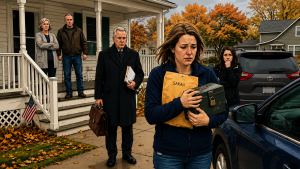
Saturday morning, I drove to my grandmother’s house with my pulse beating hard in my throat.
There were already three cars in the driveway.
My father’s truck.
My mother’s sedan.
Olivia’s minivan.
And on the porch stood Lawrence Whitfield, one hand holding a leather case, his expression so grave it made me stop before I reached the steps.
Before anyone could speak, he said, “Your grandmother asked me to play you something she recorded the week before she died.
You are to hear it first.”
My mother objected instantly.
Olivia laughed in that brittle way people do when they’re trying not to panic.
My father said the house belonged to the family.
Whitfield corrected him in a tone so dry it sounded like paper.
“No, Mr.
Bennett.
As of the filed probate documents, the property belongs to Amelia.”
Then he handed me two things.
A sealed envelope with my name on it in Grandma Ruth’s handwriting.
And a small locked metal box.
I saw Olivia’s face change when she looked at the box.
It was quick, but unmistakable.
Fear flashed there and vanished.
Whitfield led me inside while my family argued on the porch.
The house smelled exactly the way I remembered: tea, cedar, lemon polish, and the faint sweetness of old books.
My chest tightened so fast I had to stop in the entryway.
Grief had a way of hiding until it found a room it recognized.
We went into the study.
Whitfield shut the door, set a small recorder on the desk, and nodded toward the envelope.
My hands shook as I opened it.
Inside was a single page.
Amelia,
If you are reading this before hearing my recording, then events unfolded exactly as I expected.
I am sorry for the pain that means has already begun.
I left my estate to you because you are the only person in this family I trust to tell the truth, even when the truth costs you comfort.
You have also been asked to carry a burden I should have forced into the light myself while I was still alive.
The key to the box is taped beneath the third drawer in my bedroom dresser.
Do not open it until after you hear me speak.
Whatever they say, remember this: love does not demand that you surrender what was given to you in honesty.
Grandma.
By the time I looked up, my vision had blurred.
Whitfield pressed play.
My grandmother’s voice filled the room.
Frailer than I remembered, but unmistakably hers.
“If Amelia is hearing this first,” she said, “then Olivia, Ellen, and Robert have done exactly what I knew they would do.”
I closed my eyes.
She went on slowly, pausing for breath.
She said she had changed her will two years earlier after discovering that money had been disappearing from one of her accounts.
At first she assumed it was a banking mistake.
Then she noticed small withdrawals, then larger ones, all timed around visits from Olivia.
When she confronted her privately, Olivia admitted she had taken Grandma’s debit card from her purse, used it for groceries, then bills, then daycare, then credit cards.
She cried.
She apologized.
She promised it was temporary.
Grandma said she didn’t report it because she was ashamed and because Olivia begged her not to “destroy the family.” Instead, she demanded repayment and told Olivia never to touch her finances again.
Then Grandma’s voice hardened.
“But she did it again,” she said.
“Not with my card.
With pressure.
With tears.
With her mother translating theft into need and her father calling it help.
They all wanted me to smooth it over.
To call it family.
I refused.”
I opened my eyes and stared at the recorder like it had become a living thing.
Whitfield’s face remained professionally still, but he wasn’t surprised.
He had heard this before.
Grandma continued.
She said she had watched the same pattern for years: Olivia wanting, my parents excusing, me being expected to accept less because I would “be fine.” She said she left the estate to me not to reward me for being alone, but because I had built a life without feeding on anyone else’s.
She said if my parents tried to shame me into giving it away, I was not to mistake manipulation for morality.
At the very end, her voice softened.
“Amelia, if you choose to help your sister someday, let it be because you freely wish to, not because anyone has convinced you that your life matters less.
And if they deny what I say here, the………………………………..