“Maybe the planner knows more. Maybe hotel staff saw something. Maybe there’s paperwork in that library suite before they lock it down.”
“Break into a business room at my son’s wedding?” I asked.
Emily gave me a tight smile.
“I know. Very classy family activity.”
In spite of the fear sitting like a stone in my chest, a short laugh escaped me. It felt strange and good.
Then the laugh died, because footsteps were coming down the hall.
A man in a dark gray suit turned the corner. Tall, broad shoulders, earpiece curled behind one ear.
Security.
He stopped when he saw us.
“Mrs. Harper.”
There was something about hearing my name from a stranger that made every nerve wake up.
“Yes?”
He gave a polite nod.
“Mr. Harper asked that I escort you back to your suite.”
Emily stepped forward at once.
“She’s fine where she is.”
The man kept his eyes on me.
“Ma’am, there have been concerns about stress today. He thought you might appreciate privacy before the ceremony.”
Stress. Privacy. Every word came dressed in silk and meant handcuffs.
“I’m not going to my room,” I said.
His face stayed polite.
“Then perhaps the lounge.”
“No.”
A small pause.
Then he said the line I think I will remember for the rest of my life.
“Ma’am, I’d hate for this to become uncomfortable.”
Something inside me went very still. I had spent years being the woman who softened rooms, who made things easier, who swallowed pain to protect peace.
I was done.
I lifted my chin and spoke clearly enough for anyone nearby to hear.
“The uncomfortable part already happened when my son canceled my hotel room, threatened me, and now appears to be using hotel security to contain me.”
The guard blinked. Emily folded her arms. A housekeeping worker passing with towels slowed down. Two servers farther down the corridor turned their heads.
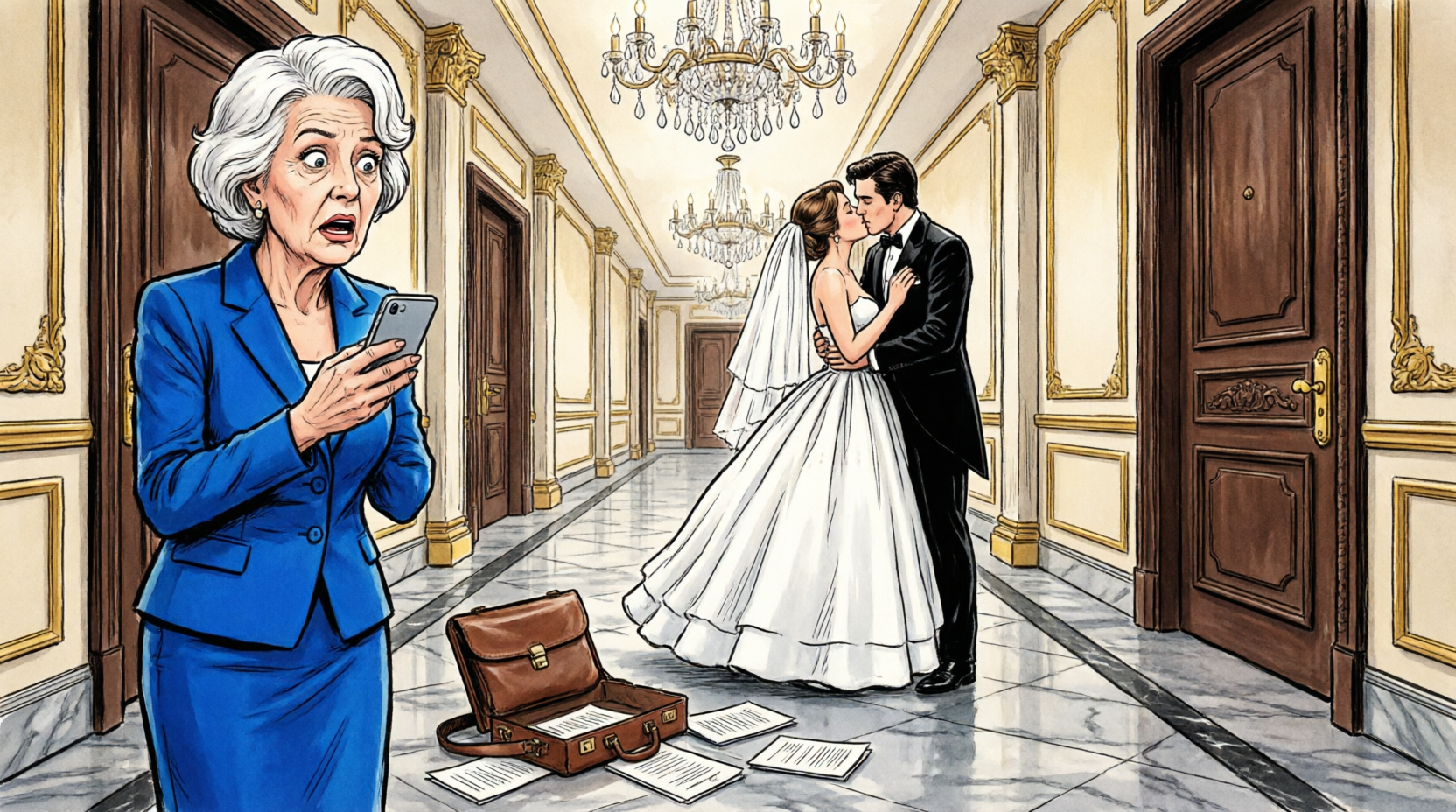
Good, I thought.
Let witnesses grow.
The guard lowered his voice.
“Mrs. Harper, I’m not here to argue.”
“Then don’t.”
For the first time, he looked unsure. He stepped back half a pace.
“I’ll inform Mr. Harper that you declined assistance.”
“Please do,” I said.
He walked away stiffly, and only after he turned the corner did I let out the breath I was holding.
Emily touched my arm.
“That was perfect.”
“I feel sick.”
“That’s okay,” she said. “You were still perfect.”
We went upstairs to the presidential suite and locked the door. I needed ten quiet minutes just to steady my hands. Emily poured me water and made me sit near the window while she paced.
Then she stopped in front of me.
“I have an idea.”
“That sentence usually ends badly.”
“Only at first.”
She crouched down so we were eye level.
“You need to speak to Richard. Not in public. Not yet. Quietly, before the ceremony if possible.”
“Brian said—”
“I know what Brian said. That’s exactly why you have to. But not alone and not without proof.”
I pressed my fingers to my temple.
“We still don’t have enough.”
“Maybe we do.”
She pointed to my phone.
“Threat texts, reservation report, emails, handwritten notes. If we can add one more thing—something tying the wedding to an investment signing—that could be enough to make Richard stop and listen.”
I thought of the library suite. Emily must have seen it in my face.
“Yes,” she said. “That room.”
I stood up slowly.
At 11:30, the hotel shifted into full wedding mode. Music checks, floral deliveries, guests changing clothes, hallways filling and emptying in waves. In that confusion, two women walking with purpose did not draw much attention.
Emily borrowed a black folder from the suite desk so we would look official. I carried my purse and kept my face calm.
My heart was anything but calm.
The fourth floor was quieter than the lower levels. The private business rooms sat along one side of a carpeted corridor with frosted glass doors and brass numbers.
Library suite.
The door was shut. Emily tried the handle.
Unlocked.
We looked at each other.
Then we went in.
The room smelled like leather and lemon polish. Shelves lined the walls, though most were filled with decorative books no one had ever read. A long conference table stood in the center. At one end sat bottled water, folders, and pens arranged with careful precision.
This was no wedding lounge.
This was a boardroom wearing a prettier face.
Emily moved quickly, checking the folders, schedules, seating charts, investor bios.
“Wait.”
My pulse jumped.
“What?”
She handed me a paper. At the top, in clean black letters, were the words:
“Preliminary Partnership Ceremony.”
Below that:
“Feymont Urban Holdings.”
“Harper Living Developments.”
And below that:
“To be executed following marriage solemnization.”
Marriage solemnization.
I read the page twice. Then a third line made my throat tighten.
“Public positioning notes: emphasize family resilience narrative. Avoid mention of financial instability, prior failed ventures, and unresolved personal liabilities.”
Unresolved personal liabilities.
I looked up at Emily.
She whispered, “That means debts.”
They were plain as daylight.
Not just a wedding. A merger. A performance. A deal designed to become more powerful because the marriage happened first.
My fingers trembled as I turned the next page. It was a short summary of Brian’s proposed company: luxury residential redevelopment, boutique buildings, city expansion, high-end branding, big ideas, bigger promises.
And next to the numbers was Richard Feymont’s preliminary commitment.
Eight million dollars.
I sat down before my knees gave out.
Eight million.
My son was willing to erase me, lie about me, and destroy my name for eight million dollars.
Emily kept flipping pages. Then she stopped so suddenly that the folder nearly slipped from her hands.
“Oh, Aunt Linda.”
“What now?”
She turned the page toward me.
“Appendix C. Family capital representation.”
Attached was a copy of my late husband’s estate papers—the same ones Brian had asked me for months ago. Only someone had highlighted sections in a way that made the estate look far larger than it had ever truly been.
Assets were listed without the debts beside them. The old house value was shown without the mortgage payoff. Temporary holdings from years ago were presented like ongoing family backing.
Not exactly forged.
But arranged to deceive.
I felt my stomach twist.
“He used your papers,” Emily said softly. “He used your life.”
I could not speak, because suddenly I saw it all. Brian had not only hidden me because I was embarrassing.
He had used pieces of my history to make himself look stronger, wealthier, steadier than he was. He had taken the years I spent surviving and polished them into a fake legacy for investors.
A sound in the hallway made us both freeze.
Voices. Male voices coming closer.
Emily hissed, “Put everything back.”
We moved fast, sliding the pages into order just as the door handle turned. There was no time to reach the far side of the room.
So we ducked behind the tall divider screen near the window, pressing ourselves into the narrow gap behind it.
The door opened.
Footsteps entered.
I knew Brian’s shoes from the sound alone. Silly, maybe, but a mother knows.
Another set followed. Richard Feymont. And a third—the lawyer-looking man from brunch.
My heart hammered so hard I was sure they would hear it.
Brian spoke first, his voice low and controlled.
“We should sign right after the ceremony, before anyone starts drifting off.”
Richard sounded calm.
“I said I would if everything remains clean.”
The lawyer rustled papers.
“There is one concern left.”
Silence.
Then Brian said, “My mother.”
My hand flew to my mouth.
Richard sighed.
“Khloe says she’s fragile.”
“Fragile?” Brian answered without hesitation. “She gets emotional and confused under pressure. She can be unpredictable. That’s why I tried to keep her comfortable upstairs.”
I closed my eyes.
He was doing it. Saying it aloud. Building the lie with a straight face.
The lawyer asked, “Medical history?”
“No diagnosis,” Brian said quickly. “But enough family concern that we manage around it.”
“Family concerned?”
I nearly bit my hand to keep from making a sound.
Richard spoke again, slower this time.
“If there’s risk of disruption, I don’t want it near this deal.”
“There won’t be,” Brian said. “If she says anything odd, please understand it comes from grief and age, not fact.”
Grief and age.
Every sentence landed like a slap. And yet beneath the pain, something stronger rose. Because now I knew.
Not guessed. Not feared.
Knew.
Then Richard said the one thing Brian clearly did not expect.
“I’d still prefer to speak with her myself at some point.”
The silence that followed was sharp.
Brian recovered quickly.
“That won’t be useful.”
Richard’s voice cooled.
“I decide what is useful.”
A beat passed.
Then Brian said too fast, “Of course. Later, perhaps. After the signing.”
After the signing.
Keep the truth quiet until the money is committed.
The lawyer cleared his throat.
“There is also the matter of the personal liability note.”
Brian answered, “Handled.”
Richard said, “Explain.”
“Handled.”
And then, for the first time since entering the room, Brian’s voice cracked just a little.
“My mother co-signed one old obligation years ago. It’s small. It won’t touch the business.”
I felt the blood drain from my face.
Co-signed?
What obligation?
Emily turned toward me with wide eyes. I shook my head slightly.
I had no idea.
Richard sounded displeased.
“I was told there were no family-linked liabilities.”
“It’s practically nothing,” Brian said. “A technical remainder from an old property transition.”
That was not how Brian talked when he was telling the truth. That was how he talked when he was stacking fancy words over a hole.
The lawyer said, “And if your mother mentions it?”
Brian answered in a quiet, hard voice I barely recognized.
“She won’t.”
A cold silence fell over the room after that. Then chairs moved, papers gathered, footsteps headed back toward the door.
“Ceremony in ninety minutes,” Richard said. “If one more surprise appears, I walk.”
The door opened. Closed. Gone.
Emily and I stayed frozen behind that screen for what felt like forever. Only when the corridor outside was silent again did I let my hand fall from my mouth.
I was shaking all over.
Emily came around the screen first and grabbed the edge of the table to steady herself.
“Did you know anything about a co-signed obligation?”
“No.”
“You’re sure?”
“Yes.”
My voice came out thin and stunned, because a memory was moving through me now. Slow, ugly, unwelcome.
About a year and a half ago, Brian had come to my house late at night with a folder and tired eyes. He said he needed one quick signature to help close a bridge loan on a development lease. He said it was temporary. He said the main documents had already been handled and this was just supporting paperwork.
He rushed me through it because he claimed a deadline was closing.
I had signed.
I did not even read every page.
He was my son.
I sat down hard in one of the library chairs.
“Oh my God,” I whispered. “He used me.”
Emily knelt in front of me.
“What did you sign?”
“I don’t know. Something tied to one of his early business loans. He said it was small. Temporary.”
“Aunt Linda,” she said very gently, “he may have put debt in your name.”
The room blurred for a second.
My son had not only lied about me, not only hidden me, not only prepared to call me unstable. He had used my signature, my husband’s estate, my life, and maybe even my credit to build a fake foundation under himself.
My chest tightened, not with tears this time, but with rage so clean it almost felt calm.
Emily stood.
“We need copies of these pages.”
“How?”
She held up her phone.
Of course.
We photographed everything. The partnership summary, the family capital page, the positioning notes, the page mentioning personal liabilities, every line, every signature block.
When we were done, I sat for one more second, staring at the polished table where my son had just tried to bargain away my truth.
Then my phone buzzed.
A new text from the unknown number.
“He knows you’re asking questions. Check your bank app now.”
My fingers turned cold. I opened the app. At first, I did not understand what I was seeing.
Then I did.
A frozen notice. A pending claim. A flagged obligation tied to a property-related default.
And next to it, under guarantor information, was my name.
For a second, I could not breathe. My own name sat there on my bank screen under a frozen notice tied to a property default I had never heard of.
My account was not empty, but part of it was locked pending review. There was a claim attached to a loan guarantee, and that guarantee carried my signature.
I stared at the screen until the words stopped shaking.
“Guarantor: Linda Harper. Default status: active review.”
My hand began to tremble so badly I had to grip the edge of the table. Emily took the phone gently from me and read it herself.
“He did it,” she whispered. “He really did it.”
I looked up at her, and something in me went still.
Not broken.
Still.
Because now the whole picture was clear. Brian had lied to Khloe’s father about his background. He had used my late husband’s estate papers to make it look like there was deeper family money than there really was. He had hidden me because I knew the truth. He had planned to paint me as confused if I spoke.
And worst of all, he had used my signature to tie me to one of his failed property loans, then kept it secret while he chased a new eight-million-dollar deal through this wedding.
He had not only betrayed me.
He had built his future on my back and hoped I would smile while he did it.
Emily looked at me carefully.
“What do you want to do?”
I stood up slowly.
“I want the truth told by the people who tried hardest to bury it.”
She nodded once.
“Then we do this clean.”
The ceremony was set for one o’clock in the hotel garden ballroom, a glass-walled room overlooking terraces full of white roses and trimmed hedges. By 12:30, guests were arriving in a soft hum of silk, perfume, polished shoes, and low voices.
The string quartet had started. Ushers were guiding people into rows. And at the center of all that beauty sat a lie.
Emily and I did not rush in.
We prepared.
First, we went to Marcus at the front desk. His face changed the moment he saw me.
“Ms. Harper.”
“I need a printed copy of the cancellation record and the timing log,” I said. “And I need your full name in case someone asks who confirmed it.”
He hesitated only a second, then nodded.
“Yes, ma’am.”
Second, Emily found the young waitress from earlier near the service hall. Her name was Tessa. She was twenty-one, in college, and working weddings on weekends.
She was the one who had left the second note.
At first, she was frightened. She kept glancing over her shoulder.
“I’m not trying to make trouble,” she whispered. “I just heard too much last night. The bride and groom were talking in one of the lounge corners after they canceled your room. Then one of the planners cried in the staff corridor because she said this wedding felt wrong. I knew you were being set up.”
“Did you hear about the deal?” Emily asked.
Tessa nodded.
“Some of it. Enough to know the marriage and the signing were being treated like the same event. And enough to know they were scared of the groom’s mother talking.”
“Would you say that if needed?” I asked.
She swallowed hard.
“If I have to.”
Third, I called my bank.
That was the hardest part, because hearing a stranger calmly explain the claim made everything feel horribly real. The woman on the phone confirmed that my signature had been attached to a guarantee on a development-related obligation.
She could not discuss every detail without a formal review, but she could confirm there was an active default issue linked to my name.
“Can you email a written summary of the current status?” I asked.
“Yes, Mrs. Harper,” she said.
When the email came through, I stared at it for a long second.
There it was. Proof. My name. My risk. My son’s hidden mess.
By then, the ceremony music had changed. Guests were being seated.
Emily touched my arm.
“It’s time.”
I walked into that ballroom feeling strangely calm. The giant flower arch at the front glowed white under the afternoon light. Every chair was full.
Brian stood at the altar in a black tuxedo, hands clasped, face set in that polished smile he used when he wanted the world to admire him.
Khloe had not come down the aisle yet.
Good, I thought.
Then we were still in time.
I saw Richard Feymont in the front row with the lawyer beside him and the black briefcase on the floor by their feet. I did not go to my assigned seat.
I walked straight down the side aisle.
At first, only a few heads turned. Then more. Then almost everyone.
Brian saw me and froze. Even from that distance, I watched the blood leave his face.
He stepped away from the altar.
“Mom,” he said tightly, trying to keep the smile on for the guests. “What are you doing?”
I kept walking until I stood beside Richard Feymont’s row.
“I need two minutes,” I said clearly. Not shouting, but loud enough that the quiet room carried every word.
Brian came faster now.
“This is not the time.”
“It should have been the time before you used my name on debt I never agreed to carry.”
That did it.
A wave of whispers moved through the ballroom.
Richard Feymont stood up slowly.
“What is she talking about?” he asked.
Brian’s face changed almost violently.
“She’s upset. I told you she gets confused when—”
“No,” I said, turning to Richard. “I get very clear when someone tries to destroy me.”
Emily reached me then, placing the folder in my hand. I opened it and looked straight at Richard Feymont.
“Sir, I am Linda Harper. I am Brian’s mother. I raised him alone after my husband died. We were not wealthy. We had debts. We lost the old house. I worked for years to keep us afloat. If you were told there was some grand family capital standing behind Brian, that is not the truth.”
The whole room had gone silent now.
Brian’s voice snapped.
“Stop.”
I lifted one page.
“This is the hotel record showing my room was canceled in person last night by your future son-in-law after he texted me, ‘Sleep in the lobby if you have to.’”
A few gasps broke across the front rows.
I lifted a second page.
“These are emails showing that he and Khloe planned to keep me away from you because I know his real past.”
I lifted the printed bank email with shaking fingers that were steady enough.
“And this is confirmation from my bank that my name is tied to a defaulted property obligation I was never properly told about.”
Richard took the papers from my hand himself. The lawyer leaned in beside him.
Brian’s voice rose.
“This is private family business.”
“No,” I said. “You made it business when you tied it to an investment and lied to get it.”
The side door opened then, and Khloe appeared in her wedding dress with her bridesmaids behind her. She stopped cold when she saw the room, saw Richard reading, saw Brian moving toward me, saw the entire ceremony crumbling before it began.
“Dad,” she said.
Richard did not answer her. He was reading too fast now, then more slowly, then reading a line again.
Finally, he looked up at Brian.
“Did you tell me your mother was mentally unstable?”
Brian said nothing.
Richard’s face hardened.
“Did you tell me your family capital was stronger than it was?”
“Richard, let me explain—”
“Did you use her legal history and signature to cover weaknesses in your own?”
Khloe rushed forward.
“Dad, this is being twisted.”
Richard turned on her so sharply she stopped where she was.
“Were you part of this?”
Her mouth opened. Closed. Opened again.
And that was answer enough.
He looked at the lawyer.
“Is the signing canceled?”
The lawyer did not even blink.
“Immediately.”
The black briefcase was lifted off the floor.
Just like that, eight million dollars vanished from Brian’s reach.
Brian stared at them in horror.
“You can’t do this.”
Richard’s voice was ice.
“Watch me.”
Then Brian turned to me, and for the first time all day, the polish was gone. He looked wild, cornered, younger and older at once.
“You ruined everything,” he said.
I looked straight back at him.
“No, Brian. I finally stopped letting you ruin me.”
The room stayed silent.
Then Tessa, the waitress, stepped nervously out from the side service door where she had been watching.
“I heard them last night,” she said, voice shaking but clear. “I heard the bride and groom talking about keeping Ms. Harper away and making her look confused if she spoke.”
Now there were no more places to hide.
Khloe began to cry, but not the kind that comes from heartbreak. The kind that comes when a plan collapses.
Richard looked at his daughter with something like deep disappointment.
“You built a marriage on a pitch deck and a lie.”
“Dad,” Khloe whispered.
He held up a hand.
“No.”
Then he turned and walked out of the ballroom with the lawyer and the briefcase. Two of the suited men followed. Half the front row stood with them.
The ceremony was over before it began.
Guests started whispering louder now, then standing, then moving in little clusters. Some looked shocked. Some embarrassed. A few looked angry on my behalf.
Emily came to stand beside me.
Brian looked from me to the emptying room and finally seemed to understand what had happened. This was not a bad moment. Not a small delay. Not a fixable crack.
His whole performance had fallen apart in public.
He took one step toward me.
“Mom, please.”
That word sounded strange in his mouth now.
I waited.
Tears filled his eyes, and for one weak second, I saw the boy he had once been. The boy with grass-stained knees and a blanket for my shoulders and a note that promised one day he would take care of me.
But a promise means nothing when a person spends years killing it.
“You could have talked to me,” I said quietly. “You could have told the truth. You could have failed honestly and started over. Instead, you tried to bury me.”
He looked down. Khloe stood a few feet away in her white dress, staring at nothing.
“I’m sorry,” Brian whispered.
And I believed he meant it. Not because he had changed in one minute.
Because he had lost.
That is not the same thing.
So I answered with the truth.
“I love you because you are my son. But I do not trust you. And until you face what you’ve done fully, you will not have access to my life, my name, or my help.”
His face crumpled.
I did not step forward to comfort him.
Some lessons only enter when the soft landing is gone.
The days after the wedding were ugly but clear. The partnership deal died. Richard Feymont sent a formal notice cutting all negotiations.
The wedding did not happen. Khloe moved out of the apartment she and Brian shared within a week. The planner quit her company two months later and sent me a short letter saying she had never forgiven herself for staying quiet as long as she did.
My bank began a fraud and misrepresentation review on the debt linked to my name. It took time, lawyers, and many painful documents, but the claim against me was eventually lifted after it was shown that Brian had rushed and misrepresented what I signed.
I still had to pay some legal fees, and that hurt. But I kept my home, my savings, and my dignity.
Brian called many times in those first few months. At first, I did not answer. Later, I answered only once.
He was crying. Really crying.
He told me Khloe had left, that investors no longer trusted him, that people would not return his calls, that he had messed up everything.
I listened.
Then I said, “The first honest thing you need to build is your own character.”
He was quiet for a long time after that.
Then he asked, “Do you think I can come back from this?”
“Yes,” I said. “But not by pretending.”
A year has passed now. Brian is not rich, not powerful, not admired in glossy rooms. He is working a regular job in property management for another company while taking classes at night.
He is in therapy. He writes me letters instead of making grand speeches. Some are awkward. Some are sincere.
Healing is slow, but at least it is real.
As for me, I never spent money on a presidential suite again. Once was enough. But I do smile whenever I pass that hotel, because the night my son told me to sleep in the lobby was the night I finally woke up.
The lesson I learned is simple. Love your family, yes. Forgive when you can, yes.
But never protect a lie just because it belongs to someone you love.
Silence can feed betrayal. Truth can hurt. But truth also clears the air so people can finally breathe again.
That day at the wedding, I did not expose my son because I hated him. I exposed him because hiding what he was becoming would have destroyed both of us.
And if you have ever felt small, pushed aside, or used by someone who thought you would stay quiet forever, remember this: kindness is not weakness. Age is not helplessness. And being a mother does not mean being a fool.
Sometimes the strongest thing a woman can do is stand up, tell the truth, and let the room change around it.