Part 1
When Lily was two weeks old, she slept best on my chest.
The nurse at the hospital had told me it was normal, that newborns liked the sound of a heartbeat because it reminded them of the only world they’d ever known. I believed her because I needed to believe something. I’d been living on three-hour naps, microwave burritos, and a kind of adrenaline I didn’t know my body could make.
That morning, Lily’s tiny fist was curled under her chin, her mouth doing little half-sucks in her sleep. My phone buzzed on the couch cushion beside us. I didn’t pick it up right away because any notification felt like a threat. Bills. Spam. Another email from the hospital billing portal reminding me I was broke in more than one way.
The message was from my mother.
I need $2,600 for new iPhones for your sister’s kids. Christmas is important for them.
I read it once, twice, three times, waiting for it to turn into a joke, waiting for a follow-up text that said Sorry wrong person, or I’m stressed and not thinking, or Are you okay, Maya? How’s the baby? How are you healing?
Nothing came.
Just that
A demand for phones. A number so specific it meant she’d already priced them out, already imagined the glossy boxes under a tree, already decided my money was the solution to her preferred version of family.
My hands went numb. Lily shifted against me and sighed, soft and innocent, and the contrast made me feel like I might break in half.
My mother hadn’t called me once during my entire pregnancy. Not a real call, anyway. She answered texts when she wanted something, but she never asked how I was. She never asked if I was scared. She didn’t ask if I’d eaten. When I sent her the ultrasound picture at twelve weeks, she replied with a thumbs-up emoji and then asked if I could babysit my sister’s kids that weekend.
And when labor started at three in the morning, I called her seventeen times. She didn’t pick up once.
Now she wanted my savings to buy iPhones for kids who still needed help tying their shoes.
I stared at Lily’s face and tried to make my brain work in straight lines.
Let me back up, because the way people look at a twenty-year-old mother depends on what story they think they’re hearing.
My name is Maya. I’m twenty. I work at a call center that sells extended warranties for appliances nobody wants to repair. I used to think I’d be in community college by now, maybe studying something useful, maybe living in a place with a real bedroom instead of a studio where my bed and my kitchen share the same air. But plans are a luxury when your family treats you like an afterthought.
Six months before Lily was born, I told my boyfriend Derek I was pregnant.
We’d been together almost two years. We’d talked about moving somewhere nicer, about getting a dog, about saving for a used car that didn’t smell like other people’s cigarettes. I wasn’t naive enough to expect him to throw confetti, but I thought he’d at least stay in the room.
He stared at me like I’d handed him a diagnosis instead of a pregnancy test.
Three days later, his stuff was gone from our apartment. No conversation, no fight, no goodbye. He moved to Portland with a girl he met online and blocked me on everything.
That was the moment I realized you can know someone’s favorite pizza order and still not know who they are when things get hard.
I called my mother that night, crying so hard I couldn’t breathe. I remember standing in the bathroom because the tile felt cold and solid under my feet and I needed something solid.
She answered on the third ring and sighed like I’d interrupted her show.
“Maya, I have enough problems,” she said. “Lauren just got divorced and she’s moving back in with her three kids. I can’t deal with your drama right now.”
Drama.
My father got on the phone for forty-five seconds. “You made your choices,” he said. “You’re an adult now. Figure it out.” I could hear the football game roaring in the background like it mattered more than my life.
Lauren, my older sister, texted me: That’s crazy. Anyway can you watch the kids this weekend?
There was one person who checked on me.
My cousin Jesse. He was older, worked construction, had the kind of hands that looked permanently dusty. He brought me groceries when my paycheck didn’t stretch. He fixed my leaking sink. He never asked what I’d done wrong.
“You’ve got this, Maya,” he’d say, leaning in my doorway with a bag of oranges like it was nothing. “That baby is lucky to have you.”
Sometimes I believed him.
Most nights during pregnancy, I lay in bed with my hand on my stomach, listening to my neighbors argue through thin walls, trying not to drown in my own thoughts. I worked until eight months along because rent didn’t care that my feet swelled and my back felt like it was splitting. I lived on ramen and Costco samples and stubbornness.
The worst part wasn’t Derek leaving.
It was watching my parents show up for Lauren like she was the only daughter they’d ever had.
They co-signed her mortgage. They threw her kids birthday parties. They watched them every weekend. They held her through her divorce, made her casseroles, told her she was strong.
For me, silence.
And the whole time, I kept a joint bank account with my mother because it had been set up when I was sixteen. At the time, it felt normal. A way to “teach me responsibility.” In reality, it was a leash.
I’d been saving in that account for years. Every spare dollar. Every birthday check from my grandmother before she died. It was supposed to cover hospital bills and a crib and diapers and the things you need when you’re about to be responsible for a human being.
The balance was $3,847.
Labor started on a Tuesday night. It felt like someone tightened a belt around my spine. I timed contractions on a free app, tried to breathe through them, tried to convince myself I could handle it until morning.
By three a.m., I couldn’t.
I called my mother. Seventeen times. No answer.
I called my father. Voicemail.
I called Lauren. She texted back: Can’t talk. Kids have school tomorrow.
Jesse was in Denver for work.
So I took an Uber to the hospital, clutching my belly while the driver ran two red lights like he was racing an invisible clock.
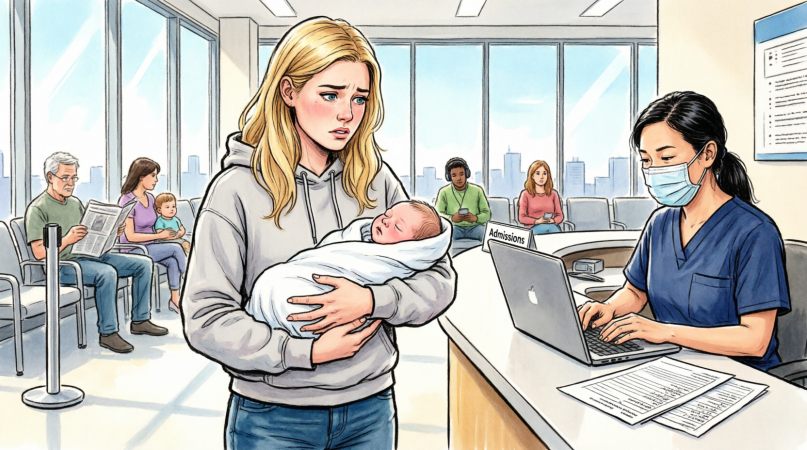
Sixteen hours of labor. Nurses rotating in and out, asking where my family was, trying not to look at me with pity. One nurse named Patricia stayed past her shift. She held my hand when I started shaking. She coached my breathing. When Lily was born, six pounds eleven ounces of perfect, Patricia cried with me.
I named my daughter Lily after my grandmother, the only person in my family who ever loved me without conditions.
I brought Lily home to my studio and tried to keep her alive while barely keeping myself afloat. Hospital bills arrived like threats. I set up a payment plan that stretched into years.
My mother finally called on day thirteen postpartum. Not to ask how I was. Not to ask about Lily.
She called to complain about Lauren’s kids being loud and how expensive everything was.
I listened numb, waiting for her to remember I’d just had a baby.
She didn’t.
And then came the text about the iPhones.
That was when something in me stopped trying to earn her love.
I set Lily gently in her crib, even though she hated it, and called my mother back.
She answered like everything was normal. “Hi, sweetie. Did you get my message about the phones?”
“Yes,” I said.
“Great. Can you transfer it today? I want to order them before—”
“No,” I said.
Silence.
“What?” Her voice sharpened.
“No, Mom,” I repeated. “I’m not giving you $2,600 for iPhones.”
Her tone went cold. “Maya, don’t be selfish. You know how hard this year has been for Lauren. Those kids deserve a nice Christmas.”
“It’s not Lily’s fault her father left,” I said, my voice shaking now. “Or that her grandmother didn’t care enough to check if she was born alive.”
“Oh, don’t be dramatic,” my mother snapped. “I’ve been busy.”
“Did you know I almost had seizures during delivery?” I interrupted. “Did you know my blood pressure spiked? Did you even wonder?”
“This isn’t about you,” she said, like a verdict. “This is about family.”
Something cracked inside me. Or maybe it finally healed.
“You’re right,” I said quietly. “This is about family. That’s why I’m taking care of mine.”
I hung up.
Then I logged into the joint bank account, stared at the $3,847, and transferred every single dollar into my personal account. I removed my mother from the joint account and closed it.
My phone started ringing immediately.
I blocked her number. Then my father’s. Then Lauren’s.
Jesse called five minutes later. “What’s going on? Your mom just called me screaming.”
“Tell me honestly,” I said, staring at Lily’s tiny face. “Am I wrong?”
Jesse went quiet. “Tell me what happened.”
So I did.
When I finished, he breathed out slowly. “Jesus Christ, Maya. No. You’re not wrong. Not even a little. She’s going to make your life hell.”
“Then make yours heaven,” Jesse said. “You don’t owe them anything.”
Three days later, I was at Target with Lily strapped to my chest, trying to decide if I could afford the good wipes or if I had to stick with the scratchy cheap ones, when I heard my name.
“Maya.”
I turned around and my heart stopped.
Derek stood there holding a basket with fancy coffee and protein bars, looking healthy, well-rested, like a man who hadn’t spent months avoiding consequences.
He stared at the baby carrier. “I heard you had the baby,” he said awkwardly. “I saw something on Facebook.”
“This is your daughter,” I said flatly. “Lily.”
He stepped closer, trying to peek at her, and I shifted my body away instinctively, protective.
“She’s beautiful,” he whispered.
“You left,” I said, voice sharp enough to make a woman nearby glance over. “You don’t get to show up in Target and feel things.”
He flinched. “I know. I messed up. I moved back last month. I broke up with Kristen. I’ve been thinking—”
“You can start by paying child support,” I cut in. “My lawyer will be in touch.”
I didn’t have a lawyer. I could barely afford diapers. But the look on his face was worth the lie.
I walked away shaking. In the parking lot, Lily fussed, and I rocked her gently until she settled.
When I came back out after loading groceries, I found a note tucked under my windshield wiper.
Nice card stock. Neat handwriting.
I saw what happened in there. You handled it with serious grace. If you ever need someone to talk to who understands complicated family stuff, here’s my number. Carter.
I stood there in the parking lot holding the note like it was a strange kind of lifeline.
That night, after Lily finally fell asleep and I ate cereal for dinner, I looked at the note again and thought: What do I have to lose?
Part 2
I texted the number at 11:47 p.m. because my life had become a series of weird hours.
This is Maya from Target. This isn’t some weird pyramid scheme thing, right?
The reply came in less than a minute.
No pyramid schemes, I promise. I’m Carter. I was in line behind you. I hope it’s not creepy that I left a note. I just recognized that look. The one where you’re holding yourself together because you don’t have a choice.
I stared at the message until my eyes burned. The fact that someone noticed felt almost embarrassing, like being seen without makeup.
I replied: That look is called postpartum exhaustion.
Fair, he wrote. And also anger. The kind that tries to eat you from the inside.
My thumbs hovered above the screen. Then, without meaning to, I typed: My mom asked me for money for iPhones two weeks after I gave birth alone.
There was a pause, then: That’s not a mother. That’s a creditor with a title.
That made a laugh escape my throat, sharp and sudden. Lily stirred in her crib, and I froze until she settled again.
We texted for three hours. Carter told me his own family story in careful pieces. Parents who treated his older brother like the sun and him like weather. A nephew he wasn’t allowed to see because his brother’s wife decided Carter was “a bad influence” after Carter refused to lend them money one too many times.
I didn’t tell him everything. Not at first. I left out the worst parts. The way I’d sat in the hospital bed pretending it didn’t matter that nobody came. The way I still caught myself hoping my mother would suddenly show up and act like a mother.
But Carter didn’t push. He didn’t pry. He asked normal questions like What’s Lily like? and Are you sleeping at all? and Do you have anyone helping you?
I told him about Jesse.
Carter responded: Good. Keep that person close.
Around midnight, Carter wrote: Would you want to meet for coffee sometime? Somewhere public, obviously. You can bring Lily. I’ll buy. No pressure.
I replied: That’s exactly what a serial killer would say.
Fair point, he wrote. How about Main Street Coffee? Always crowded. Saturday at 2. You can leave whenever. No hard feelings.
I agreed, then immediately panicked.
Saturday arrived anyway.
I almost didn’t go. I stood in my apartment staring at my reflection in the mirror, a twenty-year-old with dark circles and spit-up on her shoulder, holding a diaper bag like a shield. Who meets a stranger for coffee two weeks postpartum? Who trusts a note on a windshield?
But Lily needed formula. I needed air. And some small part of me needed proof that the world contained people who didn’t look at me like a burden.
So I went.
Main Street Coffee was packed, and Carter was already there, tall with dark hair and a friendly face that didn’t feel too perfect. He stood when he saw me and helped me maneuver Lily’s carrier into a chair spot like he’d done it before.
“Hi,” he said softly, as if loudness might scare me away. “I’m Carter.”
“Maya,” I replied.
He ordered my coffee before I could say I’d pay. When I protested, he smiled. “Let me,” he said. “I left a note on your windshield. I feel like I owe you a beverage for the emotional whiplash.”
That made me smile despite myself.
We talked for two hours. About nothing and everything. About Asheville, where he lived now. About why he was in town (visiting a friend). About my job at the call center. About how newborns smell like warm bread one minute and chaos the next.
Then Carter leaned forward, hands wrapped around his cup, and said, “I’m going to be honest because you seem like someone who appreciates honesty.”
“Oh no,” I muttered. “Here it comes. You’re married. You’re moving. You’re in a cult.”
He laughed. “None of those. I owned a software company. Sold it two years ago. I’m thirty-two. I’m single. I’m not broke. And I’m not offering because I want anything from you.”
I blinked at him. “You’re… rich.”
“I’m comfortable,” he corrected. “And when I saw you in Target, standing between that guy and your baby like you’d do it a thousand times, I don’t know. It hit me. I had to meet you.”
I stared, suspicious and exhausted. “So you left a note on my car.”
“I’m terrible at approaching women,” he admitted. “The note seemed less scary than walking up to you while you were holding a baby.”
That answer felt oddly human.
When Lily started fussing, Carter didn’t flinch. He didn’t look annoyed. He just said, “Do you want me to hold her while you drink your coffee?”
I hesitated, then handed Lily’s carrier handle to him. His hands were careful. His voice turned soft when he looked down at her. “Hey, Lily,” he murmured, like she mattered.
My throat tightened.
Before we left, Carter asked, “Can I see you again? Maybe dinner next week? I can bring food to you so you don’t have to go out.”
“I have a baby,” I said, like it was a warning.
“I noticed,” he grinned. “She can come too.”
Over the next three weeks, Carter showed up in small ways that made my life easier. He brought takeout and didn’t act like he deserved applause. He sat on the floor and folded tiny onesies while I fed Lily. He asked if I’d eaten. He offered to run errands. He never tried to touch me unless I initiated it, like he understood my body belonged to me again after being a public object for nine months.
Then one night, as Lily slept and my apartment felt too small for my stress, Carter looked around and said carefully, “Maya, can I ask you something without you getting mad?”
“That’s a terrible start,” I replied.
“Are you safe here financially?” he asked. “I mean… are you okay?”
I wanted to lie. Pretending I was fine was the only talent my family ever praised.
But I was tired of pretending.
“No,” I whispered. “I’m not okay. I’m drowning.”
Carter nodded slowly, as if he’d already suspected. “Okay,” he said. “Thank you for telling me.”
Then he said the sentence that changed my life.
“Move in with me.”
I laughed, startled. “What? Carter, we’ve known each other for three weeks.”
“I know how it sounds,” he said quickly. “But hear me out. I have a four-bedroom house in Asheville. You and Lily could have your own floor. Your own space. No pressure, no expectations. Just safety. Stability. Time to breathe.”
“That’s insane,” I said, but my heart was pounding.
“Maybe,” he admitted. “But I’d rather sound insane than watch you drown because the people who should help you don’t.”
The next morning, Jesse called, voice urgent.
“Your mom showed up at my place last night,” he said. “She’s losing it, Maya. She’s telling everyone you stole from her. She’s saying you’re an unfit mother. She says she’s going to sue for grandparents’ rights.”
My blood went cold.
“She can’t do that,” I whispered.
“Maybe not successfully,” Jesse said. “But she can make your life hell trying.”
I thought about Carter’s quiet house in Asheville. About a nursery already set up. About Lily growing up in a studio where my mother could show up and demand things like I was still sixteen and trapped.
Jesse paused. “Maybe getting out of town isn’t the worst idea.”
That night, I looked at Lily sleeping in her crib and realized something terrifying and clear.
If I stayed, my mother would keep trying to pull me back into the role she’d assigned me: the daughter who gives, the daughter who owes, the daughter who exists to solve problems she didn’t create.
If I left, I might finally become the mother Lily needed.
I texted Carter: I need time, but I’m seriously considering it.
He replied: Take your time. I’m here either way.
And for the first time in a long time, I believed someone when they said that.
Part 3
Two days later, my mother found my apartment.
I don’t know how. Maybe Lauren told her. Maybe she tracked my old Uber receipts through the shared account she’d once controlled. My mother has always been frighteningly resourceful when there’s something she wants.
It was late afternoon. I was rocking Lily in the worn chair by the window, trying to get her to settle after a crying spell that made my nerves feel raw. When the knock came, it was aggressive, like the door owed her something.
I froze.
Then I heard her voice through the wood. “Maya. Open up.”
Lily startled and began to wail. My stomach dropped.
I didn’t open the door. I didn’t answer. I moved quietly to the corner of the room and called Jesse with shaking fingers.
“She’s here,” I whispered. “She found me.”
Jesse’s voice went hard. “Don’t open the door. Call the police if she doesn’t leave.”
“She’s my mom,” I whispered, as if that meant she couldn’t hurt me.
Jesse snorted. “That woman asked you for iPhones two weeks postpartum. She’s not here to check on you. She’s here to take.”
The pounding got louder. “Maya! I know you’re in there! Don’t be ridiculous!”
Lily screamed harder, her tiny face turning red. My body reacted like an alarm system, every muscle tight, panic rising.
I called the non-emergency police line with my free hand, voice trembling as I explained that someone was banging on my door and refusing to leave and I had a newborn.
Ten minutes later, two officers arrived. I watched through the peephole as my mother shifted instantly into a performance: hands clasped, voice tearful, shoulders shaking like she was the victim.
“I’m just worried about my daughter,” she said loudly enough for me to hear. “She’s not answering me. I think she’s unstable.”
Unstable. The word slammed into me.
One officer knocked gently and asked me to open the door. My hands shook so badly I almost dropped my phone, but I opened it on the chain, Lily crying in my arms.
The officer’s gaze flicked to Lily, then to my face. “Ma’am, are you okay?” he asked quietly.
“I’m fine,” I said. “I asked her to stop contacting me. She won’t.”
My mother’s eyes narrowed, then widened dramatically. “Maya, sweetheart, I’m your mother. I’m trying to help.”
“You didn’t help when I went into labor,” I said, voice low and steady in a way that surprised me. “You didn’t call during my pregnancy. You asked me for money for iPhones. You’re not here to help.”
The second officer watched my mother carefully now, like he’d seen this before.
My mother’s voice sharpened. “You stole from me.”
“I transferred my money,” I corrected. “The money I saved. For my baby.”
“Family money,” she snapped.
“No,” I said, and this time the word felt like a door slamming shut. “My money.”
The officer cleared his throat. “Ma’am,” he said to my mother, “she’s asking you to leave. You need to leave.”
My mother looked offended, like being told no was a violation of her rights. “This is my grandchild,” she said, voice rising. “I have rights!”
The officer’s face stayed neutral. “Not in this hallway,” he replied. “Leave, or we can escort you.”
My mother turned her glare on me, pure fury beneath the tears. “You’ll regret this,” she hissed.
Then she walked away, heels clicking like punctuation.
When the door shut, I slid down to the floor and cried silently while Lily hiccuped against my chest. Not because I missed my mother. Because I finally understood she would never stop unless I made it impossible.
That night, I told Carter everything. The text. The joint account. The police. The word unstable.
Carter’s expression tightened with controlled anger. “Okay,” he said. “Then we don’t wait.”
Jesse agreed. “Leave,” he said over the phone. “Now. Before she tries something bigger.”
So I did.
Carter drove up the next morning with a truck. My whole life fit into a few boxes. That should have made me sad. Instead, it made me feel strangely light, like I’d been carrying things that weren’t mine for years.
I left no forwarding address. I changed my number. I kept only Jesse’s contact and Carter’s.
The drive to Asheville took eight hours. Lily slept most of the way, her tiny breaths steady. I watched the landscape change from familiar streets to rolling hills and then, finally, to mountains that looked like someone painted them.
When we pulled up to Carter’s house, I actually gasped.
It was a craftsman-style home with a wraparound porch and trees everywhere, like a place where people heal in movies. Carter carried my boxes inside while I stood in the driveway with Lily, stunned.
“This is your house,” I whispered.
“Our house for now,” Carter said gently. “Yours and Lily’s too. For as long as you want.”
He’d already set up a nursery. An actual nursery: crib, changing table, rocking chair, little lamp that cast warm light on soft walls. I put Lily down in her own room and stared at her sleeping face like I’d transported her into a different universe.
That night, I sat in the rocking chair and cried. Relief tears. Grief tears. The kind that happen when your body realizes it’s safe enough to feel.
The next week, Jesse helped me find legal aid in Asheville. A woman named Ms. Rivas met with me in a small office and listened to my story without flinching.
“We can file for child support,” she said. “And if your mother harasses you, we can document it. Grandparents’ rights cases exist, but they usually depend on an established relationship with the child. Your baby is a newborn. Your mother has not been involved. That matters.”
For the first time, someone spoke about my mother like she was a person who could be handled, not a force of nature.
Derek was served paperwork within a month. He texted Jesse asking if I was really doing this.
Jesse replied on my behalf: Pay for your child. That’s what adults do.
Then my mother found out where I was anyway.
A message request popped up on Facebook from her account: I know where you are. How dare you run away with my granddaughter. I’m calling a lawyer.
My skin went cold, but Carter read it calmly, like it was just noise.
“Do you want to respond?” he asked.
I stared at the screen and thought about the night I called her seventeen times. About the silence. About the iPhones.
I typed one sentence and hit send.
You had seventeen missed calls the night I gave birth. You didn’t come. You didn’t ask her name. You don’t get to be a grandmother now.
Then I blocked her.
Two weeks later, she showed up in Asheville.
Not at Carter’s house, thank God, but at a grocery store near our neighborhood. I was in the baby aisle with Lily in the carrier when I heard her voice behind me.
“There you are.”
My whole body went rigid.
She stepped closer, eyes bright with possession. “Give me my granddaughter.”
“I’m not doing this here,” I said, moving my cart like a shield.
She reached for Lily’s carrier handle.
I reacted without thinking, yanking the carrier back and shouting, “Don’t touch her!”
People turned. A store employee rushed over. My mother’s face morphed instantly into wounded innocence.
“She’s unstable,” she told the employee. “She stole money from me and kidnapped my granddaughter.”
I didn’t scream. I didn’t cry. I did the only thing Ms. Rivas had taught me to do.
I pulled out my phone and said clearly, “I’m calling the police.”
The word police made my mother step back. She hated witnesses. She hated official records. She thrived in private where she could rewrite reality.
Carter arrived within minutes because I’d started sharing my location with him when I ran errands. He walked into the aisle, saw my mother, and his face went still.
“Ma’am,” he said calmly, “you need to leave.”
My mother looked him up and down like she was trying to decide what kind of threat he was. “Who are you?”
“The person who is going to stand here until the police arrive,” Carter said.
When the officers came, my mother tried her performance again. Tears, concern, dramatic statements about family.
But this time, I had documentation. Text screenshots. Call logs. Police report numbers from my apartment. Legal aid filing receipts.
The officers listened. Then they told my mother to leave.
And as she walked away, her voice turned sharp and cruel.
“This isn’t over,” she said.
I held Lily tighter and realized she was wrong.
It was over.
Because I wasn’t alone anymore, and I wasn’t scared of her stories now that I knew how to write my own in ink.
Part 4
The first real winter in Asheville was the quietest winter of my life.
Not empty quiet. Safe quiet. The kind where the loudest sound in the house is the heater clicking on and Lily’s little sighs in her sleep.
Carter worked from home in an upstairs office. He’d come down between meetings to kiss Lily’s forehead and ask me if I’d eaten. Not in a controlling way, not like a supervisor checking performance. Like someone who understood survival is made of small things.
I started sleeping more. I started cooking because I wanted to, not because I needed to prove I was worthy of staying. I learned the grocery stores. I learned which parks had the smoothest walking trails for the stroller. I learned that my shoulders didn’t have to stay tense all the time.
Derek’s child support case moved slowly, but it moved. Ms. Rivas made sure it moved. Derek tried to argue at first that he “wasn’t sure” Lily was his.
Ms. Rivas’s response was simple: Then you can pay for the test you should have requested months ago.
The results came back. Derek was Lily’s father. A judge ordered payments, not huge, but consistent. Derek was also ordered to carry health insurance coverage for her when possible.
When the order came through, I didn’t feel victory. I felt a strange, calm satisfaction.
This was accountability. Not closure. Accountability.
My mother tried three more times in different ways.
Once, she emailed Ms. Rivas pretending to be concerned about Lily’s “well-being.” Ms. Rivas replied with a single sentence: All communication should go through counsel.
Once, she sent Lauren to message me from a new Facebook account with a photo of the kids and the caption: They miss their cousin.
I stared at the photo and felt nothing but distance. Lauren had not shown up when I was pregnant. She had not answered my calls when I was in labor. She didn’t get to use her kids as bait now.
I blocked her too.
The third time, my mother actually filed for visitation.
Ms. Rivas warned me it might happen. “Some people file not because they’ll win,” she said, “but because they want to frighten you back into compliance.”
The hearing took place in a small courtroom. I wore a plain blouse and held Lily’s tiny socks in my pocket like a talisman. Carter sat behind me, close enough that I could feel his presence without needing to look.
My mother stood at the front with a lawyer who looked bored. She cried on cue. She talked about family, about tradition, about how she was “worried” about Lily being raised away from her roots.
The judge listened, then asked one question that sliced through my mother’s performance.
“How often did you see the child before this filing?”
My mother blinked. “She’s an infant—”
The judge’s gaze sharpened. “How often did you see the mother during pregnancy? Did you provide support? Did you have an established relationship with the child?”
My mother’s lawyer shifted uncomfortably.
Ms. Rivas stood and presented my call logs, my text messages, the iPhone demand, the police reports, the documentation of my mother showing up and attempting to grab the carrier in a grocery store.
Then Ms. Rivas said quietly, “Your Honor, this is not a case about loving grandparents. This is a case about control.”
The judge looked at my mother for a long time, then said, “Petition denied.”
My mother’s face twisted. “That’s not fair,” she snapped, forgetting her tears.
The judge’s expression didn’t change. “Fair would have been showing up when your daughter called you seventeen times while in labor,” he said evenly. “Court is not a substitute for relationship.”
I pressed my lips together hard, fighting tears.
After the hearing, my mother tried to approach me. Carter stepped between us.
“Leave,” he said calmly, and there was something in his voice that made even my mother hesitate.
We walked out into bright winter sunlight. I buckled Lily into her car seat, hands steady.
In the car, Carter reached over and squeezed my knee. “You did it,” he said.
“No,” I replied, surprising myself. “I’m doing it. Every day.”
Time moved in a way I didn’t expect. Slowly, then quickly.
Lily learned to smile. Then to laugh. Her laugh sounded like a tiny bell, like joy without history.
I enrolled in online classes. I chose nursing because I couldn’t forget Patricia’s hands holding mine in the hospital when nobody else came. I wanted to be that person for someone else someday.
Carter never treated me like a project. He treated me like a partner even before we officially used that word. When I insisted on paying for something small, he let me. When I asked for space, he gave it. When I cried without warning because a commercial showed a grandmother cuddling a baby, he didn’t tell me to be grateful for what I had. He just sat with me until the wave passed.
One evening, when Lily was about ten months old, Carter was dancing around the living room with her, singing a ridiculous made-up song about mashed bananas and tiny toes. Lily squealed with laughter, her whole face lit up, and Carter looked so happy it made my chest ache.
“Maya,” he said softly later, after Lily fell asleep. “Can I tell you something?”
I braced automatically. Old reflex.
Carter touched my hand. “I love you,” he said simply. “I love Lily. I don’t need you to say anything back right now. I just don’t want to keep it inside.”
My throat tightened. “I love you too,” I whispered, and it didn’t feel like a lie. It felt like stepping into warmth after years of cold.
He proposed six months later. Not with a big crowd, not with a camera, but on the porch at sunset while Lily napped inside.
“I’m not trying to rescue you,” he said, voice steady. “You rescued yourself. I just want to build a life with you. If you want that too.”
I said yes.
We got married in a small ceremony in the mountains. Jesse came. Ms. Rivas came. A few neighbors and Carter’s best friend Marcus, who cried openly and didn’t apologize for it. No one from my family was invited.
I didn’t miss them.
After the wedding, I wrote a letter to Patricia, the nurse from the hospital. I told her Lily’s name again. I told her she’d mattered. I told her I was studying nursing because of her.
Weeks later, a card arrived in the mail.
I think about you and that baby sometimes, Patricia wrote. I’m glad you found your people. Now go be someone’s Patricia.
I kept that card in my desk drawer like it was proof of something holy.
My mother tried one more message after she heard I got married.
I heard your husband has money. Maybe now you can help your sister.
I stared at it, then wrote back one sentence, not because she deserved it, but because I wanted it on record.
I’m fine because I left everyone who treated me like I didn’t matter.
Then I blocked her again.
And that time, it didn’t hurt.
It just felt like closing a door that should have been closed years ago ……………………………………………………..
Click Here to continuous Read Full Ending Story👉: “After giving birth alone, my mom demanded $2,600 for my sister’s iPhones. I blocked her and emptied our joint account. When she found out, she…” (PART2)