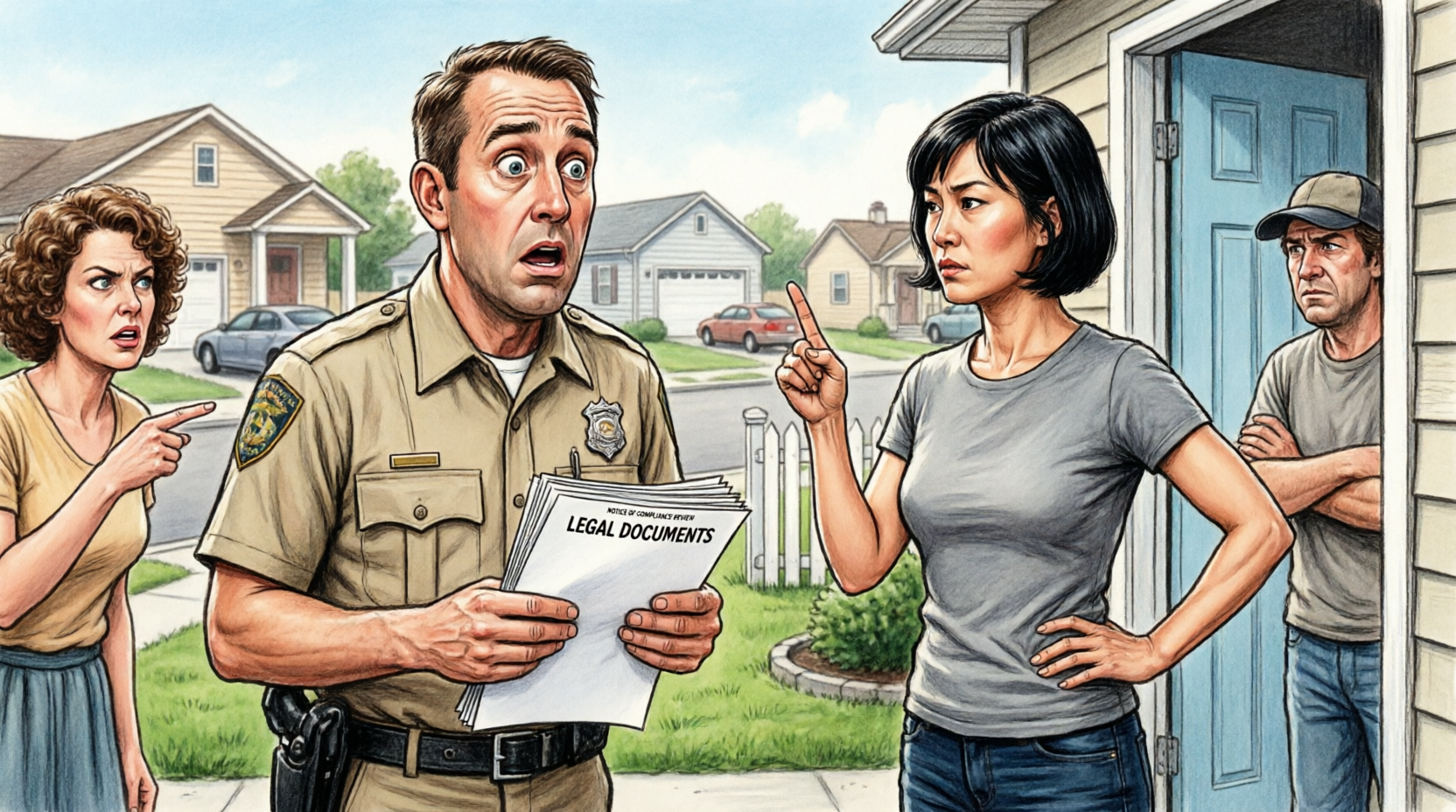
At 6 AM, pounding shook my door. A deputy sheriff stood on my porch holding papers: “Eviction order.” My name was printed on it like I was some stranger in my own home. My parents were across the street, watching-quiet, satisfied. My mom called out, “You should’ve done what family asked.” My dad said, “Pack. This is happening today.” I didn’t scream. I asked the deputy, “Can you show me who filed this?” He checked the top line, paused, AND HIS FACE CHANGED…
Part 1
The pounding started before my thoughts did, a hard metallic rhythm that didn’t belong to a neighbor, didn’t belong to a package, didn’t belong to anything friendly. It belonged to the kind of day that changed the shape of your life.
Tessa Ward sat straight up in bed, tangled in a sheet, heart already sprinting. The room was dim, February-gray leaking through the blinds. Her nightstand clock glowed 6:04 a.m. She listened for the pounding again, because part of her still wanted to believe she’d imagined it, that it was her brain misfiring out of a dream.
It came again, louder, followed by a man’s voice with the patient authority of someone who didn’t care how tired you were.
“Sheriff’s office. Open the door.”
Her body went cold in stages: fingertips, spine, then the center of her chest where panic liked to live. She pulled on a sweatshirt and stepped into the hallway without turning on lights. The house creaked like it was clearing its throat. She moved carefully, out of habit, like she was still a kid in someone else’s home trying not to get in trouble for existing.
At the front door she flicked on the porch light and pressed her eye to the peephole.
A deputy sheriff stood on her porch in a tan uniform with a black vest. Clipboard. Papers. Hands positioned like he’d done this a hundred times. Behind him, a patrol car at the curb with no flashing lights, as if discretion made an eviction gentler.
And across the street, half in shadow near the neighbor’s mailbox, her parents.
Diane and Mark Ward weren’t even trying to hide. Arms folded. Hands in coat pockets. Faces calm in a way that made Tessa’s stomach twist, because calm was what they wore when they believed they’d already won.
She cracked the door with the chain still latched.
“Ma’am,” the deputy said, voice professional and steady, “are you Tessa Ward?”
“Yes.”
He glanced down at the papers. “I’m Deputy Romero with the county sheriff’s office. I’m here regarding a writ of possession. It’s an eviction order.”
The word eviction hit her like a shove to the sternum. It didn’t belong here. Not in this house. Not with her name.
“This is my house,” she said. She kept her tone level by force. “There has to be a mistake.”
Deputy Romero’s expression didn’t change. He wasn’t here to debate reality. He was here to execute it.
“Ma’am, I’m not here to determine ownership. I’m here to enforce a court order.”
Tessa stared at the page. Her name was printed in clean black letters like she was a tenant who’d missed rent, not the person who’d paid the taxes, replaced the shingles, and planted the maple out back with her grandfather when she was seventeen. She felt the wrongness of it like grit between her teeth.
Across the street, her mother called out, voice sweet enough to rot.
“You should’ve done what family asked.”
Her father added, flat and loud, “Pack. This is happening today.”
Tessa didn’t look at them. Looking would invite the version of the story they wanted: the one where she was emotional, unstable, ungrateful. She’d spent too long living inside their narratives. She wasn’t going to give them a fresh scene.
She looked back at the deputy. “Can you show me who filed this?”
Romero’s eyes followed her finger up the page. His thumb paused on the top line, and something changed in his face. Not pity. Not shock. Recognition, like he’d just realized he’d been handed the wrong villain.
He cleared his throat once. “The plaintiffs are Diane Ward and Mark Ward.”
Her parents didn’t flinch. Her mother lifted her chin as if the words were a trophy.
Tessa felt a clean, cold stillness settle behind her ribs. If her parents were the plaintiffs, that meant they hadn’t just threatened. They’d filed. They’d gone into a courthouse and presented themselves as the reasonable ones. And if the deputy was on her porch at six in the morning, a judge had already believed them.
“When was this filed?” Tessa asked.
Romero glanced down. “Judgment was entered last week.”
Last week. She’d slept in this bed last week. She’d watered her plants, paid her bills, taken conference calls in this kitchen. Nobody had served her papers. Nobody had taped a notice to her door. No certified mail. Nothing.
“Where was I served?” she asked.
Romero scanned, his jaw tightening as if he didn’t like what he was reading. “Service address listed as 128 Maple Terrace.”
Tessa’s mind flashed to the small rental her parents lived in fifteen years ago, before they moved up, before they decided they were too good for cracked pavement and leaning mailboxes.
“That’s not my address,” she said, calm by force. “That’s not where I live.”
“It’s what’s listed on the return of service,” Romero said. Procedure, not comfort.
“Can you show me?”
He flipped a page, angled it through the crack so she could read.
Substitute service accepted by adult female occupant at Maple Terrace.
And a printed name beneath a scribbled signature.
Diane Ward.
Tessa’s throat went tight. Her parents had used an address they controlled and claimed someone accepted papers on her behalf. They’d turned her absence into consent.
Her mother called out again, tone syrupy for the deputy’s benefit. “We tried to do this the easy way, Tessa. You forced us.”
The real purpose slid into focus like a lens clicking sharp: rush her, scatter her, get her out before she could stop it. An eviction wasn’t just humiliation. It was leverage. If the deputy cleared the house, the furniture, the documents, the life inside it would be thrown onto the lawn like trash. And after that, even if she won later, damage would already be done.
Romero lowered his voice. “Do you have somewhere you can go?”
Not kind, not cruel. Just the question he had to ask.
“I’m not going anywhere,” Tessa said. “Not until I understand this.”
Romero’s eyes flicked toward her parents and back. He looked like a man stuck inside someone else’s fight. “Ma’am, if you believe the order was obtained improperly, you need to contact the court and file an emergency motion to stay enforcement.”
“How long do I have?” she asked.
He glanced at the writ. “This authorizes same-day possession. Without a judge’s stay, I have to clear the property by noon.”
Noon. She had less than six hours.
Tessa didn’t argue with a deputy. Arguing made scenes. Scenes became stories, and her parents were experts at story.
She lifted her phone. “Hold that steady,” she said, and took clear photos of every page: case number, seal, service address, the line where her mother’s name sat on the proof of service like a confession.
Then she shut the door gently and slid the deadbolt into place, as if metal could buy her time. It couldn’t. Records could.
She grabbed her wallet, keys, and a small fireproof pouch from the drawer where she kept the boring documents that became life-or-death when people decided to get creative: the deed copy, the probate distribution letter, the property tax statements, the homeowner’s policy in her name.
Her hands were steady. Her mind was loud.
In the kitchen, she dialed the courthouse clerk’s office. It rang twice.
“Civil division,” a woman answered, brisk.
“I have a writ of possession being executed today,” Tessa said. “I was never served. I need to request an emergency stay and vacate a default. The service address is wrong.”
Keys clicked. A pause.
“Case number?” the clerk asked.
Tessa read it off.
More keys. Another pause, longer, the kind that meant the clerk had pulled up the file and didn’t like what she saw.
“This is an unlawful detainer filed by Mark and Diane Ward,” the clerk said carefully. “Default judgment entered last week.”
“I was never served,” Tessa repeated. “The service address listed is Maple Terrace. That isn’t my residence.”
The clerk exhaled. “Come to the courthouse as soon as we open. Bring identification, proof of your address, and proof of ownership if you have it.”
“How fast can it be heard?” Tessa asked.
“Depends on the judge’s calendar.”
“It has to be today,” Tessa said. “The deputy said noon.”
Another exhale. “Don’t delay.”
Tessa ended the call. Through the window she could see her parents still across the street, waiting for her to start throwing boxes onto the lawn like surrender.
Instead, she walked to the front door, opened it with the chain still on, and looked at Deputy Romero.
“I’m going to the courthouse,” she said. “I’m filing an emergency stay.”
Romero nodded once. “If you get a signed stay order, call our civil unit immediately.”
“Can you give me the number?”
He hesitated, then wrote it on a card and slid it through the crack.
Across the street, her father called, louder now. “Don’t make this ugly.”
Tessa met his gaze for the first time, and her voice stayed quiet.
“You made it ugly when you lied to a judge.”
Her mother’s smile tightened. Then they watched, satisfied again, as if truth was just another tantrum.
Tessa closed the door, then left through the back, walking along the fence line so she wouldn’t have to pass them like they owned the sidewalk. She got into her car and drove into the brightening morning, hands steady on the wheel, mind already building the only thing that mattered now:
A record louder than their manipulation.
Part 2
The courthouse smelled like disinfectant and old coffee, like a place designed to clean up messes without ever admitting they were human. Tessa arrived before the doors opened and waited with the other early-morning people who looked like they hadn’t slept: a man clutching a folder to his chest, a woman with swollen eyes, a teenager in wrinkled clothes staring at his shoes.
When the security guard saw the word writ on her paperwork, his face sharpened. He waved her through faster than the rest. No questions. No small talk. Emergency had its own lane.
Upstairs in Civil Division, the line moved with the slow inevitability of bureaucracy. Tessa kept her posture still. Stillness was armor. She’d learned that from a lifetime of being told her feelings were the problem.
At the counter, she slid her ID and the printed writ forward. “I need an emergency motion to stay enforcement,” she said, “and a motion to vacate default. I was never served.”
The clerk was a man with tired eyes and a badge clipped to his collar. He typed, frowned almost immediately, and looked up. “The address on file is Maple Terrace,” he said.
“That is not my residence,” Tessa replied. “That’s my parents’ old rental. They signed for service themselves.”
He clicked again, pulled up a scanned document, and rotated his monitor slightly. The proof of service form showed substitute service accepted by an adult female occupant, with a scribbled signature and a printed name beneath it.
Diane Ward.
The clerk stared at it for a beat too long. His eyebrows rose, just a fraction. “She’s the plaintiff,” he said softly, as if saying it louder might make it worse.
“Yes,” Tessa said. “She accepted service on my behalf.”
He printed the proof of service and slid it under the glass. “Highlight that,” he murmured. “It matters.”
Tessa took the paper and kept her face blank even as anger tightened her ribs. “I also own the house,” she said, and slid her deed copy and probate distribution letter forward.
The clerk blinked, then typed faster. “They filed this as landlords,” he said, voice tightening. “They’re claiming you’re a tenant holding over.”
“A tenant,” Tessa repeated, tasting the insult. “In the house my grandfather left me.”
He clicked to another exhibit and turned the monitor again.
A one-page rental agreement, her name typed at the top, her parents’ names typed under landlord. A signature at the bottom pretending to be hers. It looked like someone had tried to copy her handwriting from a birthday card and got bored halfway through.
“They forged it,” Tessa said quietly.
Clerks didn’t say yes. They said, “If you want the judge to see this today, you need to file your emergency motion now.”
He handed her a packet of forms, thick and stapled, still warm from the printer. Emergency Motion to Stay Enforcement. Motion to Vacate Default. Request for Hearing.
“What judge?” she asked.
He checked the docket. “Judge Halprin is assigned.”
“Can I get in front of her this morning?” Tessa asked.
The clerk hesitated, then glanced toward an interior door marked Judicial Assistant. He looked back at her, measured her calm, the documentation in her hand, the fact that she wasn’t making a scene.
“I can try,” he said. “But you need to understand—”
“I understand,” Tessa cut in gently. “If I don’t get a stay, a deputy clears my house by noon.”
He nodded once, almost imperceptibly. He stamped her packet hard, the ink bleeding into paper like a bruise.
“Go to Department 14,” he said. “Ask for an emergency slot.”
As she turned to go, he added, quieter, “Ms. Ward… if that deed is recorded in your name, your parents’ eviction case has a standing problem. Judges don’t like standing problems.”
It was the closest thing to encouragement the system offered.
Outside Department 14, Tessa sat on a wooden bench and filled out the forms with slow, clean handwriting. Not rushed. Not shaky. Every line deliberate.
When the form asked for facts, she gave facts:
Service address incorrect. Plaintiff signed proof of service. Lease forged. Recorded deed in defendant’s name. Writ authorizes same-day possession.
She attached copies: her driver’s license showing her actual address, a utility bill, tax statements, the probate letter, the deed. She clipped the printed proof of service with Diane Ward’s printed name circled in pen.
Then she walked to the judicial assistant’s window and slid the packet under the glass.
The assistant flipped through, eyes moving fast. Her gaze stopped on the proof of service. Her face changed, small but immediate.
“You’re saying the plaintiff accepted service on behalf of the defendant,” she said.
“Yes.”
The assistant stared at the line again, then stood without another word and disappeared through the door behind her. Tessa waited with her hands folded, breathing steady, listening to muffled voices in chambers. A few attorneys sat scattered on benches, laptops open, sipping from courthouse coffee cups like this was just another Tuesday.
The door opened. The assistant returned holding the packet like it had gained weight.
“Judge Halprin will see you,” she said quietly. Then she leaned forward and lowered her voice further. “But I need to warn you. Your parents attached one more document. If it’s what it looks like, this isn’t just an eviction.”
Tessa’s stomach tightened. “What document?”
“A deed,” the assistant said. “A recorded deed that claims the house was transferred back to them.”
Cold rolled through Tessa’s body like someone had opened a freezer door inside her chest. “Transferred back,” she repeated, careful.
The assistant nodded. “It’s in the court file as an exhibit. You’ll see it when you’re in front of the judge.”
Tessa didn’t demand to see it now. Demanding would have made her look frantic. She’d learned, painfully, that frantic women weren’t believed as easily as calm ones.
She followed the assistant into Department 14.
The courtroom was smaller than the lobby below, built for decisions that ruined people politely. Judge Halprin sat high at the bench with a file open in front of her and the kind of frown that said she’d already smelled something rotten.
At the tables, Tessa’s parents sat with an attorney. Diane wore a soft cardigan and a concerned expression, the costume of a mother trying her best. Mark’s jaw was set, eyes forward, posture rigid like a man who believed righteousness could be manufactured through stubbornness.
When Diane saw Tessa, she offered a small, sad smile. Tessa didn’t return it.
The bailiff called the case number. Tessa approached the table alone.
“Good morning,” Judge Halprin said. Her voice wasn’t warm, but it wasn’t cruel. It was a tool. “We have an emergency motion to stay enforcement of a writ of possession. Ms. Ward, you’re the defendant.”
“Yes, Your Honor.”
“And you are appearing without counsel today?”
“Yes.”
Judge Halprin’s gaze flicked to the plaintiffs’ side. “Counsel?”
The attorney stood. “Lawrence Pike for the plaintiffs, Your Honor.”
Judge Halprin nodded once, then looked back at Tessa. “You understand the writ authorizes possession today.”
“Yes,” Tessa said. “Noon.”
“Then tell me why I should issue an emergency stay.”
Tessa slid her packet forward. “Because I was never properly served. The proof of service shows the plaintiff accepted substitute service at an address I do not live at. The plaintiff signed the service form.”
Judge Halprin’s eyes narrowed. “Plaintiff signed the service form.”
“Yes.”
She looked at Pike. “Counsel. Is that accurate?”
Pike’s smile was faint and practiced. “Your Honor, service was completed according to statute. Substitute service is permitted. The occupant accepted—”
Judge Halprin lifted a hand. “Don’t recite statute at me. Answer the question. Did your client sign as the adult female occupant who accepted substitute service?”
Pike hesitated. It was quick, but in court, hesitations had weight. “Yes, Your Honor. Mrs. Ward accepted service at the address listed in the complaint as Ms. Ward’s last known address.”
Judge Halprin snapped her gaze back to Tessa. “Is Maple Terrace your last known address?”
“No,” Tessa said. “I have not lived there as an adult. My ID, utility bills, and tax records reflect my current address.”
She slid her ID and utility bill forward. Judge Halprin scanned them and then, for the first time, looked directly at Diane Ward.
“Mrs. Ward,” Judge Halprin said, “why did you accept service on behalf of the defendant at an address that is not her residence?”
Diane’s lips trembled into practiced sorrow. “Your Honor… we’ve tried everything. She’s been unstable. She stopped answering us. We didn’t know what else to do.”
The label landed in the room like a weapon: unstable. The kind of word that made people stop asking questions.
Judge Halprin didn’t blink. “That is not an answer. You either knew where she lived or you didn’t.”
Mark leaned forward slightly. “We were trying to protect the property.”
“Protect it from whom?” Judge Halprin asked.
Silence.
Pike stepped in quickly. “Your Honor, the plaintiffs own the home. They had to recover possession. The defendant has been refusing to leave.”
Judge Halprin’s gaze sharpened. “I’ve reviewed the exhibits,” she said. “One of them is a deed.”
Tessa’s throat tightened as Judge Halprin lifted a page from the file.
“Exhibit C is a recorded quitclaim deed purporting to transfer the property from Tessa Ward to Mark and Diane Ward. Recorded two weeks ago.”
Diane inhaled like she might cry. Mark stayed stone-still.
Judge Halprin looked at Tessa. “Ms. Ward, did you sign a quitclaim deed transferring this property to your parents two weeks ago?”
“No,” Tessa said. The word came out clean.
Pike’s voice slid in smooth. “Your Honor, the deed is notarized and recorded.”
Judge Halprin’s eyes snapped to him. “I didn’t ask you.”
Then back to Tessa. “You’re saying that deed is fraudulent.”
“Yes,” Tessa replied. “And I can prove I was not present for any notarization that day.”
Judge Halprin’s pen stopped moving. “How?”
“I was at work all day,” Tessa said. “My employer has badge access logs and security records.”
Pike’s expression tightened. “Your Honor, this is turning into a title dispute.”
Judge Halprin’s voice stayed calm, but it hardened. “This is an unlawful detainer filed by people claiming to be owners, supported by a deed the defendant says she never signed, combined with a service return signed by the plaintiff at an incorrect address.”
She paused, and the pause was heavy enough to make Diane shift.
“I am not comfortable enforcing a writ of possession on this record,” Judge Halprin said.
The room seemed to inhale.
Judge Halprin turned to the bailiff. “I’m issuing an emergency stay of the writ of possession, effective immediately. Notify the sheriff’s civil unit.”
Tessa let out a controlled exhale she didn’t realize she’d been holding.
“This stay is pending a hearing on the motion to vacate default,” Judge Halprin continued, “and a referral for potential fraud regarding the deed. Counsel, the notary will appear in person with her journal.”
The word journal made Diane’s shoulders go rigid. Mark’s jaw jumped.
Judge Halprin looked at Tessa. “Ms. Ward, I need you to understand: if this deed is fraudulent, you need to protect the title immediately.”
“I understand,” Tessa said.
“Hearing is tomorrow morning. Bring your employment access logs. Plaintiffs will bring the notary and the original deed. Anyone who fails to appear will face consequences.”
The gavel didn’t slam. Judge Halprin didn’t need theatrics. Procedure was sharp enough.
Tessa took the signed stay order and walked out without looking at her parents.
In the hallway, her phone buzzed. Deputy Romero.
“I got the stay,” Tessa said the moment she answered.
Romero’s relief was audible. “Copy that. Text me a photo of the signed order. We’ll stand down.”
She sent it. Then she felt her mother behind her like a draft.
“You think this ends it?” Diane hissed, no longer sweet. “You don’t understand what you just started.”
Tessa didn’t turn around. She did understand.
If the deed was fake, this wasn’t about eviction anymore.
It was about how far her parents were willing to go to steal a dead man’s gift from their own daughter.
Part 3
Tessa didn’t go home alone.
Not because she was afraid of her own house, but because she was done letting her parents control the environment. She made two calls from the courthouse parking lot: first, to the sheriff’s civil unit to confirm they had logged the stay order; second, to her friend Marisol, a paralegal who had once taught Tessa the most important rule of fighting institutions.
Don’t fight feelings. Fight paper.
Marisol answered on the second ring. “Tess?”
“I need someone with me tonight,” Tessa said. “And I need help pulling documents.”
“On my way,” Marisol said, no questions.
From there, Tessa drove straight to the county recorder’s office. The waiting room smelled like paper and stale air conditioning. People held marriage certificates, lien releases, property tax forms. Nobody looked dramatic. Administration was always happening in quiet rooms.
At the counter, Tessa slid her ID and the recorder’s printout forward, along with the exhibit number of the quitclaim deed that supposedly transferred her house to her parents.
“I need to place a fraud alert on my property record,” she said. “A judge issued a stay today and ordered the notary to appear tomorrow.”
The clerk was a woman in her thirties with sharp eyes and a careful voice. She typed, and her expression changed almost immediately. “This quitclaim was recorded two weeks ago,” she said.
“Yes,” Tessa replied. “It was submitted in person. I did not sign it.”
The clerk clicked through intake notes. “There’s a notary acknowledgment attached.”
“A judge wants the notary’s journal,” Tessa said.
The clerk didn’t offer sympathy; she offered procedure. She printed a form and slid it forward. “Fill this out. We can flag the parcel record. It doesn’t void the deed, but it places public notice the conveyance is disputed and triggers verification if someone tries to record additional documents.”
That was exactly what Tessa needed: friction. A warning light on the title. A pause button.
She signed the form with her normal signature, slow and clean, then watched the clerk stamp it.
As the clerk added the fraud alert, she paused and leaned closer to her monitor. “Can I ask you something?”
“Yes.”
She tapped the screen. “Do you know why the notary commission number looks odd?”
Tessa’s stomach tightened. “Odd how?”
The clerk rotated the screen. The commission number had one digit crossed out and rewritten, a tiny correction most people would never notice.
“That correction should have triggered rejection,” the clerk said quietly. “But it didn’t. It went through.”
In a world where everything mattered, that small smudge was a crack in the story. An opening.
“Can you print that image?” Tessa asked.
The clerk nodded. “And the intake metadata.”
Warm pages slid into Tessa’s hands like weapons: an enlarged image of the corrected commission number and a receipt-like printout showing how the document was processed.
Outside, the morning had shifted into a pale, harmless blue that felt like an insult. Tessa drove home.
Her parents’ car was across the street again.
She didn’t slow. She didn’t look. She pulled into her driveway, entered through the back, and locked the door behind her. Marisol arrived ten minutes later with a laptop, a legal pad, and the calm face of someone who knew the difference between drama and strategy.
“Okay,” Marisol said, setting her bag on the kitchen table. “Show me everything.”
Tessa laid out the documents: writ photos, proof of service, forged lease, deed records, fraud alert confirmation, the printed notary commission correction.
Marisol’s eyes narrowed. “They forged a lease and tried to fast-track an eviction to get you out before you could contest the deed.”
“Yes.”
“And the notary commission number correction… that’s sloppy,” Marisol murmured. “Sloppy people get caught.”
Tessa didn’t feel relief. She felt focus.
“Next,” Marisol said, “we need your work records.”
Tessa had already requested them. She forwarded the email request to her company’s security office with the case number attached. Within an hour, her inbox chimed.
Badge access logs for the day in question. Parking gate logs with license plate scans. Internal door access timestamps showing she’d been inside secured areas at noon, at 12:15, at 12:22. No gaps.
Her employer also included a certification statement: a security manager verifying the logs were accurate and preserved.
Marisol exhaled slowly. “That’s solid.”
Tessa stacked the papers into a folder and labeled it with the case number, because the system liked numbers more than it liked tears.
At 4:30 p.m., the doorbell rang.
Tessa didn’t move toward the door. She started recording on her phone, capturing the timestamp, then spoke through the wood.
“What.”
Her mother’s voice came sharp. “Open the door.”
“No.”
Her father’s voice followed, controlled like he was offering a reasonable compromise. “We’re here to resolve this like family.”
Tessa kept her tone flat. “You filed an eviction. You forged a lease. You recorded a deed. That’s not family. That’s fraud.”
Diane’s voice rose. “How dare you.”
Tessa didn’t argue about daring. She asked the only question that mattered.
“Why did you do it?”
Silence. Then Mark spoke, low and cold.
“Because your grandpa promised the house would stay in the family,” he said. “And you were making decisions we didn’t approve.”
Tessa’s jaw tightened. “I am the family,” she said.
Diane snapped, “You’re ungrateful. He would have wanted us to have it.”
“He didn’t,” Tessa replied. “That’s why the deed is in my name.”
Mark’s voice dropped further, like he believed he was giving her a prophecy. “Tomorrow the notary will say you signed.”
“Then tomorrow she’ll produce her journal,” Tessa said. “And we’ll see what she claims she verified.”
Diane’s tone turned sweet again, too sweet. “You don’t want to ruin lives over paperwork, Tessa.”
The line landed like a confession: they weren’t afraid of losing the house. They were afraid of the paper trail.
“You already chose this,” Tessa said quietly. “I’m just making sure it’s recorded correctly.”
She stopped speaking. Silence was a boundary. After a moment, footsteps retreated. Car door. Engine. The street went quiet again.
At 9:12 p.m., Tessa’s phone buzzed with a text from an unknown number.
If you show up tomorrow, you’ll lose more than a house.
Her skin went cold. Not because she believed they would hurt her, but because threats meant they knew what was coming and they didn’t think they could stop it cleanly.
Marisol leaned over. “Screenshot it.”
Tessa did. Then she forwarded it to herself with the case number in the subject line.
“Tomorrow,” Marisol said, “we go early. We sit where the judge can see you. We let them talk themselves into consequences.”
Tessa nodded. She set her alarm for 6:00 a.m., the same hour they’d tried to throw her out.
Then she did the most difficult, practical thing: she went to sleep.
Not peacefully. Not easily.
But rested enough to be precise………………………………………..
Click Here to continuous Read Full Ending Story👉: (PART2)At 6 AM, pounding shook my door. A deputy sheriff stood on my porch holding papers: “Eviction order.”