1. The Sweltering Prison
The kitchen of my own home had become a sweltering, chaotic prison.
It was Easter Sunday. The air was thick, heavy with the suffocating, humid scent of boiling potatoes, roasting meats, and the sharp, metallic tang of anxiety. I stood in front of the massive, industrial-grade oven we had installed when we first bought the house—the house I had bought, with the money I had earned before I ever met David.
I am Clara. I am thirty-two years old, and I am exactly seven months pregnant.
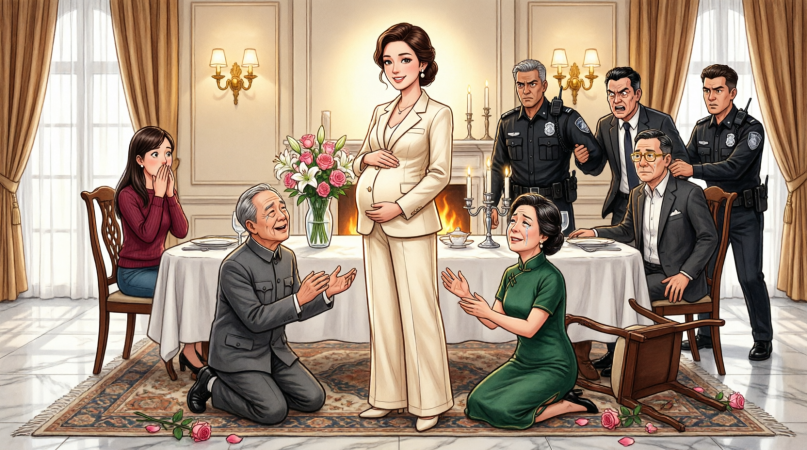
My ankles were swollen to the point where the skin felt tight and shiny, throbbing with a dull, persistent ache that radiated all the way up to my lower back. I was wearing a simple, breathable maternity dress, but my clothes were already sticking to my skin, drenched in sweat from managing a feast for twenty people entirely by myself.
With a grunt of exertion, I grabbed a pair of heavy silicone oven mitts, bent my aching knees, and hauled a massive, twenty-pound honey-glazed ham out of the scorching heat.
From the adjacent formal dining room and the sprawling, open-concept living area, a roar of raucous, entitled laughter erupted. Twenty members of my husband David’s extended family were currently sprawled across my expensive furniture, drinking the vintage Pinot Noir I had carefully selected and purchased from my private collection. They were completely, blissfully ignoring the physical labor occurring less than thirty feet away from them.
A shadow fell across the kitchen island.
I didn’t need to look up to know who it was. The overwhelming, cloying scent of cheap Chanel No. 5 announced her arrival before she even spoke.
Eleanor, my mother-in-law, stood in the doorway. She was draped in a gaudy, emerald-green silk blouse and a ridiculous amount of chunky gold jewelry that clanked every time she moved. She was swirling her wine glass, her eyes narrowing as she surveyed the kitchen like a general inspecting a poorly maintained latrine.
“The au gratin potatoes are taking entirely too long, Clara,” Eleanor sneered, her voice a shrill, grating sound that immediately spiked my blood pressure. “My family expects to eat at four o’clock sharp. We are not accustomed to waiting like peasants. Try moving a little faster. Pregnancy isn’t an illness, you know. Women have been doing this in fields for centuries.”
I gripped the edges of the scorching roasting pan, my knuckles turning white. A sharp, uncomfortable Braxton Hicks contraction rippled across my abdomen, a physical protest against the relentless stress.
I looked past the woman who had made it her life’s mission to belittle me, searching the living room for my husband.
David was leaning casually against the wet bar, holding a beer, chatting with his obnoxious cousin. He saw me looking. He saw the sweat on my forehead. He saw his mother standing in the doorway, berating the woman carrying his unborn child.
Instead of stepping in, instead of defending me or offering to carry a single platter to the table, David just shrugged. A lazy, cowardly, enabling smirk spread across his face.
“Listen to my mother, babe,” David called out, his voice carrying easily over the chatter. “We’re starving out here. Let’s get the show on the road.”
He took a sip of his beer and turned his back on me.
I didn’t scream. I didn’t burst into tears and throw the ham onto the floor, though the urge to do so was nearly overwhelming.
For the past three years of our marriage, I had played the role of the accommodating, successful wife. I had tolerated his mother’s blatant disrespect. I had excused David’s chronic laziness and his sudden, alarming shifts in mood. I had convinced myself that I was building a family, that the arrival of our baby would magically transform him into the man I thought I had married.
But as I stared at the reflection of my husband in the dark, greasy glass of the oven door, a profound, chilling clarity washed over me. The pathetic, hopeful wife died right there in the sweltering heat of the kitchen.
I knew, with absolute, freezing, terrifying certainty, that this would be the very last meal David Vance would ever eat as a free man.
2. The Shattered Silence
It took another grueling thirty minutes to ferry the massive amounts of food to the long mahogany dining table. By the time the twenty guests were finally seated, plates piled high, the dull ache in my back had sharpened into a hot, piercing pain.
I walked to the head of the table, pulling out my chair. I was utterly depleted. My hands were shaking slightly from a dangerous combination of low blood sugar and sheer physical exhaustion.
I lowered myself heavily into the chair. For the first time since 6:00 AM, I was finally off my swollen feet.
I picked up my heavy silver fork. I looked down at my plate, which held a modest portion of mashed potatoes covered in steaming, dark brown gravy. I leaned forward, bringing the fork toward my mouth, desperate for a single bite of sustenance.
I never tasted it.
A heavy, jewel-clad hand suddenly slammed violently into the back of my neck.
SMACK.
The force of the blow was explosive. It wasn’t a playful tap or an accidental bump. It was a deliberate, vicious, aggressive shove downward.
My neck snapped forward. My face crashed directly into the steaming food on my plate.
The hot gravy splashed against my cheek, stinging my skin. The soft mashed potatoes smashed into my nose and mouth. The sudden, violent physical shock sent a terrifying jolt of pure adrenaline through my pregnant body.
“Sit up straighter!”
Eleanor’s voice barked, sharp and commanding, echoing loudly over the sudden, stunned silence of the dining room. She had walked up behind my chair specifically to deliver the blow.
“You’re slumping over your food like a common peasant, Clara!” Eleanor snapped, pointing a manicured, trembling finger at me as I remained frozen, my face buried in my plate. “Show some respect at my family’s table! You look absolutely pathetic!”
The room fell dead silent. For a microsecond, the only sound was the ambient clinking of ice in water glasses. The twenty relatives stared at me, their forks suspended in mid-air, a mixture of shock and morbid curiosity painting their faces.
Then, the silence was shattered.
David barked a loud, booming, genuine laugh.
He was sitting at the opposite end of the table. He leaned back in his chair, slapping his knee, his face splitting into a wide, highly amused grin.
“Oh man, you got her good, Mom!” David chuckled loudly, pointing a finger directly at his pregnant wife. “Look at her face! She looks like a toddler who fell in the mud! That’s hilarious!”
A few of the aunts and uncles, taking their cue from the patriarch and the golden boy, began to chuckle nervously, validating the abuse, eager to align themselves with the power dynamic in the room.
I stayed completely still for three long, agonizing seconds. The hot gravy dripped slowly from my chin onto the collar of my pristine, white maternity dress.
I didn’t scream. I didn’t weep. I didn’t leap from my chair and attack the woman standing behind me.
I bypassed hysteria entirely.
Slowly, methodically, with a terrifying, robotic precision, I pushed my torso upright. I sat back in my chair. My face was a smeared, humiliating mask of brown gravy and potatoes.
I reached to the side of my plate and picked up a crisp, folded white cloth napkin.
I raised the napkin to my face. I wiped the food from my eyes, my nose, and my cheeks with deliberate, chilling slowness.
I lowered the soiled napkin to my lap. I didn’t look at Eleanor.
I looked directly down the length of the long mahogany table. I locked my eyes dead onto my husband.
The laughter in the room began to die down awkwardly. The nervous chuckles faded. The atmosphere in the dining room suddenly shifted from cruel amusement to a suffocating, heavy dread. The guests looked at my face.
My eyes were completely, utterly empty. There was no sadness. There was no anger. There was only the cold, unblinking, dead stare of a predator assessing a carcass.
David’s smile faltered. He shifted uncomfortably in his chair, suddenly realizing that the woman he had been bullying for years was no longer looking at him like a victim.
As the silence stretched, stretching thin enough to snap, I calmly reached into the deep pocket of my floral apron.
My fingers found my smartphone. Without breaking eye contact with David, I pressed a single, pre-programmed button on the side of the device.
The signal was sent. The trap was officially sprung.
3. The Architect of Ruin
I dropped the soiled napkin onto the table next to my plate. I took a slow, deliberate sip of my ice water, letting the cold liquid soothe my dry throat.
David looked away, wiping a final tear of mirth from his eye, pretending my silence was just my usual, submissive sulking. He thought he was a powerful patriarch, a man who commanded respect by humiliating the woman who funded his entire existence.
He was completely, blissfully, and utterly oblivious.
He didn’t know that Clara, the quiet, pregnant woman who cooked his meals, wasn’t just an accountant. I was a Senior Forensic Auditor for one of the largest, most ruthless financial oversight firms in the Midwest. My entire professional life was dedicated to hunting down complex white-collar crimes, dismantling fraudulent shell companies, and tracking stolen money across the globe.
And three weeks ago, my professional life had violently collided with my personal one.
While reviewing my own personal financial portfolios—preparing the nursery budget and finalizing my maternity leave structure—I noticed an anomaly. It was a small discrepancy in a quarterly report regarding the title deed to the very house we were currently sitting in.
I owned this house. I had purchased it outright, in cash, three years before I ever met David. It was my pre-marital asset, legally shielded.
Or so I thought.
It took me exactly four hours of aggressive, targeted forensic digging to unravel the horrific truth.
David, the man currently eating my roasted ham, had secretly, clumsily forged my signature on a massive, complex series of legal documents. He had utilized a corrupt, low-level notary he knew from his college days to bypass the security checks. He had taken out a catastrophic, $500,000 collateral loan against the equity of my pre-marital home.
But the theft wasn’t even the most devastating part. It was where the money went.
He hadn’t stolen half a million dollars to start a business or invest in our family’s future.
I tracked the wire transfers. Two hundred thousand dollars had been quietly funneled to an offshore account in the Bahamas—an account directly tied to an illegal, high-stakes online gambling syndicate. He was paying off his mother’s massive, hidden, decades-long gambling debts to keep loan sharks from breaking Eleanor’s legs.
The remaining three hundred thousand dollars had been routed to a luxury real estate management firm downtown. It was paying the exorbitant, two-year prepaid lease on a high-rise luxury condo.
A condo occupied by a twenty-two-year-old fitness instructor named Chloe. His mistress.
David thought his pregnant wife was too exhausted, too hormonal, and too distracted by nursery colors and baby registries to notice the mail, to check the deep-level equity reports, or to question his “late nights at the office.”
He was staggeringly, fatally wrong.
I hadn’t spent the last three weeks crying in a bathroom. I hadn’t confronted him. I hadn’t packed my bags and fled.
I had spent the last twenty-one days quietly, methodically compiling a massive, irrefutable, time-stamped digital dossier. I had gathered IP addresses, forged signature analyses, offshore routing numbers, and surveillance photos of the downtown condo.
And four days ago, I had handed that entire, perfectly wrapped package directly to my contacts within the FBI’s White-Collar Crime Division, and the primary fraud investigators at the national bank he had defrauded.
I intentionally hosted this massive, grueling Easter dinner. I allowed Eleanor to berate me. I absorbed the physical exhaustion. I took the horrifying, humiliating blow to the face.
I endured it all for one simple, tactical reason.
I wanted David, Eleanor, and every single enabling, parasitic member of his family in one room. I wanted them feeling safe, arrogant, and untouchable when the hammer finally dropped. I wanted the matriarch standing right at the absolute center of the blast radius when her empire was vaporized.
I set my water glass down on the table. I listened past the nervous chatter of the relatives who were attempting to restart a conversation.
I heard it.
The heavy, rhythmic, unmistakable sound of dozens of tactical boots marching rapidly, aggressively up my front porch steps.
4. The Federal Execution
BANG.
The sound was not a knock. It was the explosive, violent, splintering crash of a heavy steel battering ram completely obliterating the lock on my solid oak front door.
The heavy wood burst inward, the door frame shattering into hundreds of flying splinters.
“FEDERAL AGENTS! NOBODY MOVE! KEEP YOUR HANDS WHERE WE CAN SEE THEM!”
The roar of the command was deafening, amplified by the sheer, terrifying suddenness of the breach.
The dining room instantly descended into absolute, shrieking chaos.
The twenty relatives, who had been laughing at my humiliation just minutes prior, erupted into panicked screams. Aunts and uncles dove under the mahogany table, knocking over chairs and shattering crystal wine glasses. Plates of food crashed to the floor.
Four heavily armored agents, wearing dark windbreakers with FBI emblazoned across the back in bright yellow letters, stormed into the dining room. They moved with terrifying, coordinated precision, their weapons drawn and held at the low ready, aiming heavy, blinding tactical flashlights directly at the head of the table.
The harsh, blinding beams of light cut through the elegant ambiance, illuminating David and Eleanor like deer caught in the headlights of an oncoming freight train.
“David Vance and Eleanor Vance!” the lead agent roared, his voice echoing over the screaming relatives. He stepped into the light, pulling a thick stack of warrants from his tactical vest. “You are both under arrest for multiple counts of federal wire fraud, aggravated identity theft, bank fraud, and grand larceny!”
David froze.
The smug, arrogant patriarch who had laughed at his pregnant wife was entirely, instantaneously eradicated. The color violently drained from his face, leaving his skin a sickly, ghostly, translucent gray. He dropped his fork. His hands shot up into the air, trembling uncontrollably.
“Wait! Wait, there’s a mistake!” David screamed, his voice cracking, backing away from the table until his chair hit the wall. “I didn’t do anything! I’m a respectable businessman! You have the wrong house!”
“We have the right house, Mr. Vance,” a second agent barked, stepping forward rapidly. He grabbed David by the collar of his expensive shirt, hauled him roughly over the back of the chair, and slammed him face-down onto the hardwood floor, pinning his arms behind his back.
Eleanor, standing near her chair, began to hyperventilate. The matriarch clutched her heavy pearl necklace, her eyes wide with a mixture of sheer, unadulterated terror and aristocratic indignation.
“Get your hands off my son!” Eleanor shrieked, her voice reaching a hysterical pitch. She pointed a trembling, diamond-clad finger directly at me, still sitting calmly at the other end of the table. “Arrest her! Arrest that woman! She’s crazy! She’s hysterical! She called you here to ruin my family because she’s jealous!”
I didn’t flinch at the flashlights. I didn’t cower under the table.
I stood up slowly, pushing my chair back. I smoothed the front of my gravy-stained maternity dress, my posture perfectly straight, entirely untouched by the panic engulfing the room.
I walked out from behind the table, stopping a few feet away from the lead agent.
“They aren’t here for me, Eleanor,” I said.
My voice wasn’t a shout. It was a cold, precise, and completely lethal whisper that sliced effortlessly through the chaotic noise of the raid.
Eleanor stopped screaming. She stared at me, a dawning, horrifying realization creeping into her eyes.
“They’re here,” I continued, looking down at David, who was currently weeping into the floorboards as the heavy steel handcuffs ratcheted tightly around his wrists, “because David clumsily, stupidly forged my signature to steal half a million dollars to pay off your illegal, offshore gambling debts to the cartel.”
Eleanor gasped, a wet, choking sound, as the absolute totality of her ruin crashed down upon her. She stumbled backward, her knees giving out, collapsing onto the floor beside the dining table.
“And,” I added, ensuring the relatives cowering under the table heard every single word, “to pay the rent for the luxury apartment where he keeps his twenty-two-year-old mistress.”
David sobbed louder, a pathetic, broken sound. “Clara! Please! Please, I’m sorry! Don’t let them take me!”
“Enjoy the federal penitentiary, David,” I said softly, looking down at the man who had promised to love and protect me. “I hear the food is significantly better than mine.”
The lead agent nodded to me respectfully, recognizing me as the primary informant and forensic auditor who had handed them the airtight case.
“Take them out,” the agent commanded.
Two officers hauled David to his feet. He was crying for his mother, a grown man reduced to a blubbering, pathetic child, as they dragged him out of the dining room and toward the shattered front door. Another female agent pulled a weeping, hysterical Eleanor from the floor, reading her Miranda rights as she slapped the cuffs on her wrists.
I watched them disappear into the flashing red and blue lights of the police cruisers parked on my lawn.
I turned my attention back to the dining room. The remaining eighteen relatives were slowly, fearfully crawling out from under the mahogany table. They looked at me with wide, terrified eyes, realizing that the quiet, submissive woman they had treated like a servant had just unilaterally, legally annihilated the leaders of their family.
“The dinner is over,” I announced calmly, gesturing toward the door. “Get off my property. Immediately.”
They didn’t argue. They practically trampled each other in their desperate haste to escape my house.
5. The Excision of the Rot
Two months later, the contrast between my reality and the reality of the people who had abused me was absolute, staggering, and profoundly poetic.
The legal fallout from the Easter raid had been swift and merciless. The federal prosecutors, armed with the meticulous, irrefutable digital trail I had provided, didn’t even offer a generous plea deal.
David and Eleanor were both denied bail. The judge deemed them extreme flight risks, given their connections to offshore accounts and illegal gambling syndicates.
I received the updates through my attorney. David was currently sitting in a bleak, aggressively fluorescent-lit federal holding cell, facing a minimum of fifteen years for wire fraud, identity theft, and grand larceny. Eleanor, her health rapidly deteriorating under the stress of incarceration, was sitting in a county jail awaiting trial for conspiracy and money laundering.
They were entirely, permanently abandoned.
The extended family, terrified of being implicated in the federal probe, had completely severed ties with them. The high-society friends Eleanor had spent decades lying to and impressing wanted absolutely nothing to do with a woman facing federal prison. The young mistress, Chloe, facing her own potential charges for receiving stolen funds, had immediately turned state’s evidence against David to save her own skin.
They had lost their money, their freedom, their reputation, and their family. They were drowning in the exact, inescapable misery they had created.
Miles away from that bleak federal holding cell, the atmosphere in my hospital suite was pure, unadulterated magic.
The room was bathed in warm, golden afternoon sunlight. It was beautifully sanitized, smelling faintly of lavender and clean linens.
I lay in a comfortable, adjustable bed, propped up by soft pillows. I was exhausted, my body aching from labor, but I had never felt so incredibly, profoundly powerful in my entire life.
Resting perfectly safe and warm against my chest, wrapped in a soft pink blanket, was my newborn daughter, Maya.
She was healthy, perfect, and sleeping soundly, her tiny chest rising and falling with quiet, steady breaths.
There was no tension in the room. There was no oppressive, suffocating anxiety. There was no one standing in the doorway demanding I cook for them. There was no one telling me to sit up straighter, or laughing at my pain.
I was surrounded only by the people who genuinely loved and protected me.
My best friend, Sarah, was sitting in the chair beside my bed, wiping happy tears from her eyes. My lead attorney, who had secured my expedited, fault-based divorce and ensured the total recovery of my stolen funds through the bank’s fraud insurance, had sent a massive, beautiful arrangement of white orchids that sat on the windowsill.
The toxic, parasitic rot of the Vance family had been surgically, permanently excised from my life weeks before my daughter even took her first breath.
I looked down at the tiny, sleeping infant in my arms. I gently stroked her soft, dark hair, feeling an immense, heavy, and absolutely unbreakable sense of peace settle deep into my bones.
I had burned an empire to the ground. I had sent the people I once considered family to federal prison. I had ruthlessly, coldly dismantled a life I had spent three years building.
And looking at my daughter’s perfect, peaceful face, I knew I would do it a thousand times over to keep her safe.
My phone, resting on the bedside table, buzzed softly.
Sarah picked it up, glancing at the screen. She frowned, her expression darkening slightly.
“It’s an email from David’s defense attorney,” Sarah said quietly, looking at me with concern. “The subject line says ‘Plea for Leniency and Visitation Request’.”
I didn’t reach for the phone. I didn’t ask to read the pathetic, begging words David had undoubtedly dictated from his concrete cell, desperately trying to use the birth of his child to manipulate his way back into my life.
“Delete it,” I said softly, my voice calm and resolute. “And tell the firm to block his counsel’s email address. We don’t accept garbage in this house anymore.”
I leaned down and kissed the soft, warm forehead of my newborn baby, completely, utterly unbothered by the ghosts of my past.
6. The Resurrection
Exactly two years later.
It was a vibrant, warm, and breathtakingly beautiful Easter Sunday.
The sprawling, manicured backyard of my home—the home that was now solely, legally, and permanently mine—was alive with the joyous, chaotic sounds of a massive Easter egg hunt.
I had invited my chosen family. Dozens of my closest friends, my colleagues from the financial firm who respected my mind and my strength, and their children, were gathered on the lawn. The air smelled of barbecue, fresh-cut grass, and blooming jasmine.
There were no stuffy, uncomfortable formal dining tables. There were no heavy, suffocating expectations. There was only genuine, unbridled laughter and the warmth of people who brought actual light into my life.
I stood on the back deck, holding a glass of sparkling water with lime, watching the scene unfold.
My two-year-old daughter, Maya, was a blur of motion. She was wearing a bright, sunshine-yellow sundress, running at top speed across the green grass, squealing with absolute delight as she discovered a bright pink plastic egg hidden near the base of an old oak tree.
She held it up triumphantly, waving it at me, her face glowing with pure happiness.
I waved back, a massive, genuine smile breaking across my face.
As I watched her run toward her friends, my mind briefly drifted back to that sweltering, oppressive kitchen two years ago. I thought about the smell of roasting meat, the agonizing pain in my back, the searing heat of the gravy splashing against my face, and the cold, cruel, echoing laughter of the man who genuinely believed he owned me.
They thought they were breaking me. They thought that by violently forcing my face into the dirt, they were asserting their dominance, proving that I was nothing more than a subservient, helpless peasant meant to serve their needs.
They were so profoundly, fatally arrogant.
They didn’t realize that they weren’t forcing my face into the dirt to humiliate me. They were simply giving me a much closer, much clearer look at the exact ground I was preparing to bury them under.
I took a slow, satisfying sip of my sparkling water.
I had spent my entire professional life calculating the monetary value of corporate fraud, tracking hidden assets, and putting a price tag on human tragedy. I was a master of numbers and ledgers.
But it took a single, violent shove at a dining room table to teach me the absolute, priceless, immeasurable value of my own peace.
I heard the sound of small, rapid footsteps hitting the wooden deck behind me.
“Mommy! Look!” Maya shrieked, barreling into my legs and hugging me tightly. She held up a small, chocolate bunny, her eyes wide with excitement. “I found the big one!”
I set my glass down on the railing and scooped her up into my arms. She was heavy, solid, and wonderfully alive. I buried my face in her neck, making a silly, exaggerated monster noise that made her throw her head back and laugh uncontrollably.
She was completely safe. She was fiercely, unconditionally loved.
I turned my back on the empty house behind me and walked down the stairs, carrying my daughter into the bright, warm sunlight of the yard. I knew, with absolute, unshakeable certainty, that the dark, suffocating ghosts of my marriage had been permanently, thoroughly eradicated.
The execution was over. The predator was dead. And I was finally, truly, stepping fearlessly into the light.